
Question 292 marksEasy
What effect will there be on a magnetic compass when it is brought near a current carrying solenoid?
Confirming your payment
Sign up now and get 250 free tokens.
Electro-magnetism · Question 29 of 136
What effect will there be on a magnetic compass when it is brought near a current carrying solenoid?
Solution:
Concept: A solenoid (a long cylindrical coil whose length is more than its diameter) carrying a current behaves like a bar magnet. Inside it the field lines are straight, parallel to the axis and equally spaced, so the field there is uniform; outside, the lines go from its north end round to its south end.
Step 1 — State the effect.
The compass needle is deflected: it turns until it lies along the solenoid's magnetic field at the place where the compass is.
Step 2 — Near the north end.
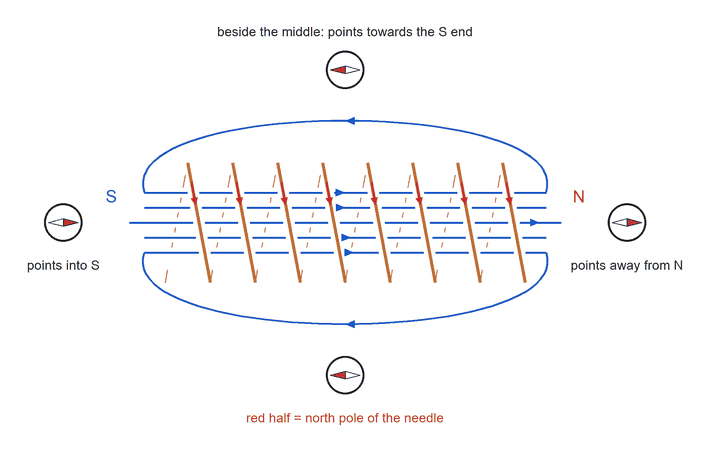
The north pole of the needle is repelled by the north end of the solenoid, so the needle points away from the solenoid.
Step 3 — Near the south end.
The north pole of the needle is attracted by the south end, so the needle points towards the solenoid.
Step 4 — Beside the middle.
Here the field outside runs from the N end towards the S end, so the needle lies parallel to the solenoid with its north pole towards the S end.
The figure shows compasses round a solenoid: at the N end the needle's north pole points away from it, at the S end it points into it, and beside the middle it points along the solenoid towards the S end.
Step 5 — Reverse the current.
If the current is reversed, the poles of the solenoid change places and every needle turns round.
Watch out: Outside the solenoid the field runs from N to S, but inside it runs from S to N.
Therefore, a compass brought near a current-carrying solenoid is deflected and comes to rest along the solenoid's magnetic field, just as it would near a bar magnet.