
Opening your dashboard
Class 10 Maths Chapter 8: Factorization of Polynomials Solutions
49 textbook questions with step-by-step answers, free to read, for ICSE 2026-27.
Get talked through Ch 8, not just shown the answer
Reading a finished solution is not the same as being able to do it. The AI tutor takes one question at a time and works it with you, in your own words, until you can.
- Ask it out loud, in your own words
- It gives you the next step, not the answer
- Stuck on part (ii)? Start there
49 questions with solutions
1–3 marks · Mixed difficulty
The first 8 solutions are on this page. This chapter is a long one, so the rest open on their own page to keep this one quick to load.
- 11 mark
Question 1
is a factor of ; the value of is :
Solve with AIAnswer
- Correct
(A) −1
(B) 1
(C) −2
(D) 2
Answer: (A) −1
Concept: The Factor Theorem says that is a factor of exactly when , that is, when the remainder on dividing by is 0.
Step 1 — Find the value of that makes the factor zero.
The theorem tells us to use the value of for which becomes 0.
is zero when .
Step 2 — Substitute and form the equation.
Let .
We put in every term of and simplify one step at a time.
Putting in :
Working out each term:
Adding the like terms:
Since is a factor, the remainder must be 0:
Step 3 — Solve for .
This is a linear equation in alone, so we collect the terms on one side and the numbers on the other; each term changes sign as it crosses the equals sign.
Taking the number to the right-hand side:
Check: with , , so divides it exactly. ✓
Watch out: When a term moves to the other side of an equation, its sign changes. For example, from , we get (not 1).
Why the other options are wrong:
- (B) 1: this comes from moving across as (forgetting to change its sign). If , then comes out as , not 0, so would not be a factor.
- (C) −2: if , then comes out as , not 0, so would not be a factor.
- (D) 2: if , then comes out as , not 0, so would not be a factor.
Therefore, the value of is −1, option (A).
- 21 mark
Question 2
Which of the following is a factor of ?
Solve with AIAnswer
(A)
- Correct
(B)
(C)
(D)
Answer: (B)
Concept: An expression is a factor of another when it divides it exactly. If both parts of a difference share a factor, we can take it out of the whole expression. The Factor Theorem gives a quick test: is a factor exactly when the expression is 0 at .
Step 1 — Factorise the second part.
The second part, , is a difference of two squares, , so we use .
Step 2 — Take out the common factor.
Both parts now contain , so we write the expression with this factor showing and take it out.
Taking out the common factor :
Removing the inner brackets:
Simplifying the second bracket:
Step 3 — Confirm with the Factor Theorem.
If is a factor, the expression must be 0 when is 2. So we put :
So is a factor of the expression.
Watch out: is a factor of only. A factor of the whole expression must divide both parts, not just one of them.
Why the other options are wrong:
- (A) : at the expression is , which is 16, not 0. divides only the part .
- (C) : the expression simplifies to , which has degree 1. A polynomial of degree 1 cannot have (degree 2) as a factor.
- (D) : at the expression is , which is 8, not 0, so is not a factor.
Therefore, is a factor, option (B).
- 31 mark
Question 3
One factor of is . The value of is :
Solve with AIAnswer
(A) −6
(B) 12
- Correct
(C) 6
(D) −12
Answer: (C) 6
Concept: The Factor Theorem says that is a factor of exactly when , that is, when the remainder on dividing by is 0.
Step 1 — Find the value of that makes the factor zero.
The theorem tells us to use the value of for which becomes 0.
is zero when .
Step 2 — Substitute and form the equation.
Let .
We put in every term of and simplify one step at a time.
Putting in :
Working out each term:
Adding the like terms:
Since is a factor, the remainder must be 0:
Step 3 — Solve for .
This is a linear equation in alone, so we collect the terms on one side and the numbers on the other; each term changes sign as it crosses the equals sign.
Taking to the right-hand side:
Check: with , , so divides it exactly. ✓
Watch out: When a term moves to the other side of an equation, its sign changes. For example, from , we get (not 1).
Why the other options are wrong:
- (A) −6: this is a sign slip: from , we get , not . If , then comes out as , not 0, so it does not work.
- (B) 12: if , then comes out as , not 0, so would not be a factor.
- (D) −12: if , then comes out as , not 0, so would not be a factor.
Therefore, the value of is 6, option (C).
- 41 mark
Question 4
If is a factor of ; the value of is :
Solve with AIAnswer
(A)
(B) 5
(C)
- Correct
(D) −5
Answer: (D) −5
Concept: The Factor Theorem says that is a factor of exactly when . Here the letter is both the number in the factor and a coefficient in the polynomial, so we put everywhere appears.
Step 1 — Find the value of that makes the factor zero.
The factor is , and it is zero when .
Step 2 — Substitute in .
Let . We replace every by ; the coefficient stays as it is.
Working out each term:
The terms and cancel:
Step 3 — Form the equation and solve.
Since is a factor, must be 0:
Taking 5 to the right-hand side, where it becomes :
Check: With , the polynomial becomes , and we put in it:
So is a factor. ✓
Watch out: is 0, because . Only is left.
Why the other options are wrong:
- (A) : if , then is , which comes out as , not 0.
- (B) 5: if , then is , which comes out as , not 0. This is the sign slip of solving as 5 in place of −5.
- (C) : if , then is , which comes out as , not 0.
Therefore, the value of is −5, option (D).
- 51 mark
Question 5
is a factor of :
Solve with AIAnswer
- Correct
(A)
(B)
(C)
(D)
Answer: (A)
Concept: The Factor Theorem says that is a factor of exactly when , that is, when the remainder on dividing by is 0.
Step 1 — Find the value of that makes the factor zero.
We test each option with the Factor Theorem, so we need the value of that makes the factor zero: is zero when .
Step 2 — Test option (A).
Let .
We put 2 in place of ; if the value is 0, then is a factor.
Putting in :
Working out each term:
Adding:
The remainder is 0, so is a factor of .
Step 3 — Test the other options.
To be sure that only one option works, we put in the other three polynomials too (see the bullets below). None of them gives 0.
Watch out: For the factor put , not .
Why the other options are wrong:
- (B) : at its value is , which adds up to 20, not 0.
- (C) : at its value is , which adds up to 1, not 0.
- (D) : at its value is , which adds up to −14, not 0.
Therefore, is a factor of , option (A).
- 63 marks
Question 6
Find, in each case, the remainder when :
(i) is divided by .
(ii) is divided by .
(iii) is divided by .
Solve with AIWritten solution
Solution:
Concept: The Remainder Theorem says that when a polynomial is divided by , the remainder is . So we never need the long division: we find the value of that makes the divisor zero and substitute it in .
Step 1 — Part (i): divide by .
Let .
The divisor is zero when , so the remainder is .
Putting in :
Working out each term:
Adding:
So the remainder is 1.
Step 2 — Part (ii): divide by .
Let .
The divisor is zero when , so the remainder is .
Putting in :
Working out each term:
Adding:
So the remainder is 0. A remainder of 0 also tells us that is a factor of this polynomial.
Step 3 — Part (iii): divide by .
Let .
The divisor is zero when , so the remainder is .
Putting in :
Working out each term:
Adding:
So the remainder is 2.
Watch out: For put (not 1). An even power of a negative number is positive, so .
Therefore, the remainders are (i) 1, (ii) 0 and (iii) 2.
- 73 marks
Question 7
Show that : is a factor of .
Solve with AIWritten solution
Solution:
Concept: The Factor Theorem says that is a factor of exactly when , that is, when the remainder on dividing by is 0. For a factor such as , we use , the value that makes it zero.
Given: and the divisor is ; we must show that .
Step 1 — Find the value of that makes the divisor zero.
The theorem tells us to use the value of for which becomes 0.
Putting it equal to 0:
Taking 2 to the other side, where its sign changes:
Dividing both sides by 3:
Step 2 — Substitute this value in .
We put in every term of ; the square of a negative fraction is positive.
Putting in :
Working out each term:
Taking the common denominator 3:
Simplifying:
Step 3 — Conclude.
The remainder is 0. So, by the Factor Theorem, divides exactly, which is what we had to show.
Check: , so divides it exactly. ✓
Watch out: For the value is (not ), and square the whole fraction: .
Therefore, is a factor of . Hence shown.
- 83 marks
Question 8
Use the Remainder Theorem to find which of the following is a factor of .
(i) (ii) (iii)
Solve with AIWritten solution
Solution:
Concept: The Remainder Theorem says that when a polynomial is divided by , the remainder is . So we never need the long division: we find the value of that makes the divisor zero and substitute it in . For a divisor such as , we use , the value that makes it zero. If the remainder is 0, the divisor is a factor.
Let .
Step 1 — Part (i): divisor .
We find the value of that makes this divisor zero, and the remainder is at that value. If it is 0, the divisor is a factor.
is zero when .
Putting in :
Working out each term:
Adding:
The remainder is , so is a factor.
Step 2 — Part (ii): divisor .
We find the value of that makes this divisor zero, and the remainder is at that value. If it is 0, the divisor is a factor.
Putting it equal to 0:
Taking 1 to the other side, where its sign changes:
Dividing both sides by 2:
Putting in :
Working out each term:
Taking the common denominator 4:
Simplifying:
The remainder is , so is not a factor.
Step 3 — Part (iii): divisor .
We find the value of that makes this divisor zero, and the remainder is at that value. If it is 0, the divisor is a factor.
is zero when .
Putting in :
Working out each term:
Adding:
The remainder is , so is a factor.
Check: Multiplying out shows the complete factorisation:
It contains and but not . ✓
Watch out: For the value is (not 1, and not ): divide by the coefficient of and keep the sign that makes the divisor zero.
Therefore, and are factors of , and is not.
- 93 marks
Question 9
(i) If is a factor of , find the value of .
(ii) Find the value of , if is a factor of expression .
- 103 marks
Question 10
Find the values of constants and when and both are the factors of expression .
- 113 marks
Question 11
Find the value of , if is a factor of .
- 123 marks
Question 12
Find the values of and so that and both are factors of .
- 133 marks
Question 13
When is divided by , the remainder is . Find the value of constant .
- 143 marks
Question 14
Find the value of , if the division of by leaves a remainder 5.
- 153 marks
Question 15
If has as a factor and leaves a remainder 3 when divided by , find the values of and .
- 163 marks
Question 16
What number should be added to so that when resulting polynomial is divided by , the remainder is 8 ?
- 173 marks
Question 17
What number should be subtracted from so that on dividing it by , the remainder is 10 ?
- 183 marks
Question 18
The polynomials and leave the same remainder when divided by . Find the value of ''.
- 193 marks
Question 19
If is a factor of the expression and when the expression is divided by , it leaves a remainder 52, find the values of and .
- 201 mark
Question 20
For the polynomial , the maximum number of linear factors can be :
- 211 mark
Question 21
If ; the value of is :
- 221 mark
Question 22
If is divided by , the result is :
- 231 mark
Question 23
Factors of are :
- 241 mark
Question 24
Factors of are :
- 253 marks
Question 25
Using the Factor Theorem, show that :
(i) is a factor of . Hence, factorise the expression completely.
(ii) is a factor of . Hence, factorise the expression completely.
- 263 marks
Question 26
Using the Remainder Theorem, factorise each of the following completely :
(i)
(ii)
(iii)
(iv)
(v) .
- 273 marks
Question 27
Using the Remainder Theorem, factorise the expression . Hence, solve the equation
- 283 marks
Question 28
Factorise the expression . Hence, find all possible values of for which .
- 293 marks
Question 29
Given that and are factors of ; calculate the values of and . Hence, find all the factors of .
- 303 marks
Question 30
The expression leaves remainders 0 and 30 when divided by and respectively. Calculate the values of and . Hence, factorise the expression completely.
- 313 marks
Question 31
If is a common factor of expression and ; show that :
- 321 mark
Question 32
The remainder, when is divided by , is :
- 331 mark
Question 33
If is a factor of ; the value of is :
- 341 mark
Question 34
Is a factor of ?
- 351 mark
Question 35
leaves a remainder 2 when divided by . The value of is :
- 361 mark
Question 36
If has as a factor, then:
- 371 mark
Question 37
Two polynomials and .
Assertion (A) : If is a factor of ; the remainder is zero.
Reason (R) : The polynomial is factor of polynomial , if .
- 381 mark
Question 38
The polynomial and one of its factors as .
Assertion (A) : The value of .
Reason (R) : .
- 391 mark
Question 39
The polynomial has as a factor of it.
Statement (1) : The value of is −4.
Statement (2) : is a factor of
- 401 mark
Question 40
A polynomial .
Statement (1) : is a factor of .
Statement (2) : .
- 413 marks
Question 41
When is divided by , the remainder is . Find the value of .
- 423 marks
Question 42
What should be subtracted from , so that the resulting expression has as a factor ?
- 433 marks
Question 43
If and are factors of , find the values of and . And then, factorise the given expression completely.
- 443 marks
Question 44
If is a factor of and , find the values of and .
- 453 marks
Question 45
Find the value of '', if and leave the same remainder when each is divided by .
- 463 marks
Question 46
The polynomial is completely divisible by ; find the values of and . Also, for these values of and factorise the given polynomial completely.
- 473 marks
Question 47
When the polynomial is divided by , the remainder is A and when the polynomial is divided by , the remainder is B. Find the value of '' if .
- 483 marks
Question 48
is a factor of the polynomial . Find the value of ''. For this value of '', factorise the given polynomial completely.
- 493 marks
Question 49
Using remainder theorem, find the value of if on dividing by , leaves a remainder 7.
What Class 10 Maths Ch 8 covers
The sections of the chapter, in the order the book takes them. Every question above comes from one of these.
- 01Basic Concepts
- 02Remainder Theorem
- 03Factor Theorem
- 04Using the Factor Theorem to Factorise the Given Polynomial
More ways to study this chapter
The same chapter asked three other ways. Practise it, revise it, and see what the board has set on Ch 8 before.
- Competency-Based Questions (CBQ)Case study questions: a situation, and the part of the chapter that answers it.40questionsOpen
- Previous Year QuestionsQuestions that have actually appeared in board papers, each tagged with its year.26questionsOpen
- Practice QuestionsExtra questions per chapter, for when one attempt at a method is not enough.41questionsOpen
Ch 8 in past ICSE papers
The same chapter as the board has actually asked it. These are worded differently from the textbook exercise, which is the point of reading them.
- 13 marks
Board paper question 1
Using remainder theorem, find the value of k if on dividing by , leaves a remainder 7.
Solve with AIWritten solution
Solution:
Concept: Remainder theorem: when a polynomial is divided by , the remainder is . To use it, find the value of that makes the divisor zero and substitute that value in .
Given: leaves remainder 7 when divided by .
Step 1 — Find the value of to substitute.
The divisor is zero when , so by the remainder theorem the remainder is .
Step 2 — Work out .
We put in .
Step 3 — Set it equal to the remainder and solve.
The remainder is given to be 7.
Check: With , becomes , which works out to 7, the given remainder.
Watch out: For the divisor substitute , not .
Therefore, .
- 23 marks
Board paper question 2
What must be subtracted from so that the resulting expression has as a factor?
Solve with AIWritten solution
Solution:
Concept: Remainder theorem: when a polynomial is divided by , the remainder is . To use it, find the value of that makes the divisor zero and substitute that value in . Factor theorem: is a factor of a polynomial exactly when , that is, when the remainder on dividing by is zero.
Given: ; a number is to be subtracted so that becomes a factor.
Step 1 — Find the value of to substitute.
The divisor is zero when , so the remainder is .
Step 2 — Work out the remainder.
We put in ; note that and .
Step 3 — Decide what to subtract.
Dividing by leaves remainder 1, so for some quotient . Subtracting this remainder leaves , which has as a factor.
Check: Take ; then , so and is a factor of .
Watch out: To make the remainder zero we subtract the remainder itself (1); subtracting would make it 2.
Therefore, 1 must be subtracted.
- 33 marks
Board paper question 3
If and are factors of , find the values of 'a' and 'b'.
Solve with AIWritten solution
Solution:
Concept: Factor theorem: is a factor of a polynomial exactly when , that is, when the remainder on dividing by is zero. Each given factor gives one equation in and ; solve the two equations together.
Given: and are factors of .
Step 1 — Use the factor .
is zero at , so .
Step 2 — Use the factor .
is zero at , so .
Step 3 — Solve the two equations.
Subtracting equation (2) from equation (1) removes .
Step 4 — Find .
We put in equation (1).
Check: With these values . Then is and is ; both work out to 0.
Watch out: is and is : an odd power of a negative number is negative.
Therefore, and .
- 43 marks
Board paper question 4
Use Remainder theorem to factorize the following polynomial :
Solve with AIWritten solution
Solution:
Concept: Remainder theorem: when a polynomial is divided by , the remainder is . To use it, find the value of that makes the divisor zero and substitute that value in . Factor theorem: is a factor of a polynomial exactly when , that is, when the remainder on dividing by is zero. To factorise a cubic, find one factor by trying small values of , divide by it, and factorise the quadratic quotient by splitting the middle term.
Step 1 — Find one factor by trial.
Let . The remainder on dividing by is , and a zero remainder means is a factor. So we try small values of in turn.
works out to , which is not zero, so is not a factor.
Now we try :
Since is zero, is a factor of by the factor theorem.
Step 2 — Divide by .
We divide by using long division:
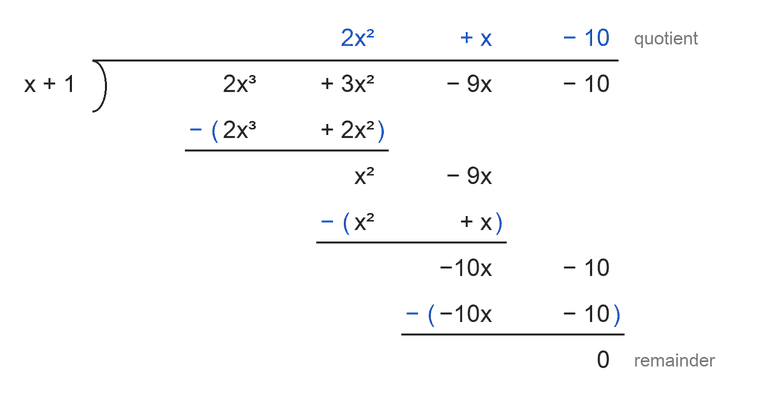
The quotient is and the remainder is 0, so:
Step 3 — Factorise the quotient.
To factorise we split the middle term. We need two numbers whose product is (here ) and whose sum is (here ). They are and .
Writing the middle term as these two parts and taking out the common factor of each pair of terms:
Step 4 — Write the complete factorisation.
We put the factors together.
Check: The other two factors also give zeros of : and both work out to 0, as the factor theorem requires.
Watch out: The factor for is , not : the factor is where is the value that gives zero.
Therefore, .
- 53 marks
Board paper question 5
Using the factor theorem, show that is a factor of . Hence, factorise the polynomial completely.
Solve with AIWritten solution
Solution:
Concept: Factor theorem: is a factor of a polynomial exactly when , that is, when the remainder on dividing by is zero. To factorise a cubic, find one factor by trying small values of , divide by it, and factorise the quadratic quotient by splitting the middle term.
Step 1 — Show that is a factor.
Let . By the factor theorem we only need to show that is zero.
Since is zero, is a factor of .
Step 2 — Divide by .
We divide by using long division:

The quotient is and the remainder is 0, so:
Step 3 — Factorise the quotient.
To factorise we split the middle term. We need two numbers whose product is (here ) and whose sum is (here ). They are and .
Writing the middle term as these two parts and taking out the common factor of each pair of terms:
Step 4 — Write the complete factorisation.
We put the factors together.
Check: The other two factors also give zeros of : and both work out to 0, as the factor theorem requires.
Watch out: A “show that” question needs the working for written out, ending with the statement of the factor theorem.
Therefore, is a factor, and .
- 63 marks
Board paper question 6
Using the Remainder Theorem find the remainders obtained when is divided by and .
Hence find if the sum of the two remainders is 1.
Solve with AIWritten solution
Solution:
Concept: Remainder theorem: when a polynomial is divided by , the remainder is . To use it, find the value of that makes the divisor zero and substitute that value in .
Given: is divided by and by ; the two remainders add up to 1.
Step 1 — Write in standard form.
We open the bracket.
Step 2 — Remainder on dividing by .
is zero at , so the remainder is .
Step 3 — Remainder on dividing by .
is zero at , so the remainder is .
Step 4 — Use the sum of the remainders.
The two remainders add up to 1.
Check: With the remainders are and 14, and is 1, as given.
Watch out: is , so is , not .
Therefore, the remainders are and , and .
All 26 board paper questions for this chapter, solved the same way.
Class 10 Maths Ch 8 questions students ask
How many questions are there in Class 10 Maths Ch 8?
49 questions. Every one is solved step by step on this page.
Are these Class 10 Maths solutions free?
Yes. Every question and its full working is free to read, with no account needed.
Can I download the Class 10 Maths Ch 8 solutions as a PDF?
There is no PDF to download. Every solution is on this page instead, which means it is searchable, always the current syllabus, and readable on a phone. Use your browser's print option if you want it on paper.