
Opening your dashboard
Class 10 Maths Chapter 8 Factorization of Polynomials: Previous Year Questions
26 questions on Chapter 8, each solved step by step. Class 10 Maths, ICSE 2026-27.
26 questions with solutions
1–4 marks · Mixed difficulty
The first 10 solutions are on this page. This chapter is a long one, so the rest open on their own page to keep this one quick to load.
- 13 marks
Question 1
Using remainder theorem, find the value of k if on dividing by , leaves a remainder 7.
Solve with AIWritten solution
Solution:
Concept: Remainder theorem: when a polynomial is divided by , the remainder is . To use it, find the value of that makes the divisor zero and substitute that value in .
Given: leaves remainder 7 when divided by .
Step 1 — Find the value of to substitute.
The divisor is zero when , so by the remainder theorem the remainder is .
Step 2 — Work out .
We put in .
Step 3 — Set it equal to the remainder and solve.
The remainder is given to be 7.
Check: With , becomes , which works out to 7, the given remainder.
Watch out: For the divisor substitute , not .
Therefore, .
- 23 marks
Question 2
What must be subtracted from so that the resulting expression has as a factor?
Solve with AIWritten solution
Solution:
Concept: Remainder theorem: when a polynomial is divided by , the remainder is . To use it, find the value of that makes the divisor zero and substitute that value in . Factor theorem: is a factor of a polynomial exactly when , that is, when the remainder on dividing by is zero.
Given: ; a number is to be subtracted so that becomes a factor.
Step 1 — Find the value of to substitute.
The divisor is zero when , so the remainder is .
Step 2 — Work out the remainder.
We put in ; note that and .
Step 3 — Decide what to subtract.
Dividing by leaves remainder 1, so for some quotient . Subtracting this remainder leaves , which has as a factor.
Check: Take ; then , so and is a factor of .
Watch out: To make the remainder zero we subtract the remainder itself (1); subtracting would make it 2.
Therefore, 1 must be subtracted.
- 33 marks
Question 3
If and are factors of , find the values of 'a' and 'b'.
Solve with AIWritten solution
Solution:
Concept: Factor theorem: is a factor of a polynomial exactly when , that is, when the remainder on dividing by is zero. Each given factor gives one equation in and ; solve the two equations together.
Given: and are factors of .
Step 1 — Use the factor .
is zero at , so .
Step 2 — Use the factor .
is zero at , so .
Step 3 — Solve the two equations.
Subtracting equation (2) from equation (1) removes .
Step 4 — Find .
We put in equation (1).
Check: With these values . Then is and is ; both work out to 0.
Watch out: is and is : an odd power of a negative number is negative.
Therefore, and .
- 43 marks
Question 4
Use Remainder theorem to factorize the following polynomial :
Solve with AIWritten solution
Solution:
Concept: Remainder theorem: when a polynomial is divided by , the remainder is . To use it, find the value of that makes the divisor zero and substitute that value in . Factor theorem: is a factor of a polynomial exactly when , that is, when the remainder on dividing by is zero. To factorise a cubic, find one factor by trying small values of , divide by it, and factorise the quadratic quotient by splitting the middle term.
Step 1 — Find one factor by trial.
Let . The remainder on dividing by is , and a zero remainder means is a factor. So we try small values of in turn.
works out to , which is not zero, so is not a factor.
Now we try :
Since is zero, is a factor of by the factor theorem.
Step 2 — Divide by .
We divide by using long division:
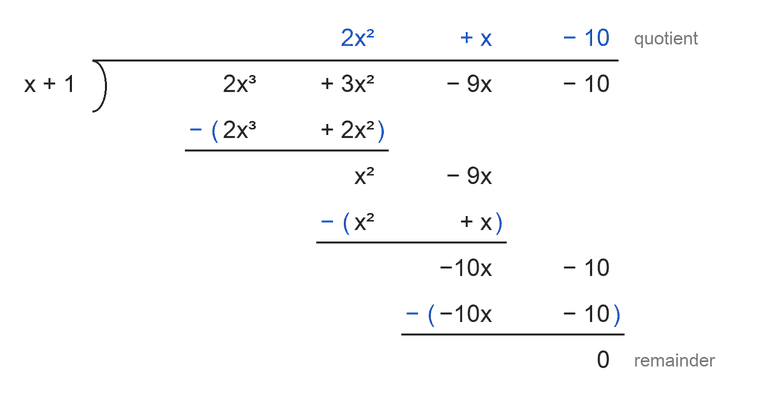
The quotient is and the remainder is 0, so:
Step 3 — Factorise the quotient.
To factorise we split the middle term. We need two numbers whose product is (here ) and whose sum is (here ). They are and .
Writing the middle term as these two parts and taking out the common factor of each pair of terms:
Step 4 — Write the complete factorisation.
We put the factors together.
Check: The other two factors also give zeros of : and both work out to 0, as the factor theorem requires.
Watch out: The factor for is , not : the factor is where is the value that gives zero.
Therefore, .
- 53 marks
Question 5
Using the factor theorem, show that is a factor of . Hence, factorise the polynomial completely.
Solve with AIWritten solution
Solution:
Concept: Factor theorem: is a factor of a polynomial exactly when , that is, when the remainder on dividing by is zero. To factorise a cubic, find one factor by trying small values of , divide by it, and factorise the quadratic quotient by splitting the middle term.
Step 1 — Show that is a factor.
Let . By the factor theorem we only need to show that is zero.
Since is zero, is a factor of .
Step 2 — Divide by .
We divide by using long division:

The quotient is and the remainder is 0, so:
Step 3 — Factorise the quotient.
To factorise we split the middle term. We need two numbers whose product is (here ) and whose sum is (here ). They are and .
Writing the middle term as these two parts and taking out the common factor of each pair of terms:
Step 4 — Write the complete factorisation.
We put the factors together.
Check: The other two factors also give zeros of : and both work out to 0, as the factor theorem requires.
Watch out: A “show that” question needs the working for written out, ending with the statement of the factor theorem.
Therefore, is a factor, and .
- 63 marks
Question 6
Using the Remainder Theorem find the remainders obtained when is divided by and .
Hence find if the sum of the two remainders is 1.
Solve with AIWritten solution
Solution:
Concept: Remainder theorem: when a polynomial is divided by , the remainder is . To use it, find the value of that makes the divisor zero and substitute that value in .
Given: is divided by and by ; the two remainders add up to 1.
Step 1 — Write in standard form.
We open the bracket.
Step 2 — Remainder on dividing by .
is zero at , so the remainder is .
Step 3 — Remainder on dividing by .
is zero at , so the remainder is .
Step 4 — Use the sum of the remainders.
The two remainders add up to 1.
Check: With the remainders are and 14, and is 1, as given.
Watch out: is , so is , not .
Therefore, the remainders are and , and .
- 73 marks
Question 7
Use factor theorem to factorise completely.
Solve with AIWritten solution
Solution:
Concept: Factor theorem: is a factor of a polynomial exactly when , that is, when the remainder on dividing by is zero. To factorise a cubic, find one factor by trying small values of , divide by it, and factorise the quadratic quotient by splitting the middle term.
Step 1 — Find one factor by trial.
Let . We try small values of until becomes zero.
works out to , which is not zero, so is not a factor.
works out to , which is not zero, so is not a factor.
Now we try :
Since is zero, is a factor of by the factor theorem.
Step 2 — Divide by .
We divide by using long division:

The quotient is and the remainder is 0, so:
Step 3 — Factorise the quotient.
To factorise we split the middle term. We need two numbers whose product is (here ) and whose sum is (here ). They are and .
Writing the middle term as these two parts and taking out the common factor of each pair of terms:
Step 4 — Write the complete factorisation.
We put the factors together.
Check: The other two factors also give zeros of : and both work out to 0, as the factor theorem requires.
Watch out: When no small whole number works at first, keep trying: here fail and works.
Therefore, .
- 83 marks
Question 8
What must be added to the polynomial , so that it leaves a remainder 10 when divided by ?
Solve with AIWritten solution
Solution:
Concept: Remainder theorem: when a polynomial is divided by , the remainder is . To use it, find the value of that makes the divisor zero and substitute that value in .
Given: ; a number is added so that the remainder on dividing by is 10.
Step 1 — Find the value of to substitute.
The divisor is zero when .
Step 2 — Find the remainder of .
We put in .
Step 3 — Add and use the required remainder.
Adding to the polynomial adds to the remainder, so the new remainder is . It must be 10.
Check: With 7 added, the remainder is , which works out to 10, as required.
Watch out: The polynomial has no constant term, so there are only three terms to evaluate.
Therefore, 7 must be added.
- 91 mark
Question 9
If is a factor of the polynomial then the value of is
Solve with AIAnswer
(A)
- Correct
(B)
(C)
(D)
Answer: (B)
Concept: Factor theorem: is a factor of a polynomial exactly when , that is, when the remainder on dividing by is zero.
Step 1 — Use the factor theorem.
is zero at , so must be zero, where .
Step 2 — Work out and solve.
We substitute and simplify.
Setting equal to zero gives , so .
Watch out: is , because is .
Why the other options are wrong:
- (A) : with , becomes , which is 4, not 0.
- (C) : with , becomes , which is −4, not 0.
- (D) : with , becomes , which is 16, not 0.
Therefore, , option (B).
- 101 mark
Question 10
The polynomial when divided by leaves, remainder 20, then '' is equal to
Solve with AIAnswer
(A)
(B)
(C)
- Correct
(D)
Answer: (D)
Concept: Remainder theorem: when a polynomial is divided by , the remainder is . To use it, find the value of that makes the divisor zero and substitute that value in .
Step 1 — Find the value of to substitute.
is zero at , so the remainder is , where .
Step 2 — Work out .
We substitute and simplify.
Step 3 — Use the remainder 20.
The remainder is 20.
Watch out: is ; keep the sign when you solve .
Why the other options are wrong:
- (A) : with , becomes , which is 40, not 20.
- (B) : with , becomes 0, not 20 (that would make a factor).
- (C) : with , becomes , which is −2, not 20. It is the right number with the wrong sign.
Therefore, , option (D).
- 112 marks
Question 11
and are two factors of the polynomial . If this polynomial is completely factorised the result is
- 121 mark
Question 12
If is a factor of , then the value of is :
- 134 marks
Question 13
Find the value of '' if is a factor of the polynomial .
- 144 marks
Question 14
Factorize completely using factor theorem : .
- 151 mark
Question 15
What must be subtracted from the polynomial , so that the result is exactly divisible by ?
- 163 marks
Question 16
The polynomial has as a factor. Find the value of . Hence factorize the resulting polynomial completely.
- 171 mark
Question 17
The factor common to the two polynomials and
- 183 marks
Question 18
It is given that is a factor of polynomial .
Find:
(a) the value of ''.
(b) hence, factorise the resulting polynomial completely.
- 191 mark
Question 19
When polynomial is divided by , the remainder is zero. The probability of to be one of the factors of the given polynomial is:
- 201 mark
Question 20
The value of for which is a factor of is:
- 214 marks
Question 21
If
(a) using Remainder and Factor theorem, find the value of '' and ''.
(b) hence, factorise the polynomial completely.
- 223 marks
Question 22
Using Remainder and Factor theorem factorise the given polynomial completely.
- 231 mark
Question 23
What must be added to so that the result is completely divisible by ?
- 244 marks
Question 24
The polynomial when divided by , leaves a remainder of 6.
(a) Find the value of .
(b) Using the value of factorise completely the polynomial .
- 251 mark
Question 25
is a factor of the polynomial . The value of is:
- 264 marks
Question 26
The remainder obtained by dividing the polynomial by is twice the remainder obtained by dividing the polynomial by .
(a) Find the value of ''.
(b) Using the value of '', find the remainder when is divided by .