
Question 244 marksAsked 2026Medium
The polynomial when divided by , leaves a remainder of 6.
(a) Find the value of .
(b) Using the value of factorise completely the polynomial .
Confirming your payment
Sign up now and get 250 free tokens.
Previous Year Questions · Question 24 of 26
The polynomial when divided by , leaves a remainder of 6.
(a) Find the value of .
(b) Using the value of factorise completely the polynomial .
Solution:
Concept: Remainder theorem: when a polynomial is divided by , the remainder is . To use it, find the value of that makes the divisor zero and substitute that value in . Factor theorem: is a factor of a polynomial exactly when , that is, when the remainder on dividing by is zero. To factorise a cubic, find one factor by trying small values of , divide by it, and factorise the quadratic quotient by splitting the middle term.
Given: leaves remainder 6 when divided by .
Step 1 — Find (part (a)).
is zero at , so the remainder is , and it equals 6.
Setting equal to 6 gives . The polynomial is .
Step 2 — Find one factor by trial.
Now we look for a factor of . We already know is 6, not 0, so is not a factor.
works out to , which is not zero, so is not a factor.
Now we try :
Since is zero, is a factor of by the factor theorem.
Step 3 — Divide by .
We divide by using long division:
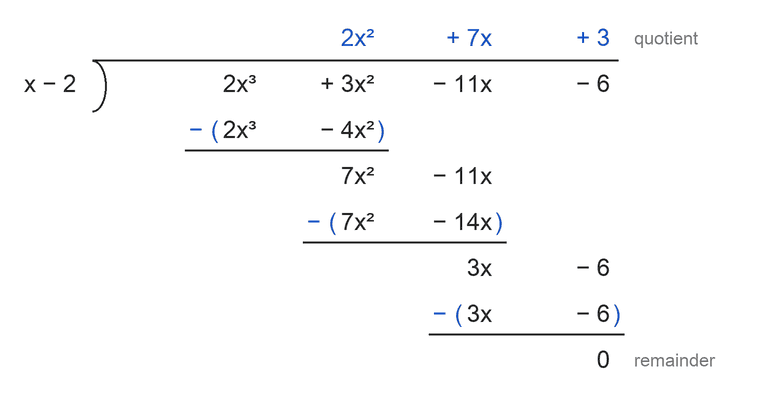
The quotient is and the remainder is 0, so:
Step 4 — Factorise the quotient.
To factorise we split the middle term. We need two numbers whose product is (here ) and whose sum is (here ). They are and .
Writing the middle term as these two parts and taking out the common factor of each pair of terms:
Step 5 — Write the complete factorisation.
We put the factors together.
Check: The other two factors also give zeros of : and both work out to 0, as the factor theorem requires.
Watch out: leaves remainder 6, so it is not a factor; do not divide by it.
Therefore, (a) ; (b) .