
Question 283 marksMedium
Factorise the expression . Hence, find all possible values of for which .
Confirming your payment
Sign up now and get 250 free tokens.
Factorization of Polynomials · Question 28 of 49
Factorise the expression . Hence, find all possible values of for which .
Solution:
Concept: To factorise a cubic, we first find one factor: by the Factor Theorem, is a factor when , and an integer with must divide the constant term. We take that factor out, which leaves a quadratic, and then factorise the quadratic by splitting its middle term. A product is 0 only when one of its factors is 0, and this gives the values of for which .
Here .
Step 1 — Find one factor by trying values of .
If an integer makes , then must divide the constant term 18, so we try one by one and stop at the first value that gives 0.
The first tries do not give 0:
| Value of | term by term | Value of | Factor? |
|---|---|---|---|
| No | |||
| No |
Now we try :
Working out each term:
Adding:
The remainder is 0, so by the Factor Theorem is a factor.
Step 2 — Take out the factor .
We split the terms of into pairs that each contain , so that it can be taken out as a common factor. What is left is a quadratic.
Splitting the terms so that can be taken out of each pair:
Taking out the common factor from each pair:
Taking out the common factor :
Step 3 — Factorise the quadratic .
The quadratic left over may still split into two linear factors, so we factorise it too.
We split the middle term. We need two numbers whose sum is and whose product is . They are and .
Taking out the common factor from each pair:
Taking out the common factor :
Putting all the factors together:
Check: the constant terms of the factors multiply to , which is the constant term of the given expression. ✓
Step 4 — Find the values of for which .
A product of numbers is 0 only when at least one of them is 0, so we put each factor equal to 0.
The equation becomes:
Putting each factor equal to 0 in turn:
| Factor | Put equal to 0 | Value of |
|---|---|---|
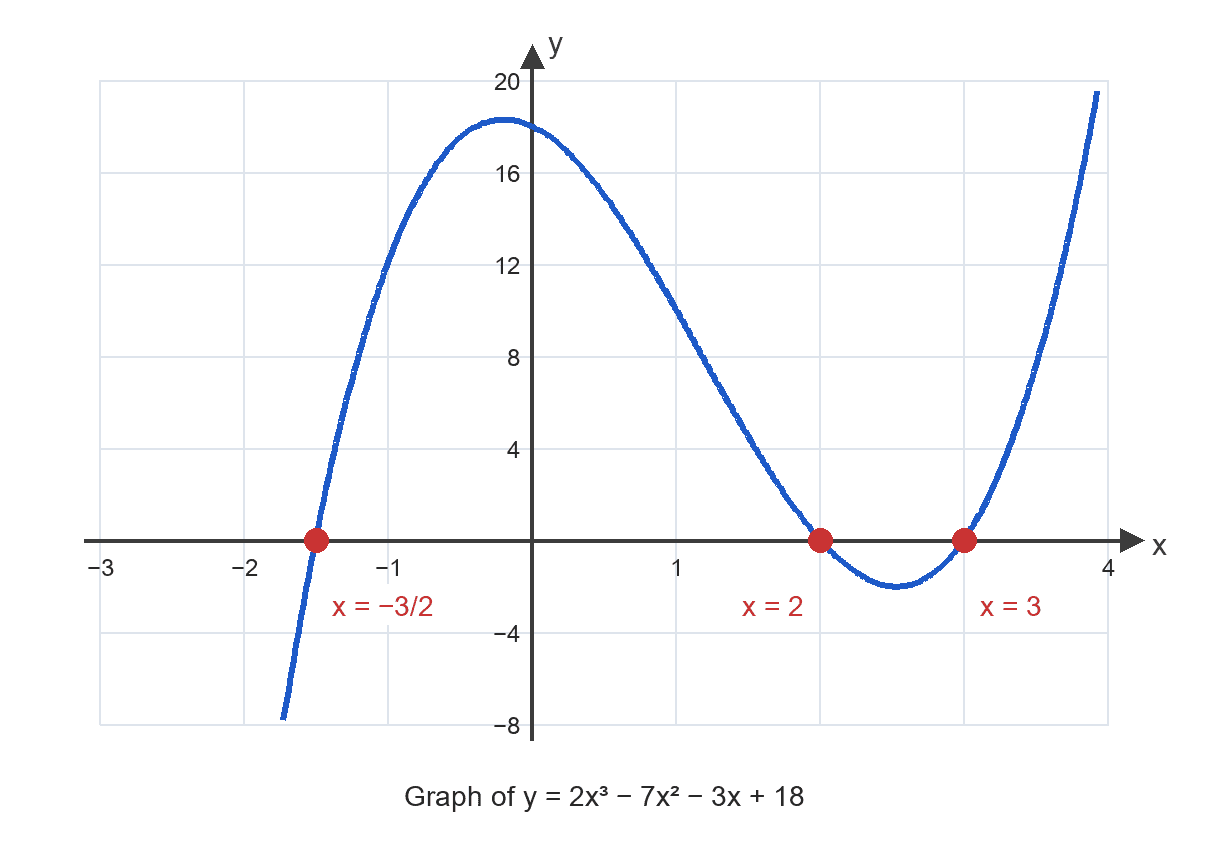
The graph of meets the -axis exactly where is , 2 and 3; these are the points where is 0.
Watch out: From , we get ; keep the minus sign. “Factorise completely” means no factor can be split further; after taking out the first factor, always factorise the quadratic that is left.
Therefore, , and is 0 for , or .