
Opening your dashboard
Class 10 Maths Chapter 7: Ratio and Proportion Solutions
82 textbook questions with step-by-step answers, free to read, for ICSE 2026-27.
Get talked through Ch 7, not just shown the answer
Reading a finished solution is not the same as being able to do it. The AI tutor takes one question at a time and works it with you, in your own words, until you can.
- Ask it out loud, in your own words
- It gives you the next step, not the answer
- Stuck on part (ii)? Start there
82 questions with solutions
1–3 marks · Mixed difficulty
The first 14 solutions are on this page. This chapter is a long one, so the rest open on their own page to keep this one quick to load.
- 11 mark
Question 1
If A : B = 7 : 5 and B : C = 7 : 5, then A : C is :
Solve with AIAnswer
(A) 25 : 49
- Correct
(B) 49 : 25
(C) 1
(D) 15 : 14
Answer: (B) 49 : 25
Concept: Two ratios that share a term (here B) can be joined into one ratio A : B : C only when that shared term is the same number in both. So we first make the B-terms equal by using their LCM.
Step 1 — Make B the same in both ratios.
B is 5 in the first ratio and 7 in the second. Their LCM is 35, so we multiply both terms of A : B by 7 and both terms of B : C by 5. This does not change either ratio.
For A : B:
For B : C:
Step 2 — Join the two ratios.
Now B is 35 in both, so the three quantities can be written together as A : B : C = 49 : 35 : 25. Reading off the first and the last terms gives A : C = 49 : 25.
Step 3 — Check by multiplying the fractions.
B cancels when the two fractions are multiplied, so this is a quick second way.
Watch out: You cannot simply copy the outer terms (7 and 5) from the two ratios. The shared term B must first be made equal in both.
Why the other options are wrong:
- (A) 25 : 49: this is the ratio turned round: 25 : 49 is C : A, not A : C.
- (C) 1: A : C would be 1 only if A and C were equal. Here A has 49 parts and C has only 25 parts.
- (D) 15 : 14: 15 : 14 is not equal to 49 : 25, because and are not equal.
Therefore, A : C = 49 : 25, option (B).
- 21 mark
Question 2
If , the value of is :
Solve with AIAnswer
(A)
(B) 2
(C)
- Correct
(D)
Answer: (D)
Concept: When two fractions are equal we can cross-multiply to remove the denominators. An equation of the form (with ) has two solutions, and .
Step 1 — Cross-multiply.
We multiply the numerator on each side by the denominator on the other side, so that no fractions are left.
Step 2 — Open the brackets.
We multiply out both brackets.
Step 3 — Collect the terms.
We subtract from both sides and add 5 to both sides, so that the terms are on the left and the numbers on the right.
Step 4 — Find x.
We divide both sides by 2 and then take the square root, keeping both signs.
Check: Both and are 4, and putting into the left side gives , which reduces to .
Watch out: has two answers. Both and are 4, so do not drop the negative value.
Why the other options are wrong:
- (A) : if is , then and the left side becomes , not .
- (B) 2: 2 is one correct value, but it is only one of the two. also works, because as well.
- (C) : if is , then and the left side becomes , not .
Therefore, the value of is , option (D).
- 31 mark
Question 3
If ; then is :
Solve with AIAnswer
(A) 6 : 1
(B) 2 : 3
- Correct
(C) 1 : 6
(D) 3 : 2
Answer: (C) 1 : 6
Concept: A ratio compares two quantities of the same kind and means the fraction . Multiplying or dividing both terms by the same non-zero number does not change a ratio, so a ratio can be written as a fraction and cross-multiplied like any equation of fractions.
Step 1 — Write the ratio as a fraction and cross-multiply.
The ratio means the fraction , and it equals . Cross-multiplying removes the fractions.
Step 2 — Open the brackets.
We multiply out both sides.
Step 3 — Separate the x terms and the y terms.
We subtract and from both sides, so that the terms are on the left and the terms on the right.
Step 4 — Write x : y.
We divide both sides of by to get the fraction .
Check: With and , the given ratio becomes 20 : 15, which reduces to 4 : 3.
Watch out: After collecting terms, means is six times , so , not 6 : 1.
Why the other options are wrong:
- (A) 6 : 1: this turns the ratio round. With and the given ratio becomes 15 : 20, which reduces to 3 : 4, not 4 : 3.
- (B) 2 : 3: with and the given ratio becomes 13 : 12, not 4 : 3.
- (D) 3 : 2: with and the given ratio becomes 12 : 13, not 4 : 3.
Therefore, , option (C).
- 41 mark
Question 4
Two numbers are in the ratio 5 : 8. If 10 is subtracted from each number, the ratio becomes 4 : 7. The numbers are :
Solve with AIAnswer
(A) 80 and 50
- Correct
(B) 50 and 80
(C) 25 and 40
(D) 40 and 25
Answer: (B) 50 and 80
Concept: When two numbers are in the ratio 5 : 8, we can write them as and for some number (one part). The second condition then gives an equation in .
Step 1 — Write the numbers using one part t.
Let the numbers be and . After 10 is subtracted from each, they become and , and their ratio is 4 : 7.
Step 2 — Cross-multiply and open the brackets.
Cross-multiplying removes the fractions.
Step 3 — Solve for t.
We subtract from both sides and add 70 to both sides.
Step 4 — Find the numbers.
One part is 10, so the numbers are and , that is 50 and 80.
Check: 50 : 80 reduces to 5 : 8, and after subtracting 10 we get 40 : 70, which reduces to 4 : 7.
Watch out: Keep the order of the ratio. The first number goes with 5, so it is the smaller number.
Why the other options are wrong:
- (A) 80 and 50: these are the right numbers in the wrong order. 80 : 50 reduces to 8 : 5, but the ratio is given as 5 : 8.
- (C) 25 and 40: 25 : 40 is 5 : 8, but after subtracting 10 the numbers are 15 and 30, and 15 : 30 reduces to 1 : 2, not 4 : 7.
- (D) 40 and 25: 40 : 25 reduces to 8 : 5, not 5 : 8. Also, after subtracting 10 we get 30 : 15, which reduces to 2 : 1, not 4 : 7.
Therefore, the numbers are 50 and 80, option (B).
- 51 mark
Question 5
The compound ratio of and is :
Solve with AIAnswer
(A) 2 : 1
(B)
- Correct
(C) 1 : 1
(D) 1 : 2
Answer: (C) 1 : 1
Concept: The compound ratio of and is : multiply the first terms together and the second terms together. The duplicate ratio of means , the triplicate ratio means , the sub-duplicate ratio means , the sub-triplicate ratio means and the reciprocal ratio means .
Step 1 — Multiply the first terms and the second terms.
The compound ratio is (product of the first terms) : (product of the second terms). As a fraction:
Step 2 — Factorise the denominator.
We use the identity , so that the common factors can be seen.
Step 3 — Cancel the common factors.
The numerator and the denominator are both , so everything cancels.
So the compound ratio is 1 : 1.
Watch out: Factorise before cancelling; it hides one factor and one factor .
Why the other options are wrong:
- (A) 2 : 1: the two products are exactly equal, so nothing is left over to give a 2.
- (B) : this keeps in the second term only. But the first product also has the factor , and the two cancel.
- (D) 1 : 2: the two products are exactly equal, so neither is double the other.
Therefore, the compound ratio is 1 : 1, option (C).
- 61 mark
Question 6
The sub-duplicate ratio of is :
Solve with AIAnswer
- Correct
(A)
(B)
(C)
(D)
Answer: (A)
Concept: The compound ratio of and is : multiply the first terms together and the second terms together. The duplicate ratio of means , the triplicate ratio means , the sub-duplicate ratio means , the sub-triplicate ratio means and the reciprocal ratio means .
Step 1 — Reduce the ratio first.
We divide both terms of by 6, which does not change the ratio.
Step 2 — Take the square root of each term.
The sub-duplicate ratio is the ratio of the square roots. The square root of is and the square root of is .
So the sub-duplicate ratio is .
Watch out: Take the square root of the number too: stays with .
Why the other options are wrong:
- (B) : the 2 is put with the wrong term. The 4 belongs to the second term, so its square root 2 goes with .
- (C) : this takes the square roots of and but forgets the numbers. 6 : 24 reduces to 1 : 4, and must stay with .
- (D) : this turns the ratio round and also leaves out the 2.
Therefore, the sub-duplicate ratio is , option (A).
- 73 marks
Question 7
If , find : .
Solve with AIWritten solution
Solution:
Concept: A ratio compares two quantities of the same kind and means the fraction . Multiplying or dividing both terms by the same non-zero number does not change a ratio, so a ratio can be written as a fraction and cross-multiplied like any equation of fractions. If we can write in terms of , every in the expression will cancel.
Step 1 — Cross-multiply the given equation.
We remove the fractions by cross-multiplying.
Step 2 — Express m in terms of n.
We subtract and from both sides.
Step 3 — Substitute in the expression.
We replace every by . Note that and .
Step 4 — Cancel.
Dividing the top and the bottom by gives the value.
Check: Take , so ; then , which reduces to , and , which reduces to .
Watch out: Square the whole of : is , so becomes (not ).
Therefore, .
- 83 marks
Question 8
If the ratio of 8 to 11 is the same as the ratio of to , find the value of .
Solve with AIWritten solution
Solution:
Concept: A ratio compares two quantities of the same kind and means the fraction . Multiplying or dividing both terms by the same non-zero number does not change a ratio, so a ratio can be written as a fraction and cross-multiplied like any equation of fractions.
Step 1 — Write the equal ratios as fractions.
“The ratio of 8 to 11 is the same as the ratio of to ” means:
Step 2 — Cross-multiply and open the brackets.
Cross-multiplying removes the fractions.
Step 3 — Find x : y.
We collect the terms on the left and the terms on the right.
Dividing both sides by :
Step 4 — Find the required value.
We write as and put in .
Cancelling 7 with 14 and 9 with 27:
Check: With and , and , and 40 : 55 reduces to 8 : 11.
Watch out: The order matters: “the ratio of 8 to 11” is , matched with in the same order.
Therefore, .
- 93 marks
Question 9
Divide ₹ 1,290 into A, B and C such that A is of B and B : C = 4 : 3.
Solve with AIWritten solution
Solution:
Concept: To share an amount in a ratio, add the parts of the ratio, find the value of one part, and multiply. When the conditions are given as two separate ratios, first join them into one continued ratio A : B : C by making the shared term (B) equal.
Step 1 — Write A : B as a ratio.
A is of B, so A : B = 2 : 5 (A has 2 parts when B has 5).
Step 2 — Make B the same in both ratios.
B has 5 parts in A : B and 4 parts in B : C. The LCM of 5 and 4 is 20, so we multiply both terms of A : B by 4 and both terms of B : C by 5. This does not change either ratio.
For A : B:
For B : C:
Now B has 20 parts in both, so the two ratios join into one:
Step 3 — Find the value of one part.
The total number of parts is 8 + 20 + 15, which is 43. The whole sum is ₹ 1,290, so we divide by 43.
So one part is worth ₹ 30.
Step 4 — Find each share.
Each person gets (number of parts) × ₹ 30. A gets 8 × 30, which is ₹ 240. B gets 20 × 30, which is ₹ 600. C gets 15 × 30, which is ₹ 450.
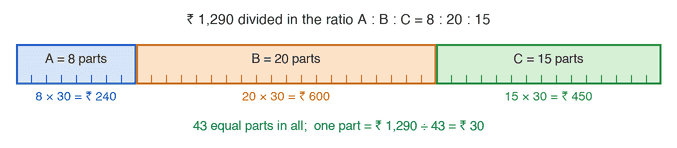
Check: 240 + 600 + 450 adds up to 1,290; 240 ÷ 600 reduces to ; and 600 : 450 reduces to 4 : 3.
Watch out: “A is of B” gives A : B = 2 : 5, not 5 : 2. Also, the two ratios cannot be joined until B is the same in both.
Therefore, A gets ₹ 240, B gets ₹ 600 and C gets ₹ 450.
- 103 marks
Question 10
A school has 630 students. The ratio of the number of boys to the number of girls is 3 : 2. This ratio changes to 7 : 5 after the admission of 90 new students. Find the number of newly admitted boys.
Solve with AIWritten solution
Solution:
Concept: To find a quantity from a ratio, divide the total into (sum of the ratio terms) equal parts. Here we find the number of boys before and after the admission, and the difference is the number of new boys.
Step 1 — Boys before the admission.
Boys : girls = 3 : 2, so the boys are 3 parts out of 3 + 2 = 5 parts of the 630 students.
So there were 378 boys and 630 − 378, that is 252, girls.
Step 2 — Total after the admission.
90 new students joined, so the total became 630 + 90, which is 720 students.
Step 3 — Boys after the admission.
Now boys : girls = 7 : 5, so the boys are 7 parts out of 7 + 5 = 12 parts of 720.
So there are 420 boys and 300 girls now.
Step 4 — New boys.
The newly admitted boys are the increase in the number of boys.
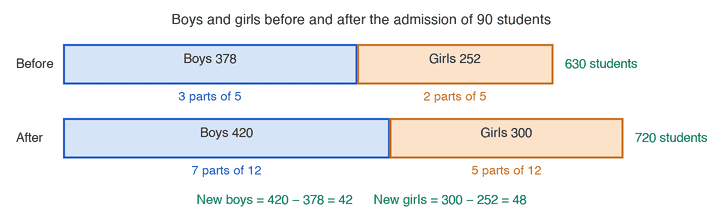
Check: The girls went from 252 to 300, so 48 new girls joined. New boys + new girls = 42 + 48, which is 90.
Watch out: Use the new total (720) with the new ratio 7 : 5; do not apply 7 : 5 to the 90 new students alone.
Therefore, the number of newly admitted boys is 42.
- 113 marks
Question 11
What quantity must be subtracted from each term of the ratio 9 : 17 to make it equal to 1 : 3 ?
Solve with AIWritten solution
Solution:
Concept: A ratio compares two quantities of the same kind and means the fraction . Multiplying or dividing both terms by the same non-zero number does not change a ratio, so a ratio can be written as a fraction and cross-multiplied like any equation of fractions.
Step 1 — Form the equation.
Let be the quantity subtracted from each term. Then must equal 1 : 3.
Step 2 — Cross-multiply and open the bracket.
Cross-multiplying removes the fractions.
Step 3 — Solve for x.
We add to both sides and subtract 17 from both sides, so that the numbers are on the left and the terms on the right.
Dividing both sides by 2:
Check: 9 − 5 = 4 and 17 − 5 = 12, and 4 : 12 reduces to 1 : 3.
Watch out: The same is subtracted from both terms, so it appears in the numerator and in the denominator.
Therefore, 5 must be subtracted from each term.
- 123 marks
Question 12
The work done by men in days and the work done by men in days are in the ratio 3 : 8. Find the value of .
Solve with AIWritten solution
Solution:
Concept: The work done by a group is (number of men) × (number of days), when every man works at the same rate. Two amounts of work in a given ratio give an equation, which we simplify by cancelling a common factor and cross-multiplying.
Step 1 — Write each amount of work.
The first group does units of work and the second does units. Their ratio is 3 : 8.
Step 2 — Cancel the common factor.
is a number of days, so it is not zero, and it can be cancelled from the top and the bottom.
Step 3 — Cross-multiply and solve.
Cross-multiplying removes the fractions.
We subtract from both sides and add 16 to both sides.
Dividing both sides by 2:
Check: With the first group does , that is 22.5 units, and the second does , that is 60 units. 22.5 : 60 reduces to 3 : 8.
Watch out: Cancel before cross-multiplying; multiplying everything out first gives a needless quadratic.
Note: This value makes the first group “men”, which is not a whole number. The ratio in the question is still satisfied exactly, so is the value the printed question gives.
Therefore, (that is, 3.5).
- 133 marks
Question 13
(i) If ; find : A : B : C.
(ii) If and , find : .
Solve with AIWritten solution
Solution:
Concept: When several quantities are equal, as , and are here, call their common value and write each letter in terms of . Two ratios with a shared letter can be combined by multiplying the fractions, so the shared letter cancels.
Step 1 — Part (i): write A, B and C in terms of k.
Let the common value of , and be . Then , and , so A : B : C = .
Step 2 — Part (i): clear the fractions.
We multiply every term by 12 (the LCM of 3, 4 and 6) and divide every term by . This does not change the ratio, and it gives A : B : C = 4 : 3 : 2.
Check: With A = 4, B = 3 and C = 2, we get 3A = 12, 4B = 12 and 6C = 12, all equal.
Step 3 — Part (ii): write each condition as a fraction.
gives (dividing both sides by ) the first fraction, and gives (dividing both sides by ) the second.
Step 4 — Part (ii): multiply the two fractions.
When the two fractions are multiplied, cancels and we are left with .
Check: Take , and . Then and are both 30, and and are both 40.
Watch out: does not make A : B equal to 3 : 4; it makes A : B equal to 4 : 3, because the quantity multiplied by the smaller number must be larger.
Therefore, (i) A : B : C = 4 : 3 : 2; (ii) .
- 143 marks
Question 14
Find the compound ratio of :
(i) 2 : 3, 9 : 14 and 14 : 27.
(ii) , and .
Solve with AIWritten solution
Solution:
Concept: The compound ratio of and is : multiply the first terms together and the second terms together. The duplicate ratio of means , the triplicate ratio means , the sub-duplicate ratio means , the sub-triplicate ratio means and the reciprocal ratio means .
Step 1 — Part (i): multiply the first terms and the second terms.
The compound ratio of 2 : 3, 9 : 14 and 14 : 27 is (2 × 9 × 14) : (3 × 14 × 27). As a fraction, we cancel before multiplying.
So the compound ratio is 2 : 9.
Step 2 — Part (ii): multiply the first terms and the second terms.
The first terms are , and ; the second terms are , and .
Step 3 — Part (ii): reduce to the lowest terms.
The common factor of the top and the bottom is , so we cancel it.
So the compound ratio is .
Watch out: Cancel common factors (14 here, in part (ii)) before multiplying out; it keeps the numbers small and avoids slips.
Therefore, (i) 2 : 9; (ii) .
- 153 marks
Question 15
If is the duplicate ratio of 3 : 5, find the value of .
- 163 marks
Question 16
If is the duplicate ratio of ; show that : .
- 173 marks
Question 17
If is the triplicate ratio of 3 : 4, find the value of .
- 181 mark
Question 18
If , 2, 10 and are in continued proportion, the values of and are respectively :
- 191 mark
Question 19
If , the value of is :
- 201 mark
Question 20
If , then is :
- 211 mark
Question 21
The mean proportion between and is :
- 221 mark
Question 22
If , 9 and 18 are in continued proportion, the value of is :
- 233 marks
Question 23
Find the fourth proportional to :
(i) 1·5, 4·5 and 3·5 (ii) , and
- 243 marks
Question 24
Find the third proportional to :
(i) and 4 (ii) and
- 253 marks
Question 25
Find the mean proportional between :
(i) and
(ii) and .
- 263 marks
Question 26
If is the mean proportion between and ; find the value of .
- 273 marks
Question 27
If , 4 and 9 are in continued proportion, find .
- 283 marks
Question 28
If is the mean proportional between and ; show that is the mean proportional between and .
- 293 marks
Question 29
If is the mean proportional between and , show that : .
- 303 marks
Question 30
If three quantities are in continued proportion; show that the ratio of the first to the third is the duplicate ratio of the first to the second.
- 313 marks
Question 31
Find the third proportional to and .
- 323 marks
Question 32
If ; then show that : .
- 333 marks
Question 33
If and ; then prove that : .
- 341 mark
Question 34
If , the value of is :
- 351 mark
Question 35
If , , and are in proportion, the value of is equal to :
- 361 mark
Question 36
is equal to :
- 371 mark
Question 37
If , the value of is :
- 381 mark
Question 38
If and ; the value of is :
- 393 marks
Question 39
If , prove that :
(i) .
(ii)
- 403 marks
Question 40
If ; prove that .
- 413 marks
Question 41
(i) If , find the value of : .
(ii) If , find the value of : .
- 423 marks
Question 42
If ; prove that : .
- 433 marks
Question 43
If , show that : .
- 443 marks
Question 44
If ; prove that : .
- 453 marks
Question 45
If , and are in continued proportion, prove that :
- 463 marks
Question 46
Using properties of proportion, solve for :
(i) .
(ii) .
- 473 marks
Question 47
If , prove that : .
- 483 marks
Question 48
Using the properties of proportion, solve for , given .
- 493 marks
Question 49
If , express in terms of and .
- 503 marks
Question 50
If , show that : .
- 513 marks
Question 51
From the following tables, find the values of , and :
(i)
Length of cloth bought (in m) 10 40 Cost of cloth (in ₹) 40 100 180 (ii)
Height of vertical pole (in cm) 56 672 448 2016 Length of its shadow on a horizontal ground (in cm) 32 - 523 marks
Question 52
(i) For the following table, find the values of , and :
Number of men 130 70 120 Number of days required to do the same work 39 30 (ii) A car covers a certain distance with uniform speed ( km/h) in hrs. Use the following table to find the values of , and .
Speed ( km/h) 60 150 Time taken ( hrs) 8 2 6 - 531 mark
Question 53
The mean proportional of and is :
- 541 mark
Question 54
If ; is :
- 551 mark
Question 55
The table, given below, shows the values of and , where is proportional (directly proportional) to .
A 24 15 12 B 20 The values of A and B are :
- 561 mark
Question 56
If ; is :
- 571 mark
Question 57
If , the value of is :
- 581 mark
Question 58
and .
Assertion (A) : The value of ratio .
Reason (R) : ; .
- 591 mark
Question 59
.
Assertion (A) : .
Reason (R) : and .
- 601 mark
Question 60
Two irrational numbers and .
Statement (1) : The mean proportion of and is .
Statement (2) : The mean proportion of two positive real numbers and is .
- 611 mark
Question 61
Numbers , and are in continued proportion.
Statement (1) :
Statement (2) : and
- 623 marks
Question 62
If , find :
- 633 marks
Question 63
If , find : .
- 643 marks
Question 64
Find the :
(i) duplicate ratio of
(ii) triplicate ratio of ,
(iii) sub-duplicate ratio of
(iv) sub-triplicate ratio of 216 : 343
(v) reciprocal ratio of 3 : 5
(vi) ratio compounded of the duplicate ratio of 5 : 6, the reciprocal ratio of 25 : 42 and the sub-duplicate ratio of 36 : 49.
- 653 marks
Question 65
Find the value of , if :
(i) is the duplicate ratio of .
(ii) is the sub-duplicate ratio of 9 : 25.
(iii) is the sub-triplicate ratio of 8 : 27.
- 663 marks
Question 66
What quantity must be added to each term of the ratio so that it may become equal to ?
- 673 marks
Question 67
A woman reduces her weight in the ratio 7 : 5. What does her weight become if originally it was 84 kg ?
- 683 marks
Question 68
If , find ; if and both are positive.
- 693 marks
Question 69
Find the :
(i) fourth proportional to , and .
(ii) third proportional to and .
(iii) mean proportion to and
- 703 marks
Question 70
Find two numbers such that the mean proportional between them is 14 and third proportional to them is 112.
- 713 marks
Question 71
If and be unequal and is the duplicate ratio of and , prove that is mean proportional between and .
- 723 marks
Question 72
If , show that :
- 733 marks
Question 73
There are 36 members in a student council in a school and the ratio of the number of boys to the number of girls is 3 : 1. How many more girls should be added to the council so that the ratio of number of boys to the number of girls may be 9 : 5 ?
- 743 marks
Question 74
If , find the value of . Hence, use componendo and dividendo to find the values of :
(i) (ii)
- 753 marks
Question 75
If , use properties of proportion to find :
(i) (ii) .
- 763 marks
Question 76
If , , are in continued proportion, prove that : .
- 773 marks
Question 77
Given . Use componendo and dividendo to prove that : .
- 783 marks
Question 78
If , find :
(i) (ii)
- 793 marks
Question 79
Given . Using componendo and dividendo, find .
- 803 marks
Question 80
If show that : .
- 813 marks
Question 81
If is the mean proportion between and , show that : .
- 823 marks
Question 82
(i) If and both are positive and , find .
(ii) Find , if .
What Class 10 Maths Ch 7 covers
The sections of the chapter, in the order the book takes them. Every question above comes from one of these.
- 01Ratio
- 02Composition of Ratios
- 03Proportion
- 04Continued Proportion
- 05Some Important Properties of Proportion
- 06Variations
More ways to study this chapter
The same chapter asked three other ways. Practise it, revise it, and see what the board has set on Ch 7 before.
- Competency-Based Questions (CBQ)Case study questions: a situation, and the part of the chapter that answers it.40questionsOpen
- Previous Year QuestionsQuestions that have actually appeared in board papers, each tagged with its year.23questionsOpen
- Practice QuestionsExtra questions per chapter, for when one attempt at a method is not enough.44questionsOpen
Ch 7 in past ICSE papers
The same chapter as the board has actually asked it. These are worded differently from the textbook exercise, which is the point of reading them.
- 13 marks
Board paper question 1
If . Find .
Solve with AIWritten solution
Solution:
Concept: A ratio is the fraction . When two ratios are equal, we cross-multiply (product of the extremes = product of the means) to get an equation in and , and then find .
Given: .
Step 1 — Write the ratios as fractions.
Each ratio is written as a fraction.
Step 2 — Cross-multiply.
We multiply each numerator by the other side's denominator and open the brackets.
Step 3 — Collect the terms and the terms.
We subtract and from both sides, so the terms are on one side and the terms on the other.
Step 4 — Find .
We divide both sides by to get on one side.
Check: With and , is 18 and is 29, giving the ratio 18 : 29.
Watch out: From we get as 4 : 3, not 3 : 4; the number next to goes with in the answer.
Therefore, .
- 23 marks
Board paper question 2
If show that
Solve with AIWritten solution
Solution:
Concept: When several ratios are equal, put each of them equal to one letter, say . Then every quantity can be written in terms of , and both sides of the result can be worked out separately and compared.
Given: The three ratios , and are equal.
Step 1 — Put each ratio equal to .
Let ; then also and . Multiplying across, , and .
Step 2 — Work out the left-hand side.
Each fraction is the cube of a ratio, and each ratio is .
Step 3 — Work out the right-hand side.
We replace , and by , and and cancel .
Step 4 — Compare.
Both sides equal , so the left-hand side equals the right-hand side.
Check: Take , , as 1, 2, 3 and , , as 2, 4, 6, so each ratio is 2. The left side is , and the right side is as well.
Watch out: equals , so it becomes ; it is not .
Therefore, . Hence proved.
- 33 marks
Board paper question 3
If is the mean proportion between and , show that:
Solve with AIWritten solution
Solution:
Concept: Three quantities , , are in continued proportion when ; then , and is called the mean proportional between and . Replace every by (and by ), then factorise.
Given: is the mean proportional between and .
Step 1 — Write the condition.
Since , the product of the means equals the product of the extremes.
Squaring this, .
Step 2 — Substitute in the numerator.
We replace by and by , and take out the common factor .
Step 3 — Substitute in the denominator.
We do the same in the denominator and take out the common factor .
Step 4 — Divide and cancel.
The bracket is common to the top and the bottom, so it cancels.
Check: 2 is the mean proportional between 1 and 4. The left side is , which becomes and reduces to ; and is also .
Watch out: Replace by ; this becomes , not .
Therefore, . Hence proved.
- 43 marks
Board paper question 4
If , use properties of proportion to find
(i)
(ii)
Solve with AIWritten solution
Solution:
Concept: Componendo and dividendo: if , then . It is most useful when one side has the form : adding gives on top and subtracting gives below.
Given: .
Step 1 — Apply componendo and dividendo.
The left side has the form with and , so we apply componendo and dividendo.
Step 2 — Find (part (i)).
We simplify to 4 and multiply both sides by .
Step 3 — Square the ratio.
For part (ii) we need and , so we square both sides.
Step 4 — Apply componendo and dividendo again (part (ii)).
Now we apply componendo and dividendo to .
Check: With and , the given fraction becomes , which reduces to .
Watch out: In part (ii) use the squares 64 and 49, not 8 and 7.
Therefore, (i) ; (ii) .
- 53 marks
Board paper question 5
Using properties of proportion, solve for . Given that is positive :
Solve with AIWritten solution
Solution:
Concept: Componendo and dividendo: if , then . It is most useful when one side has the form : adding gives on top and subtracting gives below. After that, square both sides to remove the square root.
Given: , and is positive.
Step 1 — Apply componendo and dividendo.
The left side has the form with and . We write 4 as .
Step 2 — Simplify both sides.
On the top the square roots cancel; on the bottom the terms cancel. Then we cancel the 2.
Step 3 — Square both sides.
Squaring removes the square root; is .
Step 4 — Cross-multiply and solve.
We cross-multiply and collect the terms on one side.
Step 5 — Take the positive square root.
Taking the square root of both sides gives two values, and . The question says is positive, so .
Check: With , is and is , which works out to . The left side becomes , which simplifies to , or 4.
Watch out: When you square , square the top as well: , not .
Therefore, .
- 63 marks
Board paper question 6
The following numbers, , , and are in proportion. Find .
Solve with AIWritten solution
Solution:
Concept: Four quantities , , , are in proportion when the ratio equals the ratio ; as fractions, ; then the product of the extremes equals the product of the means: .
Given: , , and are in proportion.
Step 1 — Write the proportion.
The first and fourth numbers are the extremes; the second and third are the means.
Step 2 — Product of extremes = product of means.
We multiply out both sides.
Step 3 — Bring every term to one side.
We subtract the left side from the right side, keeping the term positive.
Step 4 — Factorise by splitting the middle term.
To factorise we split the middle term. We need two numbers whose product is (here ) and whose sum is (here ). They are and .
Writing the middle term as these two parts and taking out the common factor of each pair of terms:
Step 5 — Use the Zero Product Rule.
A product is zero only when at least one of its factors is zero, so we set each factor equal to zero and solve.
Check: gives 8, 7, 8, 7, and equals . gives 2, 1, , , and equals . Both values work.
Watch out: Expand carefully: gives , which simplifies to .
Therefore, or .
All 23 board paper questions for this chapter, solved the same way.
Class 10 Maths Ch 7 questions students ask
How many questions are there in Class 10 Maths Ch 7?
82 questions. Every one is solved step by step on this page.
Are these Class 10 Maths solutions free?
Yes. Every question and its full working is free to read, with no account needed.
Can I download the Class 10 Maths Ch 7 solutions as a PDF?
There is no PDF to download. Every solution is on this page instead, which means it is searchable, always the current syllabus, and readable on a phone. Use your browser's print option if you want it on paper.