
Opening your dashboard
Class 10 Maths Chapter 7 Ratio and Proportion: Competency-Based Questions (CBQ)
40 questions on Chapter 7, each worked through on its own page with the AI tutor. Class 10 Maths, ICSE 2026-27.
40 questions
1–5 marks · Mixed difficulty
- 11 mark
Question 1
Competency: Understanding
A tea seller blends Assam tea and Nilgiri tea in the ratio by mass. Which statement must be true for every batch of this blend?
- 21 mark
Question 2
Competency: Application
Two water tanks are cubes. Their inner edges are in the ratio . The smaller tank holds 1,600 litres when full. The larger tank, when full, holds :
- 31 mark
Question 3
Competency: Application
A photograph is 12 cm wide and 18 cm high. A studio must print a larger copy without stretching or cropping the picture. Which print size can it use?
- 41 mark
Question 4
Competency: Understanding
A farmer owns a rectangular plot 16 m by 25 m. He exchanges it for a square plot of the same area. The side of the square plot, in metres, is the :
- 51 mark
Question 5
Competency: Analysis & Evaluation
A tiler charges a fixed rate for every square metre of floor. For a square room of side 3 m he charges ₹ 5,400. For a square room of side 6 m he charges ₹ 21,600.
Assertion (A) : The tiler's charge varies directly as the side of the room.
Reason (R) : If two quantities and are in direct variation, then is constant.
- 61 mark
Question 6
Competency: Application
Only two candidates stood in a school election and every vote was valid. The total number of votes and the winner's margin of victory were in the ratio . The ratio of the winner's votes to the loser's votes was :
- 72 marks
Question 7
Competency: Application
In a hostel kitchen, the masses of rice and dal cooked each day are in the ratio . The masses of dal and vegetables cooked are in the ratio .
(a) Find the ratio of the mass of rice to the mass of vegetables.
(b) On a day when 30 kg of rice is cooked, how much vegetable is cooked?
- 82 marks
Question 8
Competency: Analysis & Evaluation
A dairy prints on its cans : "milk : water ". A food inspector tests a 30-litre can and finds that it holds only 22 litres of milk. The rest is water.
(a) Is the printed ratio true for this can? Give a reason.
(b) How much milk must be added to this can to make the printed ratio true?
- 92 marks
Question 9
Competency: Application
A bakery sets the prices of its small, medium and large cakes so that the three prices are in continued proportion. The small cake costs ₹ 320 and the medium cake costs ₹ 400.
(a) Find the price of the large cake.
(b) The baker now adds an extra-large cake so that all four prices are in continued proportion. Find its price.
- 102 marks
Question 10
Competency: Application & Analysis
Six identical pumps, working together, can empty a flooded basement in 10 hours. All six pumps are started. After 4 hours, two of the pumps break down and the rest keep working. How many hours late is the basement emptied?
- 113 marks
Question 11
Competency: Analysis & Evaluation
Tanvi is given and has to find . Her working is shown below.
Step 1 : Applying componendo and dividendo,
Step 2 :
Step 3 : , so
(a) Without solving the equation, show that cannot be the answer.
(b) In which step has Tanvi gone wrong? Correct her working, find and verify your answer.
- 123 marks
Question 12
Competency: Application & Creativity
Mrs. Nair wants to share a bonus of ₹ 3,600 among her three helpers Asha, Bala and Chitra. She sets these conditions :
- Asha's share : Bala's share .
- Chitra gets more than Bala, but less than Asha and Bala together.
- Every share is a whole number of rupees.
(a) Design one way of sharing the bonus. Write the ratio Asha : Bala : Chitra in whole numbers and the three shares, and show that all the conditions are met.
(b) Show that in every correct design, Asha's share is more than ₹ 720 and less than ₹ 900.
- 133 marks
Question 13
Competency: Analysis & Evaluation
An auto-rickshaw fare is made up of a fixed charge plus a fixed amount for every kilometre. Rahul notes three fares from the driver's chart.
Distance (km) 2 5 10 Fare (₹) 54 90 150 (a) Does the fare vary directly as the distance? Give a reason.
(b) Rahul says, "A 20 km ride will cost twice the 10 km fare, that is, ₹ 300." Find the correct fare for 20 km and say by how much Rahul is wrong.
(c) Name a quantity in this situation that does vary directly as the distance.
- 145 marks
Question 14
Competency: Analysis & Evaluation
Case study: A residents' club hires a hall for its annual dinner. The rent of the hall is a fixed amount, shared equally by the members who attend. The caterer charges a fixed price per plate. The club secretary prepares this table for different numbers of members.
Number of members attending () 20 30 40 Rent share per member (₹) 1,200 800 600 480 Total food bill (₹) 7,000 10,500 14,000 (a) Which of the two quantities varies directly as , and which varies inversely as ? Support each answer with a calculation.
(b) Find the values of and .
(c) Each member pays the rent share plus the price of one plate. The treasurer says, "This total payment per member varies inversely as ." Is the treasurer right? Find the least number of members for which each member pays not more than ₹ 750.
- 154 marks
Question 15
Competency: Application & Analysis
Case study: The purity of gold is given in carats. In 22-carat gold, 22 parts out of every 24 parts by mass are pure gold and the rest is other metal, so pure gold : other metal . In 18-carat gold, pure gold : other metal .
A jeweller has an old bangle of mass 36 g made of 22-carat gold.
(a) Find the mass of pure gold and the mass of other metal in the bangle.
(b) The jeweller melts the bangle together with a 12 g chain of 18-carat gold. Find the ratio pure gold : other metal in the new alloy. What is its purity in carats?
(c) Instead, how many grams of copper must be melted with the 36 g bangle alone to turn it into 18-carat gold?
- 161 mark
Question 16
Competency: Analysis
Two water tanks hold water in the ratio . The same 20 litres of water is poured into each tank. The ratio of the water in the first tank to the water in the second tank now :
- 171 mark
Question 17
Competency: Application
Two delivery vans, A and B, run on different routes at steady speeds. The speeds of A and B are in the ratio . Van A runs for 3 hours and van B runs for 2 hours. The ratio of the distance run by A to the distance run by B is :
- 181 mark
Question 18
Competency: Understanding & Analysis
It is given that , where are non-zero numbers. Which one of the following is true for every such set of numbers?
- 191 mark
Question 19
Competency: Analysis & Evaluation
Assertion (A) : If , then .
Reason (R) : Adding 1 to both sides of gives .
- 201 mark
Question 20
Competency: Analysis
A manufacturer makes three boxes whose capacities (in litres) are in continued proportion. The product of the three capacities is 1,728. (Hypothetical data.) The capacity of the middle box is :
- 211 mark
Question 21
Competency: Application
A builder buys steel bars of the same thickness, cut to different lengths. The mass of a bar varies directly as its length. A bar 3 m long has a mass of 4.8 kg. (Hypothetical data.) The length of a bar of mass 7.2 kg is :
- 221 mark
Question 22
Competency: Understanding
The areas of two square tablecloths are in the ratio . The ratio of their perimeters is :
- 231 mark
Question 23
Competency: Application & Analysis
The graph shows the distance covered by two cyclists, A and B, who start together from the same place and ride at steady speeds.
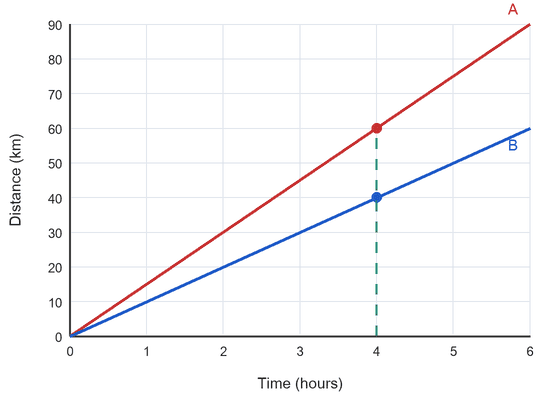
B takes how long to cover the distance that A covers in 4 hours?
- 241 mark
Question 24
Competency: Analysis & Evaluation
Assertion (A) : If 8 workers can finish a job in 15 days, then 12 workers can finish the same job in 10 days.
Reason (R) : The number of workers and the number of days needed to finish a job vary directly.
- 251 mark
Question 25
Competency: Application & Evaluation
Four shops advertise offers on pencils. (Hypothetical data.)
Shop P : 15 pencils for ₹ 90. Shop Q : 24 pencils for ₹ 150. Shop R : 18 pencils for ₹ 108. Shop S : 30 pencils for ₹ 175.
Which two shops charge the same price per pencil, so that their offers are in proportion?
- 262 marks
Question 26
Competency: Application & Evaluation
Two juice stalls make a drink from concentrate and water. Stall A mixes concentrate : water . Stall B mixes concentrate : water .
(a) Which stall's drink is stronger? Show how you compare the two ratios.
(b) How many litres of water must be added to 18 litres of Stall B's drink to make it as dilute as Stall A's drink?
- 272 marks
Question 27
Competency: Application
Two tailors, Imran and Joseph, buy cloth for school uniforms. The lengths of cloth they buy are in the ratio . The prices per metre they pay are in the ratio . In both ratios Imran's figure comes first. (Hypothetical data.)
(a) Find the ratio of the total amounts that Imran and Joseph pay.
(b) Imran pays ₹ 6,000. How much does Joseph pay?
- 282 marks
Question 28
Competency: Analysis & Evaluation
A school gives sports kits to three classes. (Hypothetical data.)
Class VII VIII IX Number of students 36 48 60 Number of kits 9 12 16 (a) For which two classes is (number of students) : (number of kits) the same ratio? Show that they form a proportion.
(b) How many kits should Class IX get so that all three classes are treated in the same ratio?
- 292 marks
Question 29
Competency: Creativity & Application
A craft teacher wants three ribbons whose lengths, in whole centimetres, are in continued proportion. All three lengths must be different and each must be less than 100 cm.
Design one set of three lengths. Show that the lengths are in continued proportion.
- 302 marks
Question 30
Competency: Evaluation
A shop prints this chart for notebooks and says, "The cost varies directly as the number of notebooks bought." (Hypothetical data.)
Number of notebooks 12 20 25 Cost (₹) 180 300 325 (a) Is the shop's claim true for all three bills? Give a reason.
(b) For which bill does the buyer get a discount? How much does the buyer save on that bill?
- 312 marks
Question 31
Competency: Application
On a map, 3 cm represents 12 km on the ground.
(a) Two towns are 8.5 cm apart on the map. What is the actual distance between them?
(b) A highway is 51 km long. What is its length on the map?
- 323 marks
Question 32
Competency: Application & Analysis
A gardener measures a creeper every Sunday. On three Sundays in a row its lengths were 64 cm, cm and 100 cm. Each week the length was multiplied by the same number, so the three lengths are in continued proportion. (Hypothetical data.)
(a) Find .
(b) The creeper keeps growing in the same way. Find its length on the next Sunday, and check that the growth factor is the same every week.
- 333 marks
Question 33
Competency: Analysis & Evaluation
In a cricket match, batter A scored 45 runs off 30 balls and batter B scored 36 runs off 20 balls. (Hypothetical data.)
(a) Write each batter's runs : balls as a ratio in lowest terms. Who scored faster? Give a reason.
(b) Batter A is still batting. If A faces 10 more balls, how many more runs must A score so that A's runs : balls becomes equal to B's ratio?
- 343 marks
Question 34
Competency: Application & Evaluation
A pizza shop sells circular pizzas. The pizza of diameter 20 cm costs ₹ 150 and the pizza of diameter 30 cm costs ₹ 300. A fair price is in the same ratio as the area of the pizza. (Hypothetical data.)
(a) Find the ratio of the areas of the two pizzas, using the duplicate ratio of the diameters.
(b) What is the fair price of the 30 cm pizza?
(c) Which pizza gives better value for money? Give a reason.
- 353 marks
Question 35
Competency: Analysis
A gardener designs rectangular flower beds, all of the same area. The table gives the length and breadth of some of the beds. (Hypothetical data.)
Length (m) 8 10 12 Breadth (m) 12 10 8 (a) Name the type of variation between and , and find and .
(b) Two of these beds have lengths in the ratio . Find the ratio of their breadths, and check your answer with two columns of the table.
- 363 marks
Question 36
Competency: Analysis & Evaluation
Meena and Zara both solve . Meena cross-multiplies. Zara uses componendo and dividendo.
(a) Solve the equation by both methods and show that the answers agree.
(b) Which method has fewer steps for this equation? Give a reason.
- 375 marks
Question 37
Competency: Analysis & Evaluation
Case study: A school hostel buys a fixed stock of rice at the start of a term. The warden notes how many days the stock lasts for different numbers of students. (Hypothetical data.)
Number of students 40 50 80 Days the stock lasts 30 24 15 10 (a) Does the number of days vary directly or inversely as the number of students? Support your answer with a calculation.
(b) Find the value of , and the number of days the stock lasts for 75 students.
(c) Zoya says, "If the number of students is cut by 25 %, the stock will last 25 % longer." Is she right? Find the correct percent.
- 384 marks
Question 38
Competency: Application & Analysis
Case study: Arjun, Bela and Chirag form a team for a quiz contest. The team wins a prize of ₹ 12,400, which the team agrees to share in the ratio of the points each member scored. Arjun's points : Bela's points , and Bela's points : Chirag's points . (Hypothetical data.)
(a) Find Arjun : Bela : Chirag as a ratio of whole numbers in lowest terms.
(b) Find each person's share of the ₹ 12,400.
(c) Chirag would like exactly ₹ 4,500. What total prize would give him this amount in the same ratio, and what would Arjun get then?
- 394 marks
Question 39
Competency: Application
Case study: Mr. Das says to his son Tarun, "The sum of our ages and the difference of our ages are in the ratio ." Mr. Das is older than Tarun. (Hypothetical data.)
(a) Find the ratio of Mr. Das's age to Tarun's age.
(b) Mr. Das is 40 years old. Find Tarun's age.
(c) After how many years will the ratio of Mr. Das's age to Tarun's age be ?
- 405 marks
Question 40
Competency: Evaluation & Creativity
Case study: Nisha runs a juice stall. Her mango drink is made from pulp, milk and syrup in the ratio by volume. The cost of each ingredient per litre is given. (Hypothetical data.)
Ingredient Pulp Milk Syrup Cost per litre (₹) 120 60 40 (a) Find the cost of making one litre of the drink. (The volumes of the ingredients add up to the volume of the drink.)
(b) She sells the drink at ₹ 110 per litre. Find her profit percent.
(c) Nisha wants a new recipe. Design a ratio pulp : milk : syrup in whole numbers, with all three ingredients used, so that pulp is at least of the drink and one litre costs at most ₹ 70. Show that your recipe meets both conditions.