
Question 551 markMCQEasy
The table, given below, shows the values of and , where is proportional (directly proportional) to .
| A | 24 | 15 | |
|---|---|---|---|
| 12 | B | 20 |
The values of A and B are :
Confirming your payment
Sign up now and get 250 free tokens.
Ratio and Proportion · Question 55 of 82
The table, given below, shows the values of and , where is proportional (directly proportional) to .
| A | 24 | 15 | |
|---|---|---|---|
| 12 | B | 20 |
The values of A and B are :
(A) A = 16 and B = 18
(B) A = 32 and B = 9
(C) A = 9 and B = 32
(D) A = 18 and B = 16
Answer: (C) A = 9 and B = 32
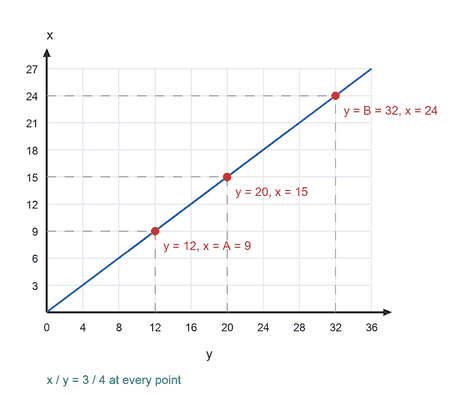
Concept: Two quantities are in direct variation (directly proportional) when one ÷ the other is the same for every pair: if one doubles, the other doubles too. So every column of the table gives the same ratio. Here is the same for every column.
Step 1 — Find the constant ratio.
The last column has both values, so it gives .
Step 2 — Find A.
In the first column, is 12 and is A, so A must be of 12.
Step 3 — Find B.
In the second column, is 24 and is B, so must be .
Cross-multiplying:
Watch out: Keep the right way up: is always of here, so is the smaller number in each column.
Why the other options are wrong:
Therefore, A = 9 and B = 32, option (C).