
Opening your dashboard
Class 10 Maths Chapter 25: Probability Solutions
75 textbook questions with step-by-step answers, free to read, for ICSE 2026-27.
Get talked through Ch 25, not just shown the answer
Reading a finished solution is not the same as being able to do it. The AI tutor takes one question at a time and works it with you, in your own words, until you can.
- Ask it out loud, in your own words
- It gives you the next step, not the answer
- Stuck on part (ii)? Start there
75 questions with solutions
1–3 marks · Mixed difficulty
The first 38 solutions are on this page. This chapter is a long one, so the rest open on their own page to keep this one quick to load.
- 11 mark
Question 1
If A and B are two complementary events then the relation between P(A) and P(B) is :
Solve with AIAnswer
(A) P(A) = P(B)
(B) P(A) + P(B) = 0
- Correct
(C) P(A) + P(B) = 1
(D) none of these
Answer: (C) P(A) + P(B) = 1
Concept: Two events are complementary when, in every trial, exactly one of them happens: together they contain every outcome, and they never happen together. If A and B are complementary, B is the same as 'not A'.
Step 1 — Use what complementary means.
Every outcome of the experiment belongs to exactly one of the two events, A or B, and to only one of them.
Step 2 — Add the two probabilities.
The probabilities of all the outcomes of an experiment add up to 1. A and B share no outcome and together contain all of them, so their probabilities add up to 1.
Step 3 — Check with an example.
When a coin is tossed, 'head' and 'tail' are complementary events, and their probabilities do add up to 1.
Watch out: Complementary events need not be equally likely. On a die, 'getting a 6' and 'not getting a 6' are complementary, but their probabilities are and .
Why the other options are wrong:
- (A) P(A) = P(B): the two probabilities are equal only when both are . For 'getting a 6' and 'not getting a 6' on a die, the probabilities are and , which are not equal.
- (B) P(A) + P(B) = 0: a probability is never negative, so the sum could be 0 only if both probabilities were 0. But one of the two events always happens, so their probabilities cannot both be 0.
- (D) none of these: option (C) gives the correct relation, so 'none of these' is wrong.
Therefore, P(A) + P(B) = 1, option (C).
- 21 mark
Question 2
Out of the vowels of English alphabet, one letter is selected at random. The probability of selecting the letter 'O' is :
Solve with AIAnswer
(A) 1
(B)
(C)
- Correct
(D)
Answer: (D)
Concept: When all the outcomes of an experiment are equally likely, the probability of an event E is P(E) = (number of outcomes favourable to E) ÷ (total number of possible outcomes). A probability always lies between 0 and 1.
Step 1 — List the possible outcomes.
The letter is chosen only from the vowels of the English alphabet: a, e, i, o and u. So there are 5 equally likely outcomes.
Step 2 — Count the favourable outcomes.
Only one of these vowels is the letter 'o', so there is 1 favourable outcome.
Step 3 — Find the probability.
Divide the number of favourable outcomes by the total number of outcomes.
Watch out: The letter is chosen from the 5 vowels only, not from all 26 letters of the alphabet.
Why the other options are wrong:
- (A) 1: a probability of 1 means a sure event. The letter chosen could also be a, e, i or u, so getting 'o' is not certain.
- (B) : is the probability of not getting 'o' (4 of the 5 vowels are not 'o').
- (C) : would be the probability if the letter were chosen from all 26 letters. Here it is chosen from the 5 vowels only.
Therefore, the probability of selecting 'O' is , option (D).
- 31 mark
Question 3
When a die is thrown, the probability of getting an even number greater than 4 is :
Solve with AIAnswer
(A)
(B)
- Correct
(C)
(D)
Answer: (C)
Concept: When all the outcomes of an experiment are equally likely, the probability of an event E is P(E) = (number of outcomes favourable to E) ÷ (total number of possible outcomes). A probability always lies between 0 and 1.
Step 1 — List the possible outcomes.
A die has 6 faces, numbered 1, 2, 3, 4, 5 and 6, and each face is equally likely to come up. So there are 6 possible outcomes.
Step 2 — Find the favourable outcomes.
The number must be even and greater than 4. The numbers greater than 4 are 5 and 6, and of these only 6 is even. So there is just 1 favourable outcome.
Step 3 — Find the probability.
Divide the number of favourable outcomes by the total number of outcomes.
Watch out: Both conditions must hold. 5 is greater than 4 but it is odd, so it does not count.
Why the other options are wrong:
- (A) : = counts both 5 and 6, that is all the numbers greater than 4. But 5 is odd.
- (B) : = is the probability of a number not greater than 4 (1, 2, 3 or 4).
- (D) : is greater than 1, and no probability can be greater than 1.
Therefore, the probability is , option (C).
- 41 mark
Question 4
If a letter is drawn from the letters of English alphabet, then the probability, that it is a letter of the word 'DELHI' is :
Solve with AIAnswer
(A)
- Correct
(B)
(C)
(D)
Answer: (B)
Concept: When all the outcomes of an experiment are equally likely, the probability of an event E is P(E) = (number of outcomes favourable to E) ÷ (total number of possible outcomes). A probability always lies between 0 and 1.
Step 1 — Count all the possible outcomes.
The letter is drawn from the whole English alphabet, which has 26 letters. So there are 26 equally likely outcomes.
Step 2 — Count the favourable outcomes.
The word 'DELHI' is made of the letters D, E, L, H and I. All 5 are different letters, so 5 outcomes are favourable.
Step 3 — Find the probability.
Divide the number of favourable outcomes by the total number of outcomes.
Watch out: The total is the 26 letters of the alphabet, not the 5 letters of the word.
Why the other options are wrong:
- (A) : divides by the 5 letters of DELHI instead of the 26 letters of the alphabet.
- (C) : is the probability of drawing one particular letter, such as D. Here any of the 5 letters of DELHI is favourable.
- (D) : is the probability that the letter is not in DELHI (26 − 5 = 21 letters).
Therefore, the probability is , option (B).
- 51 mark
Question 5
A card is selected at random from a well-shuffled deck of 52 cards. The probability of it being a face card is :
Solve with AIAnswer
- Correct
(A)
(B)
(C)
(D)
Answer: (A)
Concept: When all the outcomes of an experiment are equally likely, the probability of an event E is P(E) = (number of outcomes favourable to E) ÷ (total number of possible outcomes). A probability always lies between 0 and 1.
Step 1 — Recall the pack of cards.
A pack of 52 playing cards has 4 suits of 13 cards each. Spades (♠) and clubs (♣) are black; hearts (♥) and diamonds (♦) are red. So there are 26 black and 26 red cards. Each suit has an ace, the number cards 2 to 10 and three face cards (king, queen and jack), so the pack has 4 × 3 = 12 face cards and 4 cards of each number.
Step 2 — Find the probability.
There are 12 favourable cards (the face cards) out of 52 equally likely cards. We divide and then cancel by 4.
Watch out: The face cards are only the kings, queens and jacks. Aces are not face cards.
Why the other options are wrong:
- (B) : = counts the 4 aces as well. Aces are not face cards, so there are only 12 face cards.
- (C) : = would need 24 face cards, but a pack has only 12.
- (D) : = would need 32 face cards, but a pack has only 12.
Therefore, the probability of a face card is , option (A).
- 63 marks
Question 6
A coin is tossed once. Find the probability of :
(i) getting a tail.
(ii) not getting a tail.
Solve with AIWritten solution
Solution:
Concept: When all the outcomes of an experiment are equally likely, the probability of an event E is P(E) = (number of outcomes favourable to E) ÷ (total number of possible outcomes). A probability always lies between 0 and 1. For 'not E' we can also use P(not E) = 1 − P(E), because E and 'not E' together cover every outcome and cannot happen together.
Step 1 — List the possible outcomes.
A coin shows either a head (H) or a tail (T), and both are equally likely. So there are 2 possible outcomes.
Step 2 — (i) Getting a tail.
Only one outcome, T, is favourable.
Step 3 — (ii) Not getting a tail.
'Not getting a tail' is the complement of 'getting a tail', so we subtract the answer of part (i) from 1.
This agrees with common sense: not getting a tail means getting a head, which is 1 outcome out of 2.
Watch out: A coin has only two faces, so 'not a tail' is the same as 'a head'.
Therefore, (i) P(tail) = ; (ii) P(not a tail) = .
- 73 marks
Question 7
A bag contains 3 white, 5 black and 2 red balls, all of the same shape and size. A ball is drawn from the bag without looking into it, find the probability that the ball drawn is :
(i) a black ball.
(ii) a red ball.
(iii) a white ball.
(iv) not a red ball.
(v) not a black ball.
Solve with AIWritten solution
Solution:
Concept: When all the outcomes of an experiment are equally likely, the probability of an event E is P(E) = (number of outcomes favourable to E) ÷ (total number of possible outcomes). A probability always lies between 0 and 1. For 'not E' we can also use P(not E) = 1 − P(E), because E and 'not E' together cover every outcome and cannot happen together.
Step 1 — Count all the balls.
Every ball is equally likely to be drawn, so the total number of outcomes is the number of balls in the bag.
Step 2 — (i) A black ball.
5 of the 10 balls are black.
Step 3 — (ii) A red ball.
2 of the 10 balls are red.
Step 4 — (iii) A white ball.
3 of the 10 balls are white. The fraction is already in its lowest terms.
Step 5 — (iv) Not a red ball.
'Not red' is the complement of 'red', so we subtract the answer of part (ii) from 1.
As a check, the balls that are not red are the 3 white and 5 black ones, that is 8 balls, and = .
Step 6 — (v) Not a black ball.
'Not black' is the complement of 'black', so we subtract the answer of part (i) from 1.
Watch out: 'not red' includes both the white and the black balls.
Therefore, (i) ; (ii) ; (iii) ; (iv) ; (v) .
- 83 marks
Question 8
In a single throw of a dice, find the probability of getting a number :
(i) greater than 4.
(ii) less than or equal to 4.
(iii) not greater than 4.
Solve with AIWritten solution
Solution:
Concept: When all the outcomes of an experiment are equally likely, the probability of an event E is P(E) = (number of outcomes favourable to E) ÷ (total number of possible outcomes). A probability always lies between 0 and 1.
Step 1 — List the possible outcomes.
A die has 6 faces, numbered 1, 2, 3, 4, 5 and 6, and each face is equally likely to come up. So there are 6 possible outcomes.
Step 2 — (i) A number greater than 4.
The numbers greater than 4 are 5 and 6, so 2 outcomes are favourable.
Step 3 — (ii) A number less than or equal to 4.
The numbers less than or equal to 4 are 1, 2, 3 and 4, so 4 outcomes are favourable.
Step 4 — (iii) A number not greater than 4.
A number that is not greater than 4 must be less than or equal to 4. So this is the same event as in part (ii): the outcomes 1, 2, 3 and 4.
It is also the complement of part (i), and 1 − = gives the same answer.
Watch out: 'less than or equal to 4' includes 4 itself.
Therefore, (i) ; (ii) ; (iii) .
- 93 marks
Question 9
From a well-shuffled deck of 52 playing-cards, one card is drawn. Find the probability that the card drawn will :
(i) be a black card.
(ii) not be a red card.
(iii) be a red card.
(iv) be a face card.
(v) be a face card of red colour.
Solve with AIWritten solution
Solution:
Concept: When all the outcomes of an experiment are equally likely, the probability of an event E is P(E) = (number of outcomes favourable to E) ÷ (total number of possible outcomes). A probability always lies between 0 and 1. For 'not E' we can also use P(not E) = 1 − P(E), because E and 'not E' together cover every outcome and cannot happen together.
Step 1 — Recall the pack of cards.
A pack of 52 playing cards has 4 suits of 13 cards each. Spades (♠) and clubs (♣) are black; hearts (♥) and diamonds (♦) are red. So there are 26 black and 26 red cards. Each suit has an ace, the number cards 2 to 10 and three face cards (king, queen and jack), so the pack has 4 × 3 = 12 face cards and 4 cards of each number. One card is drawn, so there are 52 equally likely outcomes.
Step 2 — (i) A black card.
26 of the 52 cards are black.
Step 3 — (ii) Not a red card.
'Not red' is the complement of 'red'. Every card is either red or black, so a card that is not red is black. We use the complement rule with P(red card) = , since 26 of the 52 cards are red.
Step 4 — (iii) A red card.
26 of the 52 cards are red.
Step 5 — (iv) A face card.
There are 12 face cards (4 kings, 4 queens and 4 jacks).
Step 6 — (v) A face card of red colour.
The red suits are hearts and diamonds, and each has 3 face cards (king, queen and jack). So there are 2 × 3 = 6 red face cards.
Watch out: A 'red face card' must be red and a face card: only the kings, queens and jacks of hearts and diamonds.
Therefore, (i) ; (ii) ; (iii) ; (iv) ; (v) .
- 103 marks
Question 10
(i) If A and B are two complementary events then what is the relation between P(A) and P(B) ?
(ii) If the probability of happening of an event A is 0·46. What will be the probability of not happening of the event A ?
Solve with AIWritten solution
Solution:
Concept: An event E and the event 'not E' are complementary: in every trial exactly one of them happens. So P(E) + P(not E) = 1, which gives P(not E) = 1 − P(E).
Step 1 — (i) The relation for complementary events.
If A and B are complementary, every outcome belongs to exactly one of them. The probabilities of all the outcomes add up to 1, so the two probabilities add up to 1.
Step 2 — (ii) Name the two events.
'A does not happen' is the complement of 'A happens', so its probability is 1 − P(A). We are given P(A) = 0·46.
Step 3 — (ii) Subtract from 1.
Now subtract the given probability from 1.
Watch out: Subtract from 1, not from 100: probabilities written as decimals lie between 0 and 1.
Therefore, (i) P(A) + P(B) = 1; (ii) the probability that A does not happen is 0·54.
- 113 marks
Question 11
In a T.T. match between Geeta and Ritu, the probability of the winning of Ritu is 0·73. Find the probability of :
(i) winning of Geeta.
(ii) not winning of Ritu.
Solve with AIWritten solution
Solution:
Concept: An event E and the event 'not E' are complementary: in every trial exactly one of them happens. So P(E) + P(not E) = 1, which gives P(not E) = 1 − P(E).
Step 1 — See which events are complementary.
A table-tennis match cannot end in a draw, so one of the two players must win. Geeta wins exactly when Ritu does not win. So 'Geeta wins' and 'Ritu wins' are complementary events, and P(Ritu wins) = 0·73.
Step 2 — (i) Geeta wins.
Geeta wins exactly when Ritu does not, so we subtract P(Ritu wins) from 1.
Step 3 — (ii) Ritu does not win.
'Ritu does not win' is the complement of 'Ritu wins'. It is the same event as 'Geeta wins', so it has the same probability.
Watch out: 'Ritu does not win' and 'Geeta wins' are the same event here, so parts (i) and (ii) must give the same answer.
Therefore, (i) P(Geeta wins) = 0·27; (ii) P(Ritu does not win) = 0·27.
- 123 marks
Question 12
In a race between Mahesh and John; the probability that John will lose the race is 0·54. Find the probability of :
(i) winning of Mahesh.
(ii) winning of John.
Solve with AIWritten solution
Solution:
Concept: An event E and the event 'not E' are complementary: in every trial exactly one of them happens. So P(E) + P(not E) = 1, which gives P(not E) = 1 − P(E).
Step 1 — See how the events are linked.
Only Mahesh and John run the race, and one of them wins (no tie). So John loses exactly when Mahesh wins, and 'John wins' is the complement of 'John loses'. We are given P(John loses) = 0·54.
Step 2 — (i) Mahesh wins.
Mahesh wins exactly when John loses, so the two events have the same probability.
Step 3 — (ii) John wins.
'John wins' is the complement of 'John loses', so we subtract 0·54 from 1.
Watch out: The given 0·54 is the probability that John loses, which is the probability that Mahesh wins. Do not take it as John's chance of winning.
Therefore, (i) P(Mahesh wins) = 0·54; (ii) P(John wins) = 0·46.
- 133 marks
Question 13
(i) Write the probability of a sure event.
(ii) Write the probability of an event which is impossible.
(iii) For an event E, write a relation representing the range of values of P(E).
Solve with AIWritten solution
Solution:
Concept: When all the outcomes of an experiment are equally likely, the probability of an event E is P(E) = (number of outcomes favourable to E) ÷ (total number of possible outcomes). A probability always lies between 0 and 1.
Step 1 — (i) A sure event.
A sure event happens in every trial, so every outcome is favourable to it and the number of favourable outcomes equals the total number of outcomes n.
Step 2 — (ii) An impossible event.
An impossible event never happens, so no outcome is favourable to it.
Step 3 — (iii) The range of P(E).
For any event E, the number of favourable outcomes is at least 0 (impossible event) and at most n (sure event). Dividing by n, the probability lies from 0 up to 1.
Watch out: A probability can never be negative and can never be more than 1.
Therefore, (i) 1; (ii) 0; (iii) 0 ≤ P(E) ≤ 1.
- 143 marks
Question 14
In a single throw of a dice, find the probability of getting :
(i) 5
(ii) 8
(iii) a number less than 8.
(iv) a prime number.
Solve with AIWritten solution
Solution:
Concept: When all the outcomes of an experiment are equally likely, the probability of an event E is P(E) = (number of outcomes favourable to E) ÷ (total number of possible outcomes). A probability always lies between 0 and 1.
Step 1 — List the possible outcomes.
A die has 6 faces, numbered 1, 2, 3, 4, 5 and 6, and each face is equally likely to come up. So there are 6 possible outcomes.
Step 2 — (i) Getting 5.
Only one face shows 5.
Step 3 — (ii) Getting 8.
No face of a die shows 8, so no outcome is favourable. It is an impossible event.
Step 4 — (iii) A number less than 8.
Every face (1 to 6) is less than 8, so all 6 outcomes are favourable. It is a sure event.
Step 5 — (iv) A prime number.
A prime number has exactly two factors, 1 and itself. On a die the primes are 2, 3 and 5 (1 is not prime). So 3 outcomes are favourable.
Watch out: 1 is not a prime number, because it has only one factor.
Therefore, (i) ; (ii) 0; (iii) 1; (iv) .
- 153 marks
Question 15
A dice is thrown once. Find the probability of getting :
(i) an even number.
(ii) a number between 3 and 8.
(iii) an even number or a multiple of 3.
Solve with AIWritten solution
Solution:
Concept: When all the outcomes of an experiment are equally likely, the probability of an event E is P(E) = (number of outcomes favourable to E) ÷ (total number of possible outcomes). A probability always lies between 0 and 1.
Step 1 — List the possible outcomes.
A die has 6 faces, numbered 1, 2, 3, 4, 5 and 6, and each face is equally likely to come up. So there are 6 possible outcomes.
Step 2 — (i) An even number.
The even numbers on a die are 2, 4 and 6, so 3 outcomes are favourable.
Step 3 — (ii) A number between 3 and 8.
'Between 3 and 8' means greater than 3 and less than 8. On a die these numbers are 4, 5 and 6 (there is no 7 or 8), so 3 outcomes are favourable.
Step 4 — (iii) An even number or a multiple of 3.
The even numbers are 2, 4, 6 and the multiples of 3 are 3, 6. Together they are 2, 3, 4 and 6; the number 6 is in both lists, so it is counted only once. That gives 4 favourable outcomes.
Watch out: 'between a and b' does not include a and b themselves. Also, in an 'or' event, count a number that belongs to both parts (here 6) only once.
Therefore, (i) ; (ii) ; (iii) .
- 163 marks
Question 16
Which of the following cannot be the probability of an event ?
(i) (ii) 2·7 (iii) 43% (iv) –0·6 (v) –3·2 (vi) 0·35
Solve with AIWritten solution
Solution:
Concept: The probability of any event E satisfies 0 ≤ P(E) ≤ 1: it can never be negative and never be more than 1.
Step 1 — Write every value as a decimal.
To compare each value with 0 and 1, write it as a decimal.
Value As a decimal Between 0 and 1? (i) 0·6 Yes (ii) 2·7 2·7 No, it is more than 1 (iii) 43% 0·43 Yes (iv) –0·6 –0·6 No, it is negative (v) –3·2 –3·2 No, it is negative (vi) 0·35 0·35 Yes Step 2 — Pick out the values that break the rule.
A value more than 1 or less than 0 cannot be a probability. These are 2·7 (more than 1), and –0·6 and –3·2 (both negative). The values , 43% and 0·35 all lie between 0 and 1, so they can be probabilities.
Watch out: A percentage such as 43% means = 0·43, which is between 0 and 1, so it is allowed.
Therefore, (ii) 2·7, (iv) –0·6 and (v) –3·2 cannot be the probability of an event.
- 173 marks
Question 17
A bag contains six identical black balls. A child withdraws one ball from the bag without looking into it. What is the probability that he takes out :
(i) a white ball ? (ii) a black ball ?
Solve with AIWritten solution
Solution:
Concept: When all the outcomes of an experiment are equally likely, the probability of an event E is P(E) = (number of outcomes favourable to E) ÷ (total number of possible outcomes). A probability always lies between 0 and 1. An impossible event has probability 0 and a sure event has probability 1.
Step 1 — Count the possible outcomes.
The bag holds 6 balls and any one of them can be taken out, so there are 6 equally likely outcomes. All 6 balls are black.
Step 2 — (i) A white ball.
There is no white ball in the bag, so no outcome is favourable. Taking out a white ball is an impossible event.
Step 3 — (ii) A black ball.
Every ball is black, so all 6 outcomes are favourable. Taking out a black ball is a sure event.
Therefore, (i) P(white ball) = 0; (ii) P(black ball) = 1.
- 183 marks
Question 18
A single letter is selected at random from the word 'Probability'. Find the probability that it is a vowel.
Solve with AIWritten solution
Solution:
Concept: When all the outcomes of an experiment are equally likely, the probability of an event E is P(E) = (number of outcomes favourable to E) ÷ (total number of possible outcomes). A probability always lies between 0 and 1.
Step 1 — Count all the letters.
Write the word out letter by letter: P, R, O, B, A, B, I, L, I, T, Y. There are 11 letters, and each one is equally likely to be selected.
Step 2 — Count the vowels.
The vowels in the word are O, A, I and I. The letter I appears twice, and each of the two I's is a separate letter that can be selected, so there are 4 favourable outcomes.
Step 3 — Find the probability.
Divide the number of vowels by the number of letters.
Watch out: Count repeated letters each time they appear (the two I's and the two B's are all letters of the word), and do not count Y as a vowel.
Therefore, the probability that the letter is a vowel is .
- 193 marks
Question 19
Ramesh chooses a date at random in January for a party (see the following figure).
Mon Tue Wed Thu Fri Sat Sun 1 2 3 4 5 6 7 8 9 10 11 12 13 14 15 16 17 18 19 20 21 22 23 24 25 26 27 28 29 30 31 Find the probability that he chooses :
(i) a Wednesday (ii) a Friday
(iii) a Tuesday or a Saturday.
Solve with AIWritten solution
Solution:
Concept: When all the outcomes of an experiment are equally likely, the probability of an event E is P(E) = (number of outcomes favourable to E) ÷ (total number of possible outcomes). A probability always lies between 0 and 1.
Step 1 — Count all the possible outcomes.
Ramesh can choose any of the 31 dates of January, and each date is equally likely. So there are 31 outcomes.
Step 2 — (i) A Wednesday.
Read the Wednesday column of the calendar: 1, 8, 15, 22 and 29. That is 5 dates.
Step 3 — (ii) A Friday.
Read the Friday column: 3, 10, 17, 24 and 31. That is 5 dates.
Step 4 — (iii) A Tuesday or a Saturday.
The Tuesdays are 7, 14, 21 and 28 (4 dates) and the Saturdays are 4, 11, 18 and 25 (4 dates). No date is both, so there are 4 + 4 = 8 favourable dates.
Watch out: Count the dates in each column from the calendar. Some weekdays occur 5 times in this January and others only 4 times.
Therefore, (i) ; (ii) ; (iii) .
- 201 mark
Question 20
A card is drawn from a well-shuffled pack of 52 cards. The probability of the card drawn to be king and jack is :
Solve with AIAnswer
(A) 1
- Correct
(B) 0
(C)
(D)
Answer: (B) 0
Concept: When all the outcomes of an experiment are equally likely, the probability of an event E is P(E) = (number of outcomes favourable to E) ÷ (total number of possible outcomes). A probability always lies between 0 and 1. An event that can never happen is an impossible event; its probability is 0.
Step 1 — Read the event carefully.
Only one card is drawn. The event asks for that one card to be a king and a jack at the same time.
Step 2 — Count the favourable outcomes.
No card in the pack is both a king and a jack, so no outcome is favourable. The event is impossible.
Watch out: 'king and jack' is not the same as 'king or jack'. 'King or jack' has 8 favourable cards and probability = , but that is not what is asked.
Why the other options are wrong:
- (A) 1: a probability of 1 means a sure event, but a single card can never be both a king and a jack.
- (C) : is, for example, the probability of drawing a red card. It has nothing to do with this event, which has no favourable card.
- (D) : = is the probability of drawing a face card, not of a card that is a king and a jack at once.
Therefore, the probability is 0, option (B).
- 211 mark
Question 21
The probability that a non-leap year has 53 Sundays is :
Solve with AIAnswer
(A) 1
- Correct
(B)
(C)
(D)
Answer: (B)
Concept: When all the outcomes of an experiment are equally likely, the probability of an event E is P(E) = (number of outcomes favourable to E) ÷ (total number of possible outcomes). A probability always lies between 0 and 1.
Step 1 — Split the year into whole weeks.
A non-leap year has 365 days. Dividing by 7 shows how many complete weeks it holds and how many days are left over.
Step 2 — Count the Sundays in the whole weeks.
Each of the 52 complete weeks contains exactly one Sunday, so every non-leap year has at least 52 Sundays.
Step 3 — Look at the extra day.
The year has a 53rd Sunday only if the 1 extra day is a Sunday. That extra day can be any of the 7 days of the week (Monday, Tuesday, …, Sunday), each equally likely, and only one of them is Sunday.
Watch out: The equally likely outcomes are the 7 days of the week that the extra day can be, not the 365 days of the year.
Why the other options are wrong:
- (A) 1: a probability of 1 would mean every non-leap year has 53 Sundays. That happens only when the extra day is a Sunday.
- (C) : treats the 365 dates as the outcomes. What decides the 53rd Sunday is only which of the 7 weekdays the extra day falls on.
- (D) : would need 7 favourable outcomes out of 365, but the year's 52 full weeks are fixed; only the 1 extra day can vary, and it has 7 equally likely weekdays.
Therefore, the probability that a non-leap year has 53 Sundays is , option (B).
- 221 mark
Question 22
Out of 800 identical articles some are selected and remaining are rejected. If the probability of an article to be rejected is 0·425; the number of rejected articles is :
Solve with AIAnswer
- Correct
(A) 340
(B) 800
(C) 430
(D) 560
Answer: (A) 340
Concept: If P(E) = (number of favourable outcomes) ÷ (total number of outcomes), then the number of favourable outcomes = P(E) × (total number of outcomes).
Step 1 — Write the rule for the rejected articles.
Here the 'favourable' outcomes are the rejected articles, and the total is the 800 articles. So the number of rejected articles is the probability of rejection times 800.
Step 2 — Multiply.
Put in the given probability 0·425.
Check: The probability given by 340 rejected articles out of 800 is the one in the question.
Watch out: Multiply the probability by the total number of articles; do not subtract it from anything.
Why the other options are wrong:
- (B) 800: 800 is the total number of articles. All 800 would be rejected only if the probability of rejection were 1.
- (C) 430: 430 rejected articles out of 800 would give a probability of 430 ÷ 800 = 0·5375, not 0·425.
- (D) 560: 560 rejected articles out of 800 would give a probability of 560 ÷ 800 = 0·7, not 0·425.
Therefore, 340 articles are rejected, option (A).
- 231 mark
Question 23
A bag contains 24 balls of which 4 are red, 8 are white and remaining are blue. A ball is drawn at random, the probability of it to be blue is :
Solve with AIAnswer
- Correct
(A) 0·5
(B) 1
(C)
(D) 2
Answer: (A) 0·5
Concept: When all the outcomes of an experiment are equally likely, the probability of an event E is P(E) = (number of outcomes favourable to E) ÷ (total number of possible outcomes). A probability always lies between 0 and 1.
Step 1 — Find the number of blue balls.
The balls that are not red or white are blue, so subtract the red and white balls from the total.
Step 2 — Find the probability.
12 of the 24 balls are blue, and each ball is equally likely to be drawn.
As a decimal, = 0·5.
Watch out: First find how many balls are blue; the question gives only the red and white numbers.
Why the other options are wrong:
- (B) 1: a probability of 1 would mean every ball is blue, but only 12 of the 24 balls are blue.
- (C) : = is the probability of drawing a white ball.
- (D) 2: 2 is greater than 1, and no probability can be greater than 1.
Therefore, the probability of a blue ball is 0·5, option (A).
- 241 mark
Question 24
An integer is chosen from integers between 0 and 51, the probability of it to be divisible by 6 is :
Solve with AIAnswer
(A)
- Correct
(B)
(C)
(D)
Answer: (B)
Concept: When all the outcomes of an experiment are equally likely, the probability of an event E is P(E) = (number of outcomes favourable to E) ÷ (total number of possible outcomes). A probability always lies between 0 and 1.
Step 1 — Count the integers to choose from.
'Between 0 and 51' does not include 0 or 51, so the integers are 1, 2, 3, …, 50. There are 50 equally likely outcomes.
Step 2 — Count the multiples of 6.
The multiples of 6 from 1 to 50 are 6, 12, 18, 24, 30, 36, 42 and 48. The next one, 54, is too big. So there are 8 favourable outcomes.
Step 3 — Find the probability.
Divide and cancel by 2.
Watch out: 'between a and b' does not include a and b themselves. So the integers are 1 to 50, which is 50 numbers.
Why the other options are wrong:
- (A) : = would need only 6 multiples of 6, but there are 8 of them from 1 to 50.
- (C) : is the probability of choosing one particular integer, not any of the 8 multiples of 6.
- (D) : = would need only 2 multiples of 6, but there are 8.
Therefore, the probability is , option (B).
- 253 marks
Question 25
Nine cards (identical in all respects) are numbered 2 to 10. A card is selected from them at random. Find the probability that the card selected will be :
(i) an even number.
(ii) a multiple of 3.
(iii) an even number and a multiple of 3.
(iv) an even number or a multiple of 3.
Solve with AIWritten solution
Solution:
Concept: When all the outcomes of an experiment are equally likely, the probability of an event E is P(E) = (number of outcomes favourable to E) ÷ (total number of possible outcomes). A probability always lies between 0 and 1.
Step 1 — List the possible outcomes.
The cards are numbered 2, 3, 4, 5, 6, 7, 8, 9 and 10. There are 9 cards and each is equally likely to be selected.
Step 2 — (i) An even number.
The even numbers are 2, 4, 6, 8 and 10, which is 5 cards.
Step 3 — (ii) A multiple of 3.
The multiples of 3 are 3, 6 and 9, which is 3 cards.
Step 4 — (iii) An even number and a multiple of 3.
The number must be in both lists. Only 6 is even and also a multiple of 3, so there is 1 card.
Step 5 — (iv) An even number or a multiple of 3.
The number may be in either list. Put the two lists together and count 6 only once: 2, 3, 4, 6, 8, 9 and 10, which is 7 cards. Using counts, 5 + 3 − 1 = 7.
Watch out: 'and' means in both lists; 'or' means in at least one list, with the common card 6 counted once.
Therefore, (i) ; (ii) ; (iii) ; (iv) .
- 263 marks
Question 26
Hundred identical cards are numbered from 1 to 100. The cards are well shuffled and then a card is drawn. Find the probability that the number on the card drawn is :
(i) a multiple of 5. (ii) a multiple of 6.
(iii) between 40 and 60. (iv) greater than 85.
(v) less than 48.
Solve with AIWritten solution
Solution:
Concept: When all the outcomes of an experiment are equally likely, the probability of an event E is P(E) = (number of outcomes favourable to E) ÷ (total number of possible outcomes). A probability always lies between 0 and 1.
Step 1 — Count the possible outcomes.
The cards are numbered 1 to 100 and each is equally likely to be drawn, so there are 100 outcomes.
Step 2 — (i) A multiple of 5.
The multiples of 5 are 5, 10, 15, …, 100. Since 100 ÷ 5 = 20, there are 20 of them.
Step 3 — (ii) A multiple of 6.
The multiples of 6 are 6, 12, 18, …, 96. Since 6 × 16 = 96 and 6 × 17 = 102 is too big, there are 16 of them.
Step 4 — (iii) Between 40 and 60.
'Between 40 and 60' means 41, 42, …, 59; 40 and 60 are not included. The count is 59 − 41 + 1 = 19.
Step 5 — (iv) Greater than 85.
The numbers greater than 85 are 86, 87, …, 100. The count is 100 − 86 + 1 = 15.
Step 6 — (v) Less than 48.
The numbers less than 48 are 1, 2, …, 47, which is 47 numbers (48 itself is not included).
Watch out: 'between a and b' does not include a and b themselves. Likewise 'greater than 85' starts at 86 and 'less than 48' stops at 47.
Therefore, (i) ; (ii) ; (iii) ; (iv) ; (v) .
- 273 marks
Question 27
From 25 identical cards, numbered 1, 2, 3, 4, 5, ....., 24, 25; one card is drawn at random. Find the probability that the number on the card drawn is a multiple of :
(i) 3 (ii) 5 (iii) 3 and 5 (iv) 3 or 5.
Solve with AIWritten solution
Solution:
Concept: When all the outcomes of an experiment are equally likely, the probability of an event E is P(E) = (number of outcomes favourable to E) ÷ (total number of possible outcomes). A probability always lies between 0 and 1.
Step 1 — Count the possible outcomes.
The cards are numbered 1 to 25 and each is equally likely, so there are 25 outcomes.
Step 2 — (i) A multiple of 3.
The multiples of 3 are 3, 6, 9, 12, 15, 18, 21 and 24, which is 8 numbers.
Step 3 — (ii) A multiple of 5.
The multiples of 5 are 5, 10, 15, 20 and 25, which is 5 numbers.
Step 4 — (iii) A multiple of 3 and 5.
A number that is a multiple of both 3 and 5 is a multiple of 3 × 5 = 15. From 1 to 25 that is only 15.
Step 5 — (iv) A multiple of 3 or 5.
Add the two counts and subtract the number counted twice (15 is in both lists).
They are 3, 5, 6, 9, 10, 12, 15, 18, 20, 21, 24 and 25.
Watch out: In an 'or' event, count an outcome that belongs to both parts only once. Here 15 is a multiple of both 3 and 5.
Therefore, (i) ; (ii) ; (iii) ; (iv) .
- 283 marks
Question 28
A dice is thrown once. Find the probability of getting a number :
(i) less than 3.
(ii) greater than or equal to 4.
(iii) less than 8.
(iv) greater than 6.
Solve with AIWritten solution
Solution:
Concept: When all the outcomes of an experiment are equally likely, the probability of an event E is P(E) = (number of outcomes favourable to E) ÷ (total number of possible outcomes). A probability always lies between 0 and 1.
Step 1 — List the possible outcomes.
A die has 6 faces, numbered 1, 2, 3, 4, 5 and 6, and each face is equally likely to come up. So there are 6 possible outcomes.
Step 2 — (i) Less than 3.
The numbers less than 3 are 1 and 2, so 2 outcomes are favourable.
Step 3 — (ii) Greater than or equal to 4.
The numbers 4, 5 and 6 are greater than or equal to 4, so 3 outcomes are favourable.
Step 4 — (iii) Less than 8.
Every face, 1 to 6, is less than 8. All 6 outcomes are favourable, so it is a sure event.
Step 5 — (iv) Greater than 6.
No face of a die is greater than 6, so no outcome is favourable. It is an impossible event.
Watch out: 'greater than or equal to 4' includes 4 itself.
Therefore, (i) ; (ii) ; (iii) 1; (iv) 0.
- 293 marks
Question 29
A book contains 85 pages. A page is chosen at random. What is the probability that the sum of the digits on the page is 8 ?
Solve with AIWritten solution
Solution:
Concept: When all the outcomes of an experiment are equally likely, the probability of an event E is P(E) = (number of outcomes favourable to E) ÷ (total number of possible outcomes). A probability always lies between 0 and 1.
Step 1 — Count the possible outcomes.
The pages are numbered 1 to 85 and each page is equally likely to be chosen, so there are 85 outcomes.
Step 2 — Find the one-digit page.
Among the pages 1 to 9, the digit sum is the number itself, so only page 8 has digit sum 8.
Step 3 — Find the two-digit pages.
For a two-digit page, the tens digit and the units digit must add up to 8. Tens digit 1 needs units digit 7, tens digit 2 needs units digit 6, and so on down to tens digit 8 with units digit 0. This gives 17, 26, 35, 44, 53, 62, 71 and 80, and all of them are within the 85 pages. That is 8 pages.
Step 4 — Count all the favourable pages.
Together the pages are 8, 17, 26, 35, 44, 53, 62, 71 and 80.
Step 5 — Find the probability.
Divide the number of favourable pages by the number of pages. The fraction does not simplify.
Watch out: Do not forget the one-digit page 8, and stop at the last page, 85.
Therefore, the probability that the sum of the digits is 8 is .
- 303 marks
Question 30
A pair of dice is thrown. Find the probability of getting a sum of 10 or more, if 5 appears on the first dice.
Solve with AIWritten solution
Solution:
Concept: When all the outcomes of an experiment are equally likely, the probability of an event E is P(E) = (number of outcomes favourable to E) ÷ (total number of possible outcomes). A probability always lies between 0 and 1.
Step 1 — Count all the possible outcomes.
Each of the 6 faces of the first die can come with each of the 6 faces of the second die. So there are 6 × 6 = 36 equally likely outcomes, written as ordered pairs (first die, second die). (3, 5) and (5, 3) are different outcomes.
Step 2 — Find the favourable outcomes.
We need the first die to show 5 and the sum to be 10 or more. With 5 on the first die, the second die must show at least 10 − 5 = 5, that is 5 or 6. So the favourable outcomes are (5, 5) and (5, 6), which is 2 outcomes.
Step 3 — Find the probability.
Divide by all 36 outcomes, as the book's own hint for this question does.
Watch out: '10 or more' includes the sum 10 itself, so (5, 5) counts.
Note: The book prints a hint for this question: total cases 6 × 6 = 36 and favourable cases (5, 5) and (5, 6). This reads the question as 'the first die shows 5 and the sum is 10 or more'. If the words 'if 5 appears on the first dice' are read as 'given that the first die shows 5', only the 6 throws (5, 1) to (5, 6) count, and the answer would be = .
Therefore, the probability is .
- 313 marks
Question 31
If two coins are tossed once, what is the probability of getting :
(i) 2 heads ?
(ii) at least one head ?
(iii) both heads or both tails ?
Solve with AIWritten solution
Solution:
Concept: When all the outcomes of an experiment are equally likely, the probability of an event E is P(E) = (number of outcomes favourable to E) ÷ (total number of possible outcomes). A probability always lies between 0 and 1.
Step 1 — List the possible outcomes.
Each coin can show a head (H) or a tail (T), so two coins give 2 × 2 = 4 equally likely outcomes: HH, HT, TH and TT. HT (head on the first coin, tail on the second) and TH are different outcomes.
Step 2 — (i) 2 heads.
Only HH has two heads.
Step 3 — (ii) At least one head.
'At least one head' means one head or two heads: HH, HT and TH, which is 3 outcomes.
Step 4 — (iii) Both heads or both tails.
The favourable outcomes are HH and TT, which is 2 outcomes.
Watch out: HT and TH are two different outcomes; listing only HH, 'one head' and TT gives 3 outcomes that are not equally likely.
Therefore, (i) ; (ii) ; (iii) .
- 323 marks
Question 32
Two dice are rolled together. Find the probability of getting :
(i) a total of at least 10.
(ii) a multiple of 2 on one die and an odd number on the other die.
Solve with AIWritten solution
Solution:
Concept: When all the outcomes of an experiment are equally likely, the probability of an event E is P(E) = (number of outcomes favourable to E) ÷ (total number of possible outcomes). A probability always lies between 0 and 1.
Step 1 — Count all the possible outcomes.
Each of the 6 faces of the first die can come with each of the 6 faces of the second die. So there are 6 × 6 = 36 equally likely outcomes, written as ordered pairs (first die, second die). (3, 5) and (5, 3) are different outcomes. The table shows the sum for every outcome.
First die \ Second die 1 2 3 4 5 6 1 2 3 4 5 6 7 2 3 4 5 6 7 8 3 4 5 6 7 8 9 4 5 6 7 8 9 10 5 6 7 8 9 10 11 6 7 8 9 10 11 12 Step 2 — (i) A total of at least 10.
'At least 10' means a sum of 10, 11 or 12. From the table these are (4, 6), (5, 5), (6, 4), (5, 6), (6, 5) and (6, 6), which is 6 outcomes.
Step 3 — (ii) Count the outcomes with an even number first.
A multiple of 2 is an even number: 2, 4 or 6. The odd numbers are 1, 3 and 5. If the first die is even and the second is odd, there are 3 choices for each die.
Step 4 — (ii) Count the outcomes with an odd number first.
The even number may also be on the second die, so we count (odd, even) in the same way. No number is both even and odd, so no outcome is counted twice.
Step 5 — (ii) Find the probability.
Add the two groups and divide by 36.
Watch out: 'on one die … on the other' allows either die to be the even one, so count both orders.
Therefore, (i) ; (ii) .
- 333 marks
Question 33
A card is drawn from a well-shuffled pack of 52 cards. Find the probability that the card drawn is :
(i) a spade. (ii) a red card.
(iii) a face card. (iv) 5 of heart or diamond.
(v) Jack or queen. (vi) ace and king.
(vii) a red and a king.
(viii) a red or a king.
Solve with AIWritten solution
Solution:
Concept: When all the outcomes of an experiment are equally likely, the probability of an event E is P(E) = (number of outcomes favourable to E) ÷ (total number of possible outcomes). A probability always lies between 0 and 1.
Step 1 — Recall the pack of cards.
A pack of 52 playing cards has 4 suits of 13 cards each. Spades (♠) and clubs (♣) are black; hearts (♥) and diamonds (♦) are red. So there are 26 black and 26 red cards. Each suit has an ace, the number cards 2 to 10 and three face cards (king, queen and jack), so the pack has 4 × 3 = 12 face cards and 4 cards of each number. One card is drawn, so there are 52 equally likely outcomes.
Step 2 — (i) A spade.
One suit has 13 cards, so there are 13 spades.
Step 3 — (ii) A red card.
Hearts and diamonds are red, so there are 26 red cards.
Step 4 — (iii) A face card.
There are 12 face cards: the king, queen and jack of each of the 4 suits.
Step 5 — (iv) The 5 of hearts or the 5 of diamonds.
There is one 5 of hearts and one 5 of diamonds, so 2 cards are favourable.
Step 6 — (v) A jack or a queen.
There are 4 jacks and 4 queens, and no card is both, so 4 + 4 = 8 cards are favourable.
Step 7 — (vi) An ace and a king.
Only one card is drawn, and no card is both an ace and a king. So no card is favourable: it is an impossible event.
Step 8 — (vii) A red card and a king.
The card must be red and a king. The red kings are the king of hearts and the king of diamonds, which is 2 cards.
Step 9 — (viii) A red card or a king.
The card may be red, or a king, or both. Add the 26 red cards and the 4 kings, then subtract the 2 red kings, which were counted twice.
Watch out: For 'red or a king', the two red kings are already among the 26 red cards; count them only once. For 'red and a king', only those 2 cards count.
Therefore, (i) ; (ii) ; (iii) ; (iv) ; (v) ; (vi) 0; (vii) ; (viii) .
- 343 marks
Question 34
A bag contains 16 coloured balls. Six are green, 7 are red and 3 are white. A ball is chosen, without looking into the bag. Find the probability that the ball chosen is :
(i) red (ii) not red
(iii) white (iv) not white
(v) green or red (vi) white or green
(vii) green or red or white.
Solve with AIWritten solution
Solution:
Concept: When all the outcomes of an experiment are equally likely, the probability of an event E is P(E) = (number of outcomes favourable to E) ÷ (total number of possible outcomes). A probability always lies between 0 and 1. For 'not E' we can also use P(not E) = 1 − P(E), because E and 'not E' together cover every outcome and cannot happen together.
Step 1 — Count the possible outcomes.
The bag has 6 green, 7 red and 3 white balls, and 6 + 7 + 3 = 16. Each ball is equally likely to be chosen, so there are 16 outcomes.
Step 2 — (i) Red.
7 of the 16 balls are red.
Step 3 — (ii) Not red.
'Not red' is the complement of 'red', so subtract the answer of part (i) from 1.
As a check, the balls that are not red are the 6 green and 3 white ones, that is 9 balls.
Step 4 — (iii) White.
3 of the 16 balls are white.
Step 5 — (iv) Not white.
'Not white' is the complement of 'white', so subtract the answer of part (iii) from 1.
Step 6 — (v) Green or red.
A ball cannot be two colours at once, so add the green and red balls: 6 + 7 = 13 balls.
Step 7 — (vi) White or green.
Add the white and green balls: 3 + 6 = 9 balls.
Step 8 — (vii) Green or red or white.
Every ball in the bag is green, red or white, so all 16 balls are favourable. It is a sure event.
Watch out: 'not red' means green or white, so it has 6 + 3 = 9 balls, not 16 − 6.
Therefore, (i) ; (ii) ; (iii) ; (iv) ; (v) ; (vi) ; (vii) 1.
- 353 marks
Question 35
A ball is drawn at random from a box containing 12 white, 16 red and 20 green balls. Determine the probability that the ball drawn is :
(i) white (ii) red
(iii) not green (iv) red or white.
Solve with AIWritten solution
Solution:
Concept: When all the outcomes of an experiment are equally likely, the probability of an event E is P(E) = (number of outcomes favourable to E) ÷ (total number of possible outcomes). A probability always lies between 0 and 1. For 'not E' we can also use P(not E) = 1 − P(E), because E and 'not E' together cover every outcome and cannot happen together.
Step 1 — Count the possible outcomes.
The box has 12 white, 16 red and 20 green balls. Each ball is equally likely to be drawn.
Step 2 — (i) White.
12 of the 48 balls are white.
Step 3 — (ii) Red.
16 of the 48 balls are red.
Step 4 — (iii) Not green.
The balls that are not green are the white and red ones: 12 + 16 = 28 balls.
The complement rule gives the same answer. First find the probability of a green ball (20 of the 48 balls), then subtract it from 1.
Step 5 — (iv) Red or white.
A ball has only one colour, so add the red and white balls: 16 + 12 = 28 balls.
Watch out: 'not green' and 'red or white' are the same event here, so parts (iii) and (iv) must agree.
Therefore, (i) ; (ii) ; (iii) ; (iv) .
- 363 marks
Question 36
A card is drawn from a pack of 52 cards. Find the probability that the card drawn is :
(i) a red card (ii) a black card
(iii) a spade (iv) an ace
(v) a black ace (vi) ace of diamonds
(vii) not a club (viii) a queen or a jack.
Solve with AIWritten solution
Solution:
Concept: When all the outcomes of an experiment are equally likely, the probability of an event E is P(E) = (number of outcomes favourable to E) ÷ (total number of possible outcomes). A probability always lies between 0 and 1. For 'not E' we can also use P(not E) = 1 − P(E), because E and 'not E' together cover every outcome and cannot happen together.
Step 1 — Recall the pack of cards.
A pack of 52 playing cards has 4 suits of 13 cards each. Spades (♠) and clubs (♣) are black; hearts (♥) and diamonds (♦) are red. So there are 26 black and 26 red cards. Each suit has an ace, the number cards 2 to 10 and three face cards (king, queen and jack), so the pack has 4 × 3 = 12 face cards and 4 cards of each number. One card is drawn, so there are 52 equally likely outcomes.
Step 2 — (i) A red card.
There are 26 red cards (hearts and diamonds).
Step 3 — (ii) A black card.
There are 26 black cards (spades and clubs).
Step 4 — (iii) A spade.
There are 13 spades.
Step 5 — (iv) An ace.
There is one ace in each suit, so there are 4 aces.
Step 6 — (v) A black ace.
The black aces are the ace of spades and the ace of clubs, which is 2 cards.
Step 7 — (vi) The ace of diamonds.
There is exactly one ace of diamonds.
Step 8 — (vii) Not a club.
There are 13 clubs, so the cards that are not clubs number 52 − 13 = 39.
Step 9 — (viii) A queen or a jack.
There are 4 queens and 4 jacks, and no card is both, so 4 + 4 = 8 cards are favourable.
Watch out: 'a black ace' must be black and an ace, so only 2 of the 4 aces count.
Therefore, (i) ; (ii) ; (iii) ; (iv) ; (v) ; (vi) ; (vii) ; (viii) .
- 373 marks
Question 37
Thirty identical cards are marked with numbers 1 to 30. If one card is drawn at random, find the probability that it is :
(i) a multiple of 4 or 6.
(ii) a multiple of 3 and 5.
(iii) a multiple of 3 or 5.
Solve with AIWritten solution
Solution:
Concept: When all the outcomes of an experiment are equally likely, the probability of an event E is P(E) = (number of outcomes favourable to E) ÷ (total number of possible outcomes). A probability always lies between 0 and 1.
Step 1 — Count the possible outcomes.
The cards are numbered 1 to 30 and each is equally likely, so there are 30 outcomes.
Step 2 — (i) List the multiples of 4 and of 6.
The multiples of 4 are 4, 8, 12, 16, 20, 24 and 28 (7 numbers). The multiples of 6 are 6, 12, 18, 24 and 30 (5 numbers). The numbers 12 and 24 are in both lists (they are multiples of 12).
Step 3 — (i) Count 'a multiple of 4 or 6'.
Add the two counts and subtract the 2 numbers counted twice.
Step 4 — (ii) A multiple of 3 and 5.
A multiple of both 3 and 5 is a multiple of 15. From 1 to 30 these are 15 and 30, which is 2 numbers.
Step 5 — (iii) A multiple of 3 or 5.
The multiples of 3 are 3, 6, …, 30 (10 numbers) and the multiples of 5 are 5, 10, …, 30 (6 numbers). The 2 multiples of 15 are in both lists, so subtract them once.
Watch out: The common multiple of 4 and 6 is 12 (their L.C.M.), not 24. Using 24 alone would miss the number 12.
Therefore, (i) ; (ii) ; (iii) .
- 383 marks
Question 38
In a single throw of two dice, find the probability of :
(i) a doublet
(ii) a number less than 3 on each dice.
(iii) an odd number as a sum.
(iv) a total of atmost 10.
(v) an odd number on one dice and a number less than or equal to 4 on the other dice.
Solve with AIWritten solution
Solution:
Concept: When all the outcomes of an experiment are equally likely, the probability of an event E is P(E) = (number of outcomes favourable to E) ÷ (total number of possible outcomes). A probability always lies between 0 and 1. For 'not E' we can also use P(not E) = 1 − P(E), because E and 'not E' together cover every outcome and cannot happen together.
Step 1 — Count all the possible outcomes.
Each of the 6 faces of the first die can come with each of the 6 faces of the second die. So there are 6 × 6 = 36 equally likely outcomes, written as ordered pairs (first die, second die). (3, 5) and (5, 3) are different outcomes. The table shows the sum for every outcome.
First die \ Second die 1 2 3 4 5 6 1 2 3 4 5 6 7 2 3 4 5 6 7 8 3 4 5 6 7 8 9 4 5 6 7 8 9 10 5 6 7 8 9 10 11 6 7 8 9 10 11 12 Step 2 — (i) A doublet.
A doublet means both dice show the same number: (1, 1), (2, 2), (3, 3), (4, 4), (5, 5) and (6, 6). That is 6 outcomes.
Step 3 — (ii) A number less than 3 on each die.
Each die must show 1 or 2, so there are 2 choices for each die: (1, 1), (1, 2), (2, 1) and (2, 2).
Step 4 — (iii) An odd sum.
A sum is odd only when one die is odd and the other is even. (odd, even) gives 3 × 3 = 9 outcomes and (even, odd) gives another 9, so 18 outcomes are favourable. (In the table, half of the 36 sums are odd.)
Step 5 — (iv) A total of at most 10.
'At most 10' means 10 or less. It is easier to count the sums above 10: 11 from (5, 6) and (6, 5), and 12 from (6, 6), which is 3 outcomes. The rest are favourable.
Step 6 — (v) Count the outcomes with the odd number on the first die.
The odd numbers are 1, 3, 5 and the numbers less than or equal to 4 are 1, 2, 3, 4. With an odd number on the first die and a number ≤ 4 on the second, there are 3 × 4 = 12 outcomes.
Step 7 — (v) Count the outcomes with the odd number on the second die.
The odd number may be on either die, so we also count a number ≤ 4 on the first die with an odd number on the second: again 4 × 3 = 12 outcomes.
Step 8 — (v) Remove the outcomes counted twice.
An outcome is in both groups when each die shows a number that is odd and ≤ 4, that is 1 or 3: (1, 1), (1, 3), (3, 1) and (3, 3). These 4 outcomes were counted twice, so subtract them once.
Watch out: In (v) either die can carry the odd number, as in the book's own example on 'a multiple of 2 on one dice and a multiple of 3 on the other'. Count both orders, then remove the outcomes counted twice, such as (3, 1).
Therefore, (i) ; (ii) ; (iii) ; (iv) ; (v) .
- 391 mark
Question 39
Three coins are tossed simultaneously the probability of getting atleast two heads is :
- 401 mark
Question 40
A card is drawn from a pack of a well shuffled cards. The probability of getting either a king or a queen is :
- 411 mark
Question 41
Two dice are rolled together and the product (P) of their scores is obtained :
Event A : P is 6.
Event B : P is an odd number.
Event C : P is 35.
Which of the following event/events has probability equal to 0 ?
- 421 mark
Question 42
A bag contains 20 red balls, 12 blue balls and 8 green balls. Three balls are drawn one by one with replacement, the probability that the third ball being green is :
- 431 mark
Question 43
Below are given the probabilities A, B, C and D of an event. P(A) : , P(B) : 1·2, P(C) : –1·2 and P(D) : . Which of the above values of the probabilities is possible:
- 441 mark
Question 44
A letter of English alphabet is chosen at random from English alphabets.
Assertion (A) : The probability that the chosen letter is not a consonant is 5 : 23.
Reason (R) : The probability of an event = (Total number of outcomes) ÷ (Number of favourable outcomes)
- 451 mark
Question 45
Number x is chosen from –3, –2, –1, 0, 1, 2 and 3. Also, x² ≤ 5.
Assertion (A) : Probability for x² ≤ 5 is .
Reason (R) : Probability = (Favourable outcomes) ÷ (Total number of outcomes)
- 461 mark
Question 46
Face cards of spades are removed from a pack of 52 cards and the remaining cards are well-shuffled. Then a card is drawn from the pack.
Statement (1) : The probability of drawing a face card is .
Statement (2) : Kings, queens and jacks are the face cards and so the total number of face cards in the pack of 52 cards is 3 × 4 = 12.
- 471 mark
Question 47
In a lottery ticket, there are 20 prizes and 25 blanks.
Statement (1) : Probability of not getting the prize = 1 – .
Statement (2) : P(getting prize) + P(blank) = 1
- 483 marks
Question 48
From a well-shuffled deck of 52 cards, one card is drawn. Find the probability that the card drawn is :
(i) a face card.
(ii) not a face card.
(iii) a queen of black colour.
(iv) a card with number 5 or 6.
(v) a card with number less than 8.
(vi) a card with number between 2 and 9.
- 493 marks
Question 49
In a match between A and B;
(i) the probability of winning of A is 0·83. What is the probability of winning of B?
(ii) the probability of losing the match is 0·49 for B. What is the probability of winning of A ?
- 503 marks
Question 50
A and B are friends. Ignoring the leap year, find the probability that both friends will have:
(i) different birthdays.
(ii) the same birthday.
- 513 marks
Question 51
A man tosses two different coins (one of ₹ 2 and another of ₹ 5) simultaneously. What is the probability that he gets :
(i) at least one head ? (ii) atmost one head ?
- 523 marks
Question 52
All the three face cards of spades are removed from a well-shuffled pack of 52 cards. A card is then drawn at random from the remaining pack. Find the probability of getting :
(i) a black face card (ii) a queen
(iii) a black card.
- 533 marks
Question 53
In a musical chairs game, a person has been advised to stop playing the music at any time within 40 seconds after its start. What is the probability that the music will stop within the first 15 seconds ?
- 543 marks
Question 54
In a bundle of 50 shirts, 44 are good, 4 have minor defects and 2 have major defects. What is the probability that :
(i) it is acceptable to a trader who accepts only a good shirt ?
(ii) it is acceptable to a trader who rejects only a shirt with major defects ?
- 553 marks
Question 55
Two dice are thrown at the same time. Find the probability that the sum of the two numbers appearing on the top of the dice is :
(i) 8 (ii) 13
(iii) less than or equal to 12.
- 563 marks
Question 56
The probability that two boys do not have the same birthday is 0·897. What is the probability that the two boys have the same birthday ?
- 573 marks
Question 57
A bag contains 10 red balls, 16 white balls and 8 green balls. A ball is drawn out of the bag at random. What is the probability that the ball drawn will be :
(i) not red ? (ii) neither red nor green ?
(iii) white or green ?
- 583 marks
Question 58
A bag contains twenty ₹ 5 coins, fifty ₹ 2 coins and thirty ₹ 1 coins. If it is equally likely that one of the coins will fall down when the bag is turned upside down, what is the probability that the coin :
(i) will be a ₹ 1 coin ?
(ii) will not be a ₹ 2 coin ?
(iii) will neither be a ₹ 5 coin nor be a ₹ 1 coin ?
- 593 marks
Question 59
A game consists of spinning an arrow which comes to rest pointing at one of the numbers 1, 2, 3, 4, 5, 6, 7, 8, 9, 10, 11, 12; as shown alongside.
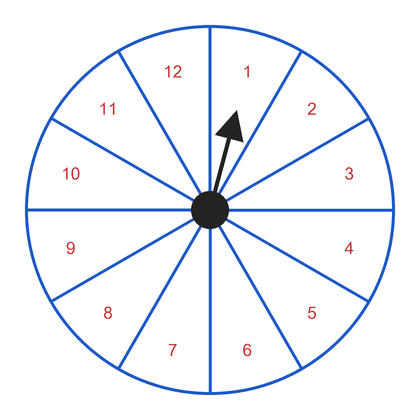
If the outcomes are equally likely, find the probability that the pointer will point at :
(i) 6
(ii) an even number.
(iii) a prime number.
(iv) a number greater than 8.
(v) a number less than or equal to 9.
(vi) a number between 3 and 11.
- 603 marks
Question 60
One card is drawn from a well-shuffled deck of 52 cards. Find the probability of getting :
(i) a queen of red colour.
(ii) a black face card.
(iii) the jack or the queen of hearts.
(iv) a diamond.
(v) a diamond or a spade.
- 613 marks
Question 61
From a deck of 52 cards, all the face cards are removed and then the remaining cards are shuffled. Now one card is drawn from the remaining deck. Find the probability that the card drawn is :
(i) a black card. (ii) 8 of red colour.
(iii) a king of black colour.
- 623 marks
Question 62
Seven cards : the eight, the nine, the ten, jack, queen, king and ace of diamonds are well shuffled. One card is then picked up at random.
(i) What is the probability that the card drawn is the eight or the king ?
(ii) If the king is drawn and put aside, what is the probability that the second card picked up is : (a) an ace ? (b) a king ?
- 633 marks
Question 63
(i) 4 defective pens are accidentally mixed with 16 good ones. It is not possible to just look at a pen and tell whether or not it is defective. One pen is drawn at random from the lot. What is the probability that the pen is defective ?
(ii) Suppose the pen drawn in (i) is defective and is not replaced. Now one more pen is drawn at random from the rest. What is the probability that this pen is :
(a) defective ? (b) not defective ?
- 643 marks
Question 64
A bag contains 100 identical marble stones which are numbered from 1 to 100. If one stone is drawn at random from the bag, find the probability that it bears :
(i) a perfect square number.
(ii) a number divisible by 4.
(iii) a number divisible by 5.
(iv) a number divisible by 4 or 5.
(v) a number divisible by 4 and 5.
- 653 marks
Question 65
A circle with diameter 20 cm is drawn somewhere on a rectangular piece of paper with length 40 cm and width 30 cm. This paper is kept horizontal on table top and a dice, very small in size, is dropped on the rectangular paper without seeing towards it. If the dice falls and lands on the paper only, find the probability that it will fall and land :
(i) inside the circle. (ii) outside the circle.
- 663 marks
Question 66
Two dice (each bearing numbers 1 to 6) are rolled together. Find the probability that the sum of the numbers on the upper-most faces of two dice is :
(i) 4 or 5. (ii) 7, 8 or 9.
(iii) between 5 and 8. (iv) more than 10.
(v) less than 6.
- 673 marks
Question 67
Three coins are tossed together. Write all the possible outcomes. Now, find the probability of getting :
(i) exactly two heads. (ii) at least two heads.
(iii) atmost two heads. (iv) all tails.
(v) at least one tail.
- 683 marks
Question 68
Two dice are thrown simultaneously. What is the probability that :
(i) 4 will not come up either time ?
(ii) 4 will come up at least once ?
- 693 marks
Question 69
Offices in Delhi are open for five days in a week (Monday to Friday). Two employees of an office remain absent for one day in the same particular week. Find the probability that they remain absent on :
(i) the same day (ii) consecutive day
(iii) different days.
- 703 marks
Question 70
A box contains some black balls and 30 white balls. If the probability of drawing a black ball is two-fifths of a white ball; find the number of black balls in the box.
- 713 marks
Question 71
From a pack of 52 playing cards, all cards whose numbers are multiples of 3 are removed. A card is now drawn at random. What is the probability that the card drawn is
(i) a face card (King, Jack or Queen)
(ii) an even numbered red card ?
- 723 marks
Question 72
A dice has 6 faces marked by the given numbers as shown below :
1 2 3 –1 –2 –3 The dice is thrown once. What is the probability of getting
(i) a positive integer ?
(ii) an integer greater than –3 ?
(iii) the smallest integer ?
- 733 marks
Question 73
Sixteen cards are labelled as a, b, c, ........, m, n, o, p. They are put in a box and shuffled. A boy is asked to draw a card from the box. What is the probability that the card drawn is :
(i) a vowel (ii) a consonant
(iii) none of the letters of the word median ?
- 743 marks
Question 74
A box contains a certain number of balls. On each of 60% balls, letter A is marked. On each of 30% balls, letter B is marked and on each of remaining balls, letter C is marked. A ball is drawn from the box at random. Find the probability that the ball drawn is :
(i) marked C (ii) A or B
(iii) neither B nor C.
- 753 marks
Question 75
A box contains a certain number of balls. Some of these balls are marked A, some are marked B and the remainings are marked C. When a ball is drawn at random from the box P(A) = and P(B) = . If there are 40 balls in the box which are marked C, find the number of balls in the box.
What Class 10 Maths Ch 25 covers
The sections of the chapter, in the order the book takes them. Every question above comes from one of these.
- 01Some Basic Terms and Concepts
- 02Measurement of Probability
- 03Important
More ways to study this chapter
The same chapter asked three other ways. Practise it, revise it, and see what the board has set on Ch 25 before.
- Competency-Based Questions (CBQ)Case study questions: a situation, and the part of the chapter that answers it.40questionsOpen
- Previous Year QuestionsQuestions that have actually appeared in board papers, each tagged with its year.19questionsOpen
- Practice QuestionsExtra questions per chapter, for when one attempt at a method is not enough.42questionsOpen
Ch 25 in past ICSE papers
The same chapter as the board has actually asked it. These are worded differently from the textbook exercise, which is the point of reading them.
- 13 marks
Board paper question 1
A game of numbers has cards marked with 11, 12, 13, ….. , 40. A card is drawn at random. Find the Probability that the number on the card drawn is:
(i) A perfect square
(ii) Divisible by 7
Solve with AIWritten solution
Solution:
Concept: When all outcomes are equally likely, . A probability always lies from 0 (impossible event) to 1 (sure event), and .
Step 1 — Count the total outcomes.
The cards run from 11 to 40; the count of whole numbers from a to b is b − a + 1.
(i)
Step 2 — Count the perfect squares.
The perfect squares from 11 to 40 are 16, 25 and 36 (since 3² = 9 is too small and 7² = 49 too big), so 3 cards are favourable.
(ii)
Step 3 — Count the multiples of 7.
The numbers from 11 to 40 divisible by 7 are 14, 21, 28 and 35, so 4 cards are favourable.
Watch out: 11 to 40 has 30 numbers, not 29: count both ends.
Therefore, (i) P(perfect square) = ; (ii) P(divisible by 7) = .
- 23 marks
Board paper question 2
Sixteen cards are labelled as a,b,c…….m,n,o,p. They are put in a box and shuffled. A boy is asked to draw a card from the box. What is the probability that the card drawn is:
(i) a vowel.
(ii) a consonant.
(iii) none of the letters of the word median.
Solve with AIWritten solution
Solution:
Concept: When all outcomes are equally likely, . A probability always lies from 0 (impossible event) to 1 (sure event), and .
Step 1 — Count the total outcomes.
The 16 cards are the letters a to p, and each is equally likely to be drawn.
(i)
Step 2 — Count the vowels.
The vowels among a to p are a, e, i and o (u comes after p), so 4 cards are favourable.
(ii)
Step 3 — Count the consonants.
Every card that is not a vowel is a consonant, so 16 − 4 = 12 cards are favourable.
(iii)
Step 4 — Count the letters not in 'median'.
The word median uses the 6 different letters m, e, d, i, a, n, all of which are among a to p, so 16 − 6 = 10 cards are favourable.
Watch out: The letter u is a vowel but is NOT among a to p, so only 4 vowels count here.
Therefore, (i) P(vowel) = ; (ii) P(consonant) = ; (iii) P(none of the letters of median) = .
- 34 marks
Board paper question 3
Cards bearing numbers 2, 4, 6, 8, 10, 12, 14, 16, 18 and 20 are kept in a bag. A card is drawn at random from the bag. Find the probability of getting a card which is :
(i) a prime number.
(ii) a number divisible by 4.
(iii) a number that is a multiple of 6.
(iv) an odd number.
Solve with AIWritten solution
Solution:
Concept: When all outcomes are equally likely, . A probability always lies from 0 (impossible event) to 1 (sure event), and .
Step 1 — Count the total outcomes.
There are 10 cards, 2 to 20 in steps of 2, each equally likely.
(i)
Step 2 — Count the primes.
2 is the only even prime; every other card is even and greater than 2, so it has 2 as a factor. So 1 card is favourable.
(ii)
Step 3 — Count the multiples of 4.
The cards divisible by 4 are 4, 8, 12, 16 and 20, so 5 cards are favourable.
(iii)
Step 4 — Count the multiples of 6.
The cards that are multiples of 6 are 6, 12 and 18, so 3 cards are favourable.
(iv)
Step 5 — Look for odd numbers.
Every card is even, so no card is odd: the event is impossible and its probability is 0.
Watch out: 2 IS a prime number (its only factors are 1 and itself), so P(prime) is not 0.
Therefore, (i) P(prime) = ; (ii) P(divisible by 4) = ; (iii) P(multiple of 6) = ; (iv) P(odd) = 0.
- 43 marks
Board paper question 4
There are 25 discs numbered 1 to 25. They are put in a closed box and shaken thoroughly. A disc is drawn at random from the box.
Find the probability that the number on the disc is:
(i) an odd number.
(ii) divisible by 2 and 3 both.
(iii) a number less than 16.
Solve with AIWritten solution
Solution:
Concept: When all outcomes are equally likely, . A probability always lies from 0 (impossible event) to 1 (sure event), and .
Step 1 — Count the total outcomes.
There are 25 discs, numbered 1 to 25, each equally likely.
(i)
Step 2 — Count the odd numbers.
The odd numbers 1, 3, 5, …, 25 are 13 in number (12 even numbers 2 to 24 are left out).
(ii)
Step 3 — Count the numbers divisible by both 2 and 3.
A number divisible by both 2 and 3 is divisible by 6: these are 6, 12, 18 and 24, so 4 discs are favourable.
(iii)
Step 4 — Count the numbers less than 16.
The numbers 1 to 15 are less than 16, so 15 discs are favourable.
Watch out: The phrase 'divisible by 2 and 3 both' means divisible by 6; do not add the multiples of 2 and of 3.
Therefore, (i) P(odd) = ; (ii) P(divisible by 2 and 3) = ; (iii) P(less than 16) = .
- 53 marks
Board paper question 5
Each of the letters of the word 'AUTHORIZES' is written on identical circular discs and put in a bag. They are well shuffled. If a disc is drawn at random from the bag, what is the probability that the letter is :
(i) a vowel ?
(ii) one of the first 9 letters of the English alphabet which appears in the given word ?
(iii) one of the last 9 letters of the English alphabet which appears in the given word ?
Solve with AIWritten solution
Solution:
Concept: When all outcomes are equally likely, . A probability always lies from 0 (impossible event) to 1 (sure event), and .
Step 1 — Write the sample space.
AUTHORIZES has 10 letters, all different: A, U, T, H, O, R, I, Z, E, S. So there are 10 equally likely discs.
(i)
Step 2 — Count the vowels.
The vowels in the word are A, U, O, I and E, so 5 discs are favourable.
(ii)
Step 3 — Count the letters from A to I.
The first 9 letters are A, B, C, D, E, F, G, H, I; of these the word contains A, E, H and I, so 4 discs are favourable.
(iii)
Step 4 — Count the letters from R to Z.
The last 9 letters are R, S, T, U, V, W, X, Y, Z; of these the word contains R, S, T, U and Z, so 5 discs are favourable.
Watch out: The last 9 letters of the alphabet start at R (Z is the 26th, so the 18th letter R begins the last 9).
Therefore, (i) P(vowel) = ; (ii) P(one of the first 9 letters) = ; (iii) P(one of the last 9 letters) = .
- 61 mark
Board paper question 6
The probability of getting a number divisible by 3 in throwing a dice is:
Solve with AIAnswer
(A)
- Correct
(B)
(C)
(D)
Answer: (B)
Concept: When all outcomes are equally likely, . A probability always lies from 0 (impossible event) to 1 (sure event), and .
Step 1 — List the outcomes.
A die has 6 equally likely outcomes: 1, 2, 3, 4, 5, 6.
Step 2 — List the favourable outcomes.
The numbers divisible by 3 are 3 and 6, so 2 outcomes are favourable.
Step 3 — Find the probability.
We divide the favourable outcomes by the total.
Watch out: 6 is also divisible by 3; counting only 3 gives .
Why the other options are wrong:
- (A) : It counts only the number 3 and forgets 6.
- (C) : It is the probability of an even number (or of an odd number), 3 out of 6.
- (D) : It is the probability of a number NOT divisible by 3, 4 out of 6.
Therefore, the probability is , option (B).
All 19 board paper questions for this chapter, solved the same way.
Class 10 Maths Ch 25 questions students ask
How many questions are there in Class 10 Maths Ch 25?
75 questions. Every one is solved step by step on this page.
Are these Class 10 Maths solutions free?
Yes. Every question and its full working is free to read, with no account needed.
Can I download the Class 10 Maths Ch 25 solutions as a PDF?
There is no PDF to download. Every solution is on this page instead, which means it is searchable, always the current syllabus, and readable on a phone. Use your browser's print option if you want it on paper.