
Opening your dashboard
Class 10 Maths Chapter 25 Probability: Competency-Based Questions (CBQ)
40 questions on Chapter 25, each worked through on its own page with the AI tutor. Class 10 Maths, ICSE 2026-27.
40 questions
1–5 marks · Mixed difficulty
- 11 mark
Question 1
Competency: Application
A traffic signal repeats the same cycle all day : green for 40 seconds, yellow for 5 seconds and red for 45 seconds. A car reaches the signal at a random moment. The probability that the signal is green at that moment is :
- 21 mark
Question 2
Competency: Application
In a school raffle, every ticket has the same chance of being drawn for the single prize. Meera has bought 5 tickets, and the probability that she wins is 0·02. The total number of tickets sold is :
- 31 mark
Question 3
Competency: Analysis
A whole number is chosen at random from 1 to 30. Consider these four events :
P : the number is a multiple of 5
Q : the number is a prime number
R : the number is a perfect square
S : the number is even
Arranged in order from the least likely to the most likely, the events are :
- 41 mark
Question 4
Competency: Analysis & Evaluation
Each letter of the word ASSESSMENT is written on a separate card. The ten cards are shuffled and one card is drawn at random. Dev finds the probability that the card shows the letter S :
Step 1 : The different letters in the word are A, S, E, M, N and T.
Step 2 : So the total number of possible outcomes is 6.
Step 3 : The number of outcomes favourable to "S" is 1.
Step 4 :
In which step does Dev's first mistake occur?
- 51 mark
Question 5
Competency: Understanding & Analysis
Two coins are tossed together.
Assertion (A) : The probability of getting at least one head is .
Reason (R) : , and the event "not at least one head" is the event "no head", whose probability is .
- 61 mark
Question 6
Competency: Evaluation
The weather office says, "The probability of rain in the city tomorrow is 0·9." Which is the most reasonable way to understand this statement?
- 72 marks
Question 7
Competency: Application
The blood groups of the 60 students of Class 10 are recorded in the school health register.
Blood group O A B AB Number of students 24 15 18 3 One student is chosen at random. Find the probability that the student's blood group is (a) B, (b) not O.
- 82 marks
Question 8
Competency: Analysis
Red House, Blue House and Green House have reached the final of the school quiz. Exactly one of them will win. The quiz master says that Red House is twice as likely to win as Blue House, and that the probability of Green House winning is 0·25. Find the probability that (a) Blue House wins, (b) Red House wins.
- 92 marks
Question 9
Competency: Evaluation
Ravi tosses a fair coin five times and gets a head every time. Before the sixth toss he says, "A tail is due now, so this time a tail is more likely than a head." Is Ravi right? Give a reason, and state the probability of getting a tail on the sixth toss.
- 102 marks
Question 10
Competency: Application & Analysis
In a board game, a player throws two dice and moves forward by the sum of the two numbers. Shreya's token is 9 squares away from "Home". There is also a "Go back to Start" square 4 squares ahead of her token. On her next throw, is Shreya more likely to land exactly on Home or to land on "Go back to Start"? Find both probabilities.
- 113 marks
Question 11
Competency: Application
The parking slots of a mall are numbered from 1 to 60. A computer gives each car one of the 60 slots at random. Slots whose numbers are multiples of 6 have an electric-vehicle charger. Slots whose numbers are multiples of 10 are next to the exit. Find the probability that a car gets a slot that :
(a) has a charger,
(b) has a charger and is also next to the exit,
(c) has no charger and is not next to the exit.
- 123 marks
Question 12
Competency: Analysis & Evaluation
Two stalls at a school fete charge the same fee and give the same prize.
Stall A : Draw one card from a well-shuffled pack of 52 cards. You win if it is a face card.
Stall B : Throw two dice. You win if you get a doublet (the same number on both dice) or a sum of 11.
(a) Find the probability of winning at Stall A.
(b) Find the probability of winning at Stall B.
(c) Which stall should a player choose? Justify your answer by comparing the two probabilities.
- 133 marks
Question 13
Competency: Creativity
One card is drawn at random from a well-shuffled pack of 52 playing cards.
Frame a probability question about this experiment whose answer is . Then solve your own question to show that the answer is correct.
- 145 marks
Question 14
Competency: Analysis & Evaluation
Case study: A school asked 200 of its students how they come to school. The results are shown below.
Bus Cycle Walk Car Total Boys 40 32 18 10 100 Girls 48 16 24 12 100 Total 88 48 42 22 200 (a) One of the 200 students is chosen at random. Find the probability that the student (i) comes by bus, (ii) does not come by car.
(b) Find the probability that a student chosen at random from the 200 is a girl who walks to school. Then find the probability that a student chosen at random from the boys only comes by cycle.
(c) The Principal makes two statements. Check each one.
Statement 1 : "If I pick one of the cyclists at random, it is twice as likely to be a boy as a girl."
Statement 2 : "More than one-fourth of these students cycle to school, so we need a bigger cycle stand."
- 154 marks
Question 15
Competency: Application & Analysis
Case study: Aarav's suitcase has a two-digit number lock. The code can be any of 00, 01, 02, …, 99, and every code is equally likely. Aarav has forgotten his code.
(a) He tries one code at random. What is the probability that it opens the lock?
(b) Find the probability that a code chosen at random (i) has both digits the same, (ii) has digits that add up to 12.
(c) Aarav now remembers that his code is an odd number greater than 70. His sister says, "Then one guess has a 1 in 15 chance of being right." Is she right? If Aarav also remembers that the two digits of his code are different, what is the probability that one guess is right?
- 161 mark
Question 16
Competency: Application
The spinner shown has 12 equal sectors. Each sector is marked with the first letter of its colour : R (red), G (green), B (blue) or Y (yellow). The arrow is spun and stops on one sector at random.

The probability that the arrow stops on a sector that is neither red nor blue is :
- 171 mark
Question 17
Competency: Application & Analysis
In her notebook Maya writes the probability of an event as and the probability of the event "not " as , where is a whole number. The probability of is :
- 181 mark
Question 18
Competency: Analysis
Asha and Bilal each throw one fair die. The player who gets the higher number wins. If both get the same number, nobody wins. The probability that Asha wins is :
- 191 mark
Question 19
Competency: Analysis
A certain month has 30 days and its first day is a Wednesday. One day of this month is chosen at random. The probability that it is a Saturday or a Sunday is :
- 201 mark
Question 20
Competency: Understanding
Ravi tosses a coin three times and writes the results in order, for example HTT. He calls a result alternating if no two neighbouring tosses show the same face. The probability that his three tosses are alternating is :
- 211 mark
Question 21
Competency: Evaluation
Sana wants to draw a red ball. She may draw one ball at random from either of two bags.
Bag X : 6 red balls and 9 blue balls
Bag Y : 8 red balls and 16 blue balls
Which of these is the best advice for Sana?
- 221 mark
Question 22
Competency: Understanding
A pack of 52 playing cards is shuffled thoroughly and Meena picks one card without looking.
Assertion (A) : The probability that her card is black is equal to the probability that her card is red.
Reason (R) : The black cards of the pack are the 13 spades and the 13 diamonds.
Choose the correct option.
- 231 mark
Question 23
Competency: Analysis
The roll numbers of the 45 students of a class run from 1 to 45. The teacher chooses one student at random. The probability that the roll number is divisible by 3 but not divisible by 9 is :
- 241 mark
Question 24
Competency: Understanding & Analysis
A number is chosen at random from the whole numbers 1 to 30.
Assertion (A) : The probability that the number is a multiple of 6 is .
Reason (R) : The probability of any event always lies between 0 and 1, both included.
Choose the correct option.
- 251 mark
Question 25
Competency: Analysis
In which of these experiments are the two outcomes named equally likely?
- 262 marks
Question 26
Competency: Evaluation
Rohan draws one card at random from a well-shuffled pack of 52 playing cards. He may bet on one of these two events :
Event E : the card bears an even number (2, 4, 6, 8 or 10)
Event F : the card bears an odd number (3, 5, 7 or 9)
The aces and the face cards carry no number. Find and , and decide which event Rohan should bet on.
- 272 marks
Question 27
Competency: Application
A game-maker paints twenty marbles that carry the numbers 1 to 20. The marbles with an odd number get a red coat. Among the other marbles, those whose number is a multiple of 4 get a blue coat, and all remaining marbles get a green coat. A marble is picked blindly from the jar. Find the probability that its coat is green.
- 282 marks
Question 28
Competency: Analysis & Evaluation
Pooja and Qadir play a game with two dice. Both dice are thrown together. Pooja scores a point if the sum of the two numbers is less than 6. Qadir scores a point if the sum is more than 8.
(a) Find the probability that Pooja scores a point and the probability that Qadir scores a point.
(b) Is the game fair to both players? Give a reason.
- 292 marks
Question 29
Competency: Application
In a class, one student is chosen at random to lead the morning assembly. The probability that the student chosen is a girl is . There are 18 boys in the class. How many students are there in the class, and how many of them are girls?
- 302 marks
Question 30
Competency: Application
A bus has 40 seats numbered 1 to 40. The seats are in rows of 4, so row 1 has seats 1 to 4, row 2 has seats 5 to 8, and so on up to row 10. In each row the two end seats are window seats (in row 1, seats 1 and 4). A seat is given to a passenger at random. Find the probability that the seat is
(a) a window seat,
(b) a window seat in one of the last three rows.
- 312 marks
Question 31
Competency: Analysis
A bag holds balls of only four colours. When one ball is drawn at random, the probabilities of getting a red, a blue, a green and a yellow ball are , , and respectively. Show that these four values can be correct. Then find the least number of balls the bag can hold, and the number of balls of each colour in that bag.
- 323 marks
Question 32
Competency: Creativity
Two coins are tossed together, so the possible outcomes are HH, HT, TH and TT.
(a) Describe in words an event for which , and list the outcomes in it.
(b) Describe the event "not " in words and find its probability.
(c) Describe a different event for which .
- 333 marks
Question 33
Competency: Application
Fifty tokens carry the two-digit numbers 10, 11, 12, …, 59, one number on each token. A token is picked blindly from the jar. Find the probability that its number
(a) has digits whose sum is 7,
(b) has digits whose product is 12,
(c) has its tens digit greater than its units digit.
- 343 marks
Question 34
Competency: Application
A cycle shop kept a record of the number of cycles it sold on each of 50 days. (Hypothetical data.)
Cycles sold in a day 0 1 2 3 4 Number of days 5 12 18 10 5 One of these 50 days is chosen at random. Find the probability that on this day the shop sold
(a) exactly 2 cycles,
(b) at least 3 cycles,
(c) at most 1 cycle. Then show that your answer to (c) and the probability of selling at least 2 cycles add up to 1.
- 353 marks
Question 35
Competency: Understanding
A bag contains 15 balls numbered 2, 4, 6, …, 30. One ball is drawn at random. For each event below, say whether it is a sure event, an impossible event or neither, and give its probability.
(a) The number on the ball is odd.
(b) The number on the ball is even.
(c) The number on the ball is a multiple of 6.
- 363 marks
Question 36
Competency: Analysis
A fair cubical die has its six faces marked 1, 2, 2, 3, 3, 3. It is thrown once.
(a) Find the probability of getting 1, the probability of getting 2 and the probability of getting 3.
(b) Find the probability of getting an odd number.
(c) Are the numbers 1, 2 and 3 equally likely outcomes? Give a reason.
- 375 marks
Question 37
Competency: Analysis & Evaluation
Case study: Forty students of Class 10 each joined exactly one club. The bar graph shows how many students joined each club. (Hypothetical data.)
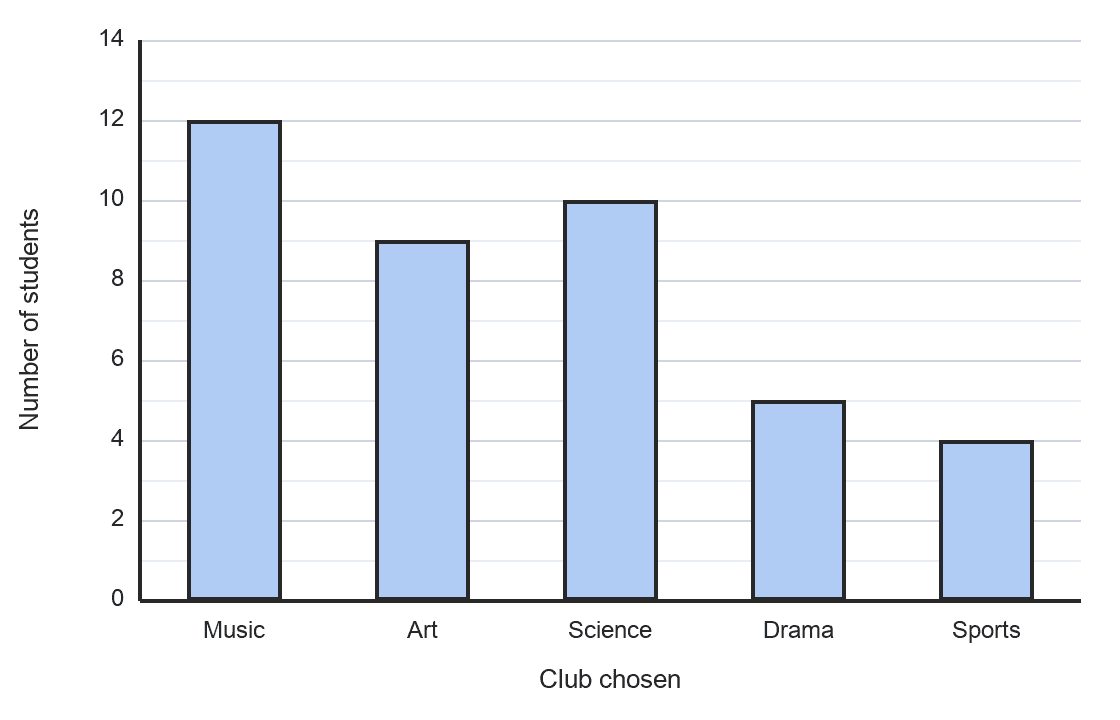
One of these 40 students is chosen at random.
(a) Find the probability that the student joined (i) Music, (ii) Sports.
(b) Find the probability that the student joined (i) Art or Science, (ii) any club other than Drama.
(c) The Principal says, "A student is more likely to be in Music or Art than in the other three clubs together." Is the Principal right? Support your answer with probabilities.
- 384 marks
Question 38
Competency: Application & Analysis
Case study: A quiz host keeps 20 question cards in a box: 8 are easy, 6 are medium and 6 are hard. A contestant draws one card at random. (Hypothetical data.)
(a) Find the probability that the card is easy.
(b) Find the probability that the card is not hard.
(c) The host wants the probability of a hard card to be exactly , so she puts some more hard cards into the box. How many hard cards must she add?
- 394 marks
Question 39
Competency: Application & Evaluation
Case study: In a board game, a random draw picks one of the 24 squares of the board, and every square has the same chance. The squares are of these kinds. (Hypothetical data.)
Kind of square Property Station Utility Chance Tax Jail Number of squares 12 4 2 3 2 1 (a) Find the probability that the square picked is a station.
(b) Find the probability that the square picked is not a property.
(c) Gita says, "Landing on a property is more likely than landing on a square that is not a property." Hari says, "Landing on a property is less likely than landing on a square that is not a property." Decide who is right.
- 405 marks
Question 40
Competency: Analysis & Evaluation
Case study: A school computer chooses a date for the annual day in a year that is not a leap year, so the year has 365 days. The months of such a year are of these lengths.
Number of days in the month 28 30 31 Number of months 1 4 7 (a) Method 1: The computer picks one of the 12 months at random. Find the probability that the month has 31 days.
(b) Method 2: The computer picks one of the 365 days of the year at random. Find the probability that the day is in a month that has 31 days.
(c) Tanvi says, "Both methods give the same probability for a 31-day month, because 7 of the 12 months have 31 days." Is Tanvi right? Compare the two probabilities and explain why they differ.