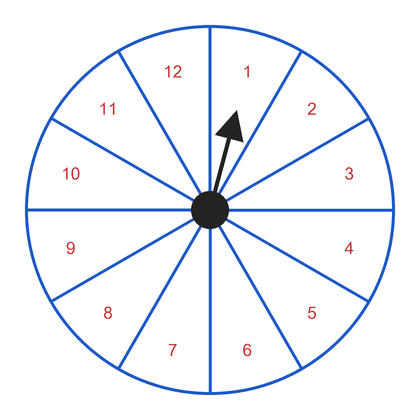
Solution:
Concept: When all the outcomes of an experiment are equally likely, the probability of an event E is P(E) = (number of outcomes favourable to E) ÷ (total number of possible outcomes). A probability always lies between 0 and 1.
Step 1 — Count the possible outcomes.
The arrow can stop at any of the 12 numbers 1, 2, 3, …, 12, and the outcomes are equally likely. So there are 12 outcomes.
Step 2 — (i) The number 6.
Only one sector shows 6.
P(6)=121
Step 3 — (ii) An even number.
The even numbers are 2, 4, 6, 8, 10 and 12, which is 6 outcomes.
P(even)=126=21
Step 4 — (iii) A prime number.
The primes from 1 to 12 are 2, 3, 5, 7 and 11 (1 is not prime), which is 5 outcomes.
P(prime)=125
Step 5 — (iv) A number greater than 8.
The numbers greater than 8 are 9, 10, 11 and 12, which is 4 outcomes.
P(greater than 8)=124=31
Step 6 — (v) A number less than or equal to 9.
The numbers 1, 2, …, 9 are at most 9, which is 9 outcomes.
P(at most 9)=129=43
Step 7 — (vi) A number between 3 and 11.
'Between 3 and 11' means 4, 5, 6, 7, 8, 9 and 10 (3 and 11 are not included), which is 7 outcomes.
P(between 3 and 11)=127
Watch out: 1 is not a prime number, and 'between 3 and 11' leaves out 3 and 11.
Therefore, (i) 121; (ii) 21; (iii) 125; (iv) 31; (v) 43; (vi) 127.