
Opening your dashboard
Class 10 Maths Chapter 14: Equation of a Line Solutions
128 textbook questions with step-by-step answers, free to read, for ICSE 2026-27.
Get talked through Ch 14, not just shown the answer
Reading a finished solution is not the same as being able to do it. The AI tutor takes one question at a time and works it with you, in your own words, until you can.
- Ask it out loud, in your own words
- It gives you the next step, not the answer
- Stuck on part (ii)? Start there
128 questions with solutions
1–3 marks · Mixed difficulty
The first 16 solutions are on this page. This chapter is a long one, so the rest open on their own page to keep this one quick to load.
- 11 mark
Question 1
The point (, −4) lies on the line , then the value of is :
Solve with AIAnswer
(A) −6
(B) 6
(C) −8
- Correct
(D) 8
Answer: (D) 8
Concept: A point lies on a line exactly when its co-ordinates satisfy the equation of the line. So we put the -co-ordinate of the point in place of and its -co-ordinate in place of : if the two sides come out equal, the point lies on the line; if not, it does not.
Step 1 — Put the point into the equation.
The point lies on , so and must satisfy the equation. We substitute them and then add 4 to both sides.
Step 2 — Check the answer.
We put the point back into the left side of the equation; it should give 4.
Watch out: Keep the brackets when you substitute a negative co-ordinate: is , so we add 4 to both sides.
Why the other options are wrong:
- (A) −6: with , the point is , and , not 4.
- (B) 6: with , the point is , and , not 4.
- (C) −8: with , the point is , and , not 4.
Therefore, , option (D).
- 21 mark
Question 2
The line passes through the point (6, 3), the value of is :
Solve with AIAnswer
- Correct
(A) 2
(B) −2
(C)
(D)
Answer: (A) 2
Concept: A point lies on a line exactly when its co-ordinates satisfy the equation of the line. So we put the -co-ordinate of the point in place of and its -co-ordinate in place of : if the two sides come out equal, the point lies on the line; if not, it does not.
Step 1 — Put the point into the equation.
The line passes through (6, 3), so and satisfy it. We substitute, add 3 to both sides and then divide by 6.
Step 2 — Check the answer.
With , the line is . We test the point (6, 3) in its left side.
Watch out: After substituting, move the across as : , not .
Why the other options are wrong:
- (B) −2: with , the left side is , not 9.
- (C) : with , the left side is , not 9.
- (D) : with , the left side is , not 9.
Therefore, , option (A).
- 31 mark
Question 3
The line passes through the point (2, −4); is this statement true ?
Solve with AIAnswer
- Correct
(A) no
(B) yes
(C) neither true nor false
(D) none of the above
Answer: (A) no
Concept: A point lies on a line exactly when its co-ordinates satisfy the equation of the line. So we put the -co-ordinate of the point in place of and its -co-ordinate in place of : if the two sides come out equal, the point lies on the line; if not, it does not.
Step 1 — Substitute the point.
We work out the left side of at the point (2, −4). The -value is negative, so we keep it in brackets.
Step 2 — Compare with the right side.
The left side is 8 but the right side is 10. Since , the point (2, −4) does not satisfy the equation, so the line does not pass through it. The statement is not true, and the answer is “no”.
Watch out: is ; dropping the minus sign would give , which also differs from 10, but for the wrong reason.
Why the other options are wrong:
- (B) yes: “yes” would need the left side to equal 10, but it equals 8.
- (C) neither true nor false: a point either satisfies the equation or it does not, so the statement is either true or false; here substitution shows it is false.
- (D) none of the above: option (A), “no”, is correct, so “none of the above” is wrong.
Therefore, the line does not pass through (2, −4); the answer is “no”, option (A).
- 41 mark
Question 4
The point of intersection of the lines and lies on the line ; the value of is :
Solve with AIAnswer
(A) 3
(B) 4
- Correct
(C) 2
(D) −2
Answer: (C) 2
Concept: A point lies on a line exactly when its co-ordinates satisfy the equation of the line. So we put the -co-ordinate of the point in place of and its -co-ordinate in place of : if the two sides come out equal, the point lies on the line; if not, it does not. The point of intersection of two lines is the point lying on both, so its co-ordinates satisfy both equations at once.
Step 1 — Find the point of intersection.
We add the equations and , so that cancels, and then divide by 2.
Since , , so . The lines meet at (4, 4).
Step 2 — Put (4, 4) into the third line.
The point (4, 4) lies on , so we substitute , and solve for .
Watch out: Find the intersection point first; the value of comes from the third line only after and are known.
Why the other options are wrong:
- (A) 3: with , , not 0, so (4, 4) would not lie on the line.
- (B) 4: with , , not 0.
- (D) −2: with , , not 0.
Therefore, , option (C).
- 51 mark
Question 5
The line bisects the line segment joining the points (0, ) and (4, 0), the value of is :
Solve with AIAnswer
(A) 2
- Correct
(B) 4
(C) −4
(D) −2
Answer: (B) 4
Concept: A line bisects a line segment when it passes through the mid-point of the segment. The mid-point of the join of and is . So we find the mid-point and make it satisfy the equation of the line.
Step 1 — Find the mid-point of the segment.
The segment joins (0, ) and (4, 0). We use the mid-point formula for each co-ordinate.
So the mid-point is .
Step 2 — Make the mid-point satisfy the line.
Since bisects the segment, the mid-point lies on it. We substitute, subtract 2 and multiply by 2.
Watch out: It is the mid-point that lies on the bisecting line, not the end point (0, ).
Why the other options are wrong:
- (A) 2: with , the mid-point is (2, 1), and , not 4.
- (C) −4: with , the mid-point is (2, −2), and , not 4.
- (D) −2: with , the mid-point is (2, −1), and , not 4.
Therefore, , option (B).
- 63 marks
Question 6
Find, which of the following points lie on the line :
(i) (1, 3) (ii) (0, 5) (iii) (−5, 0) (iv) (5, 5)
Solve with AIWritten solution
Solution:
Concept: A point lies on a line exactly when its co-ordinates satisfy the equation of the line. So we put the -co-ordinate of the point in place of and its -co-ordinate in place of : if the two sides come out equal, the point lies on the line; if not, it does not.
Step 1 — Part (i): test (1, 3).
We work out the left side of at the point (1, 3).
The left side equals the right side (0), so (1, 3) lies on the line.
Step 2 — Part (ii): test (0, 5).
We put and into the left side.
Since , (0, 5) does not lie on the line.
Step 3 — Part (iii): test (−5, 0).
We put and into the left side, keeping the negative value in brackets.
The left side is 0, so (−5, 0) lies on the line.
Step 4 — Part (iv): test (5, 5).
We put and into the left side.
The left side is 0, so (5, 5) lies on the line.
Watch out: The -co-ordinate is multiplied by ; for (0, 5) the middle term is .
Therefore, the points (1, 3), (−5, 0) and (5, 5) lie on the line ; the point (0, 5) does not.
- 73 marks
Question 7
State, true or false :
(i) the line passes through the point (2, 3).
(ii) if the point (2, ) lies on the line , then .
Solve with AIWritten solution
Solution:
Concept: A point lies on a line exactly when its co-ordinates satisfy the equation of the line. So we put the -co-ordinate of the point in place of and its -co-ordinate in place of : if the two sides come out equal, the point lies on the line; if not, it does not.
Step 1 — Part (i): test (2, 3) in the line.
We work out the left side of at the point (2, 3).
The left side is 2, but the right side is 0. Since , the line does not pass through (2, 3), so statement (i) is false.
Step 2 — Part (ii): find .
The point (2, ) lies on , so and satisfy the equation. We substitute and solve for .
So , not 5. As a check, with , the left side is , which is not 3. Statement (ii) is false.
Watch out: The line in (i) has 0 on the right side, not 1; it is not in intercept form, so (2, 3) is not on it.
Therefore, (i) false, since ; (ii) false, since , not 5.
- 83 marks
Question 8
For what value of will the point (3, ) lie on the line ?
Solve with AIWritten solution
Solution:
Concept: A point lies on a line exactly when its co-ordinates satisfy the equation of the line. So we put the -co-ordinate of the point in place of and its -co-ordinate in place of : if the two sides come out equal, the point lies on the line; if not, it does not.
Step 1 — Put the point into the equation.
The point lies on , so and satisfy the equation. We substitute, keeping in brackets.
Step 2 — Solve for .
We subtract 27 from both sides and then divide both sides by −4.
Step 3 — Check the answer.
With , the point is (3, −6). We test it in the left side of the equation.
This equals the right side, 3, so the value is correct.
Watch out: The point is , so , not : the term is .
Therefore, .
- 93 marks
Question 9
The line contains the point (, ); calculate the value of .
Solve with AIWritten solution
Solution:
Concept: A point lies on a line exactly when its co-ordinates satisfy the equation of the line. So we put the -co-ordinate of the point in place of and its -co-ordinate in place of : if the two sides come out equal, the point lies on the line; if not, it does not.
Step 1 — Put the point into the equation.
The point lies on the line, so we replace by and by , keeping in brackets.
Step 2 — Clear the fractions.
The denominators are 5 and 3, and their L.C.M. is 15, so we multiply every term by 15.
Step 3 — Expand and solve.
We open the bracket (the multiplies both terms), collect like terms and solve for .
Step 4 — Check the answer.
With , the point is . We test it in the left side of the equation.
Watch out: is : the minus sign changes the sign of both terms in the bracket.
Therefore, .
- 103 marks
Question 10
Does the line bisect the join of (5, −2) and (−1, 2) ?
Solve with AIWritten solution
Solution:
Concept: A line bisects a line segment when it passes through the mid-point of the segment. The mid-point of the join of and is . So we find the mid-point and make it satisfy the equation of the line.
Step 1 — Find the mid-point of the join.
The points are (5, −2) and (−1, 2). We use the mid-point formula for each co-ordinate.
So the mid-point is (2, 0).
Step 2 — Test the mid-point in the line.
We work out the left side of at the point (2, 0).
The left side equals the right side, 6, so the mid-point lies on the line.
Watch out: Test the mid-point, not the two end points; the end points need not lie on the line at all.
Therefore, yes, the line bisects the join of (5, −2) and (−1, 2): it passes through the mid-point (2, 0).
- 113 marks
Question 11
(i) The line bisects the join of (, 3) and (2, −5), find the value of .
(ii) The line bisects the join of (8, −1) and (0, ). Find the value of .
Solve with AIWritten solution
Solution:
Concept: A line bisects a line segment when it passes through the mid-point of the segment. The mid-point of the join of and is . So we find the mid-point and make it satisfy the equation of the line.
Step 1 — Part (i): find the mid-point.
The join is from to (2, −5). We use the mid-point formula for each co-ordinate.
So the mid-point is .
Step 2 — Part (i): make the mid-point satisfy .
We put and into the equation, add 2 to both sides, multiply by 2 and solve.
Step 3 — Part (ii): find the mid-point.
The join is from (8, −1) to . We use the mid-point formula again.
So the mid-point is .
Step 4 — Part (ii): make the mid-point satisfy .
We substitute the mid-point; simplifies to . Then we collect terms.
Watch out: In (ii), is , not .
Therefore, (i) ; (ii) .
- 123 marks
Question 12
(i) The point (−3, 2) lies on the line , calculate the value of .
(ii) The line contains the point (−4, 4), calculate the value of .
Solve with AIWritten solution
Solution:
Concept: A point lies on a line exactly when its co-ordinates satisfy the equation of the line. So we put the -co-ordinate of the point in place of and its -co-ordinate in place of : if the two sides come out equal, the point lies on the line; if not, it does not.
Step 1 — Part (i): put (−3, 2) into .
The point lies on the line, so and satisfy the equation. We substitute and solve for .
Step 2 — Part (ii): put (−4, 4) into .
The line contains the point, so and satisfy the equation. We substitute and solve for .
Step 3 — Check both answers.
We put each value back into its equation; in each case the two sides agree.
Watch out: In (ii) the point is : the 4 replaces on the left and the replaces on the right.
Therefore, (i) ; (ii) .
- 133 marks
Question 13
The point P divides the join of (2, 1) and (−3, 6) in the ratio 2 : 3. Does P lie on the line ?
Solve with AIWritten solution
Solution:
Concept: The section formula: the point dividing the join of and internally in the ratio is . A point lies on a line exactly when its co-ordinates satisfy the equation of the line. So we put the -co-ordinate of the point in place of and its -co-ordinate in place of : if the two sides come out equal, the point lies on the line; if not, it does not.
Step 1 — Find P by the section formula.
P divides the join of (2, 1) and (−3, 6) in the ratio 2 : 3. So , , and . We work out each co-ordinate.
So P is (0, 3).
Step 2 — Test P in the line.
We work out the left side of at the point (0, 3).
The left side equals the right side, 0, so P lies on the line.
Watch out: multiplies the co-ordinate of the second point and that of the first; swapping them gives the point dividing in 3 : 2 instead.
Therefore, yes, P(0, 3) lies on the line .
- 143 marks
Question 14
The line segment joining the points (5, −4) and (2, 2) is divided by the point Q in the ratio 1 : 2. Does the line contain Q ?
Solve with AIWritten solution
Solution:
Concept: The section formula: the point dividing the join of and internally in the ratio is . A point lies on a line exactly when its co-ordinates satisfy the equation of the line. So we put the -co-ordinate of the point in place of and its -co-ordinate in place of : if the two sides come out equal, the point lies on the line; if not, it does not.
Step 1 — Find Q by the section formula.
Q divides the join of (5, −4) and (2, 2) in the ratio 1 : 2. So , , and . We work out each co-ordinate.
So Q is (4, −2).
Step 2 — Test Q in the line.
We work out the left side of at the point (4, −2), keeping in brackets.
The left side is 8 but the right side is 0. Since , Q does not lie on the line.
Watch out: is ; writing would wrongly put Q on the line.
Therefore, no, the line does not contain Q(4, −2).
- 153 marks
Question 15
Find the point of intersection of the lines and . If this point lies on the line ; find the value of .
Solve with AIWritten solution
Solution:
Concept: A point lies on a line exactly when its co-ordinates satisfy the equation of the line. So we put the -co-ordinate of the point in place of and its -co-ordinate in place of : if the two sides come out equal, the point lies on the line; if not, it does not. The point of intersection of two lines satisfies both equations, so we solve them as simultaneous equations.
Step 1 — Make the subject of the simpler equation.
From we move to the other side.
Step 2 — Substitute into the other equation.
We replace by in and solve for .
Then gives the -co-ordinate.
So the lines meet at (−2, 3).
Step 3 — Make (−2, 3) satisfy the third line.
The point (−2, 3) lies on . We substitute and solve for .
Check: We put back; the line becomes , and at (−2, 3) its left side is 4, as required.
Watch out: is : multiply both terms of the bracket by .
Therefore, the point of intersection is (−2, 3), and .
- 163 marks
Question 16
Show that the lines , and are concurrent.
Solve with AIWritten solution
Solution:
Concept: Three lines are concurrent when all three pass through one point. So we find the point where two of them meet and test whether it lies on the third. A point lies on a line exactly when its co-ordinates satisfy the equation of the line. So we put the -co-ordinate of the point in place of and its -co-ordinate in place of : if the two sides come out equal, the point lies on the line; if not, it does not.
Step 1 — Make the subject of .
We add to both sides so that can be replaced in the first equation.
Step 2 — Find where the first two lines meet.
We replace by in and solve for .
Then gives the -co-ordinate.
So the first two lines meet at (3, −1).
Step 3 — Test (3, −1) in the third line.
We work out the left side of at the point (3, −1).
The left side is 0, so the third line also passes through (3, −1).
Watch out: It is not enough to find where two lines meet; the proof needs the third line tested at that point.
Therefore, all three lines pass through (3, −1), so they are concurrent. Hence proved.
- 171 mark
Question 17
The slope of a line is , its inclination is:
- 181 mark
Question 18
The slope of a line is 5, the slope of its perpendicular is :
- 191 mark
Question 19
The slope of the line passing through the origin and the point (−3, 4) is :
- 201 mark
Question 20
The inclination of a line passing through the points (4, 3) and (5, 4) is :
- 211 mark
Question 21
The slope of the line which is perpendicular to the line segment joining the points (8, −5) and (−4, 7) is :
- 223 marks
Question 22
Find the slope and the inclination of the line AB if :
(i) A = (−3, −2) and B = (1, 2)
(ii) A = and B = (3, 0)
(iii) A = and B =
- 233 marks
Question 23
The line passing through (0, 2) and (−3, −1) is parallel to the line passing through (−1, 5) and (4, ). Find .
- 243 marks
Question 24
The line passing through (−4, −2) and (2, −3) is perpendicular to the line passing through (, 5) and (2, −1). Find .
- 253 marks
Question 25
Without using the distance formula, show that the points A (4, −2), B (−4, 4) and C (10, 6) are the vertices of a right-angled triangle.
- 263 marks
Question 26
Without using the distance formula, show that the points A (4, 5), B (1, 2), C (4, 3) and D (7, 6) are the vertices of a parallelogram.
- 273 marks
Question 27
(−2, 4), (4, 8), (10, 7) and (11, −5) are the vertices of a quadrilateral. Show that the quadrilateral, obtained on joining the mid-points of its sides, is a parallelogram.
- 283 marks
Question 28
Show that the points P (, ), Q (, ) and R (, ) are collinear.
- 293 marks
Question 29
Find , if the slope of the line joining (, 2) and (8, −11) is .
- 303 marks
Question 30
A (5, 4), B (−3, −2) and C (1, −8) are the vertices of a triangle ABC. Find :
(i) the slope of the altitude of AB,
(ii) the slope of the median AD and
(iii) the slope of the line parallel to AC.
- 313 marks
Question 31
The slope of the side BC of a rectangle ABCD is . Find :
(i) the slope of the side AB,
(ii) the slope of the side AD.
- 323 marks
Question 32
The points (, 3), (2, −4) and (, −2) are collinear. Find .
- 333 marks
Question 33
Plot the points A(1, 1), B(4, 7) and C(4, 10) on a graph paper. Join A and B, and also A and C. Which segments appears to have the steeper slope, AB or AC ? Justify your conclusion by calculating the slopes of AB and AC.
- 341 mark
Question 34
The line passing through the points (−7, 4) and (5, 4) is parallel to :
- 351 mark
Question 35
The line intersecting the -axis at point (0, 2) and making an angle of 45° with -axis has equation :
- 361 mark
Question 36
The line , intersects the -axis at point A, the co-ordinates of point A are :
- 371 mark
Question 37
The equation of a line with -intercept 7 and -intercept −7 is :
- 381 mark
Question 38
The slope and the -intercept of the line are :
- 393 marks
Question 39
Find the equation of a line whose -intercept = −1 and inclination = 45°.
- 403 marks
Question 40
Find the equation of the line whose slope is and which passes through (−3, 4).
- 413 marks
Question 41
Find the equation of a line which passes through (5, 4) and makes an angle of 60° with the positive direction of the -axis.
- 423 marks
Question 42
Find the equation of the line passing through :
(i) (0, 1) and (1, 2) (ii) (−1, −4) and (3, 0)
- 433 marks
Question 43
The co-ordinates of two points P and Q are (2, 6) and (−3, 5) respectively. Find :
(i) the gradient of PQ;
(ii) the equation of PQ;
(iii) the co-ordinates of the point where PQ intersects the -axis.
- 443 marks
Question 44
The co-ordinates of two points A and B are (−3, 4) and (2, −1). Find :
(i) the equation of AB;
(ii) the co-ordinates of the point where the line AB intersects the -axis.
- 453 marks
Question 45
The figure given alongside shows two straight lines AB and CD intersecting each other at point P (3, 4). Find the equations of AB and CD.

- 463 marks
Question 46
In ΔABC, A = (3, 5), B = (7, 8) and C = (1, −10). Find the equation of the median through A.
- 473 marks
Question 47
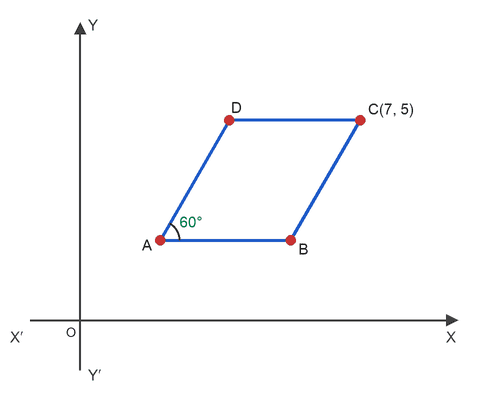
The following figure shows a parallelogram ABCD whose side AB is parallel to the -axis, ∠A = 60° and vertex C = (7, 5). Find the equations of BC and CD.
- 483 marks
Question 48
Find the equation of the straight line passing through origin and the point of intersection of the lines and .
- 493 marks
Question 49
In triangle ABC, the co-ordinates of vertices A, B and C are (4, 7), (−2, 3) and (0, 1) respectively. Find the equation of median through vertex A.
Also, find the equation of the line through vertex B and parallel to AC.
- 503 marks
Question 50
Find the equation of the perpendicular dropped from the point (−1, 2) onto the line joining the points (1, 4) and (2, 3).
- 513 marks
Question 51
Find the equation of the line, whose :
(i) -intercept = 5 and -intercept = 3
(ii) -intercept = −4 and -intercept = 6
- 523 marks
Question 52
Find the equation of the line whose slope is and -intercept is 6.
- 533 marks
Question 53
Find the equation of the line with -intercept 5 and a point on it (−3, 2).
- 543 marks
Question 54
Find the equation of the line through (1, 3) and making an intercept of 5 on the -axis.
- 553 marks
Question 55
Find the equations of the lines passing through point (−2, 0) and equally inclined to the co-ordinate axes.
- 563 marks
Question 56
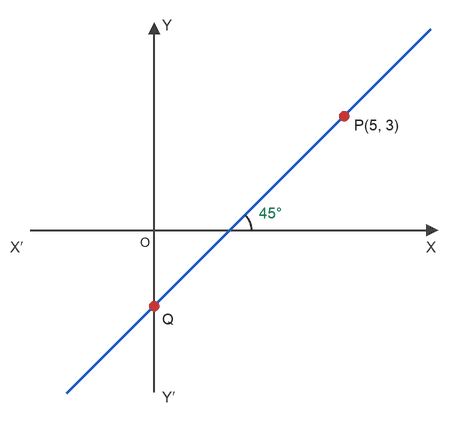
The line through P(5, 3) intersects -axis at Q.
(i) Write the slope of the line.
(ii) Write the equation of the line.
(iii) Find the co-ordinates of Q.
- 573 marks
Question 57
Write down the equation of the line whose gradient is and which passes through point P, where P divides the line segment joining A (4, −8) and B (12, 0) in the ratio 3 : 1.
- 583 marks
Question 58
A (1, 4), B (3, 2) and C (7, 5) are vertices of a triangle ABC. Find :
(i) the co-ordinates of the centroid of triangle ABC.
(ii) the equation of a line, through the centroid and parallel to AB.
- 593 marks
Question 59
A (7, −1), B (4, 1) and C (−3, 4) are the vertices of a triangle ABC. Find the equation of a line through the vertex B and the point P in AC; such that AP : CP = 2 : 3.
- 601 mark
Question 60
The equation of a line with -intercept 5 and -intercept also 5 is :
- 611 mark
Question 61
The inclination of a line, which is not passing through origin, is 1. Its intercepts with both the axes are :
- 621 mark
Question 62
The line passing through point (1, 1) and making -intercept equal to 3 has equation:
- 631 mark
Question 63
Equation of a line passing through the intersection of the lines and with inclination 45° is :
- 641 mark
Question 64
A line cuts equal intercepts with positive direction of both the axes and passes through the point (6, 6). The equation of the line is :
- 653 marks
Question 65
Find the slope and -intercept of the line :
(i) (ii) (iii)
- 663 marks
Question 66
The equation of a line is . Find its slope and -intercept. Also, find its inclination.
- 673 marks
Question 67
(i) Is the line perpendicular to the line ?
(ii) Is the line perpendicular to the line ?
(iii) Is the line parallel to the line ?
(iv) Determine so that the slope of the line through (1, 4) and (, 2) is 2.
- 683 marks
Question 68
Find the slope of the line which is parallel to :
(i) (ii)
- 693 marks
Question 69
Find the slope of the line which is perpendicular to :
(i) (ii)
- 703 marks
Question 70
(i) Lines and are parallel to each other. Find the relation connecting and .
(ii) Lines and are perpendicular to each other. Find the relation connecting and .
- 713 marks
Question 71
Find the value of if the lines, whose equations are and are perpendicular to each other.
- 723 marks
Question 72
The equation of a line AB is .
(i) Find the slope of the line AB.
(ii) Calculate the angle that the line AB makes with the positive direction of the -axis.
- 733 marks
Question 73
The lines represented by and are parallel. Find the value of .
- 743 marks
Question 74
The line through A(−2, 3) and B(4, ) is perpendicular to the line . Find the value of .
- 753 marks
Question 75
Find the equation of the line passing through (−5, 7) and parallel to :
(i) -axis (ii) -axis
- 763 marks
Question 76
Find the equation of the line passing through (5, −3) and parallel to .
- 773 marks
Question 77
Find the equation of the line passing through (−2, 1) and perpendicular to .
- 783 marks
Question 78
Find the equation of the perpendicular bisector of the line segment obtained on joining the points (6, −3) and (0, 3).
- 793 marks
Question 79
B (−5, 6) and D (1, 4) are the vertices of rhombus ABCD. Find the equations of diagonals BD and AC.
- 803 marks
Question 80
A (1, −5), B (2, 2) and C (−2, 4) are the vertices of triangle ABC. Find the equation of :
(i) the median of the triangle through A.
(ii) the altitude of the triangle through B.
(iii) the line through C and parallel to AB.
- 813 marks
Question 81
(i) Write down the equation of the line AB, through (3, 2) and perpendicular to the line .
(ii) AB meets the -axis at A and the -axis at B. Write down the co-ordinates of A and B. Calculate the area of triangle OAB, where O is the origin.
- 823 marks
Question 82
The line meets -axis at A. Write the co-ordinates of A.
Determine the equation of the line through A and perpendicular to .
- 833 marks
Question 83
The point P is the foot of perpendicular from A (−5, 7) to the line . Determine :
(i) the equation of the line AP
(ii) the co-ordinates of P
- 843 marks
Question 84
The points A, B and C are (4, 0), (2, 2) and (0, 6) respectively. Find the equations of AB and BC.
If AB cuts the -axis at P and BC cuts the -axis at Q, find the co-ordinates of P and Q.
- 853 marks
Question 85
Match the equations A, B, C and D with the lines , , and , whose graphs are roughly drawn in the given diagram.
A ≡ ; B ≡ ; C ≡ ; D ≡

- 861 mark
Question 86
The line passes through the point (). The value of is :
- 871 mark
Question 87
The inclination of the line is :
- 881 mark
Question 88
Assertion (A) : and are two straight lines. To find whether the lines are parallel to each other or not, we need to find the slope of each line.
Reason (R) : If slopes of both the lines are same, they are parallel to each other.
- 891 mark
Question 89
Assertion (A) : and are two intersecting lines.
Reason (R) : The inclinations of both the given lines are not equal.
- 901 mark
Question 90
If the lines and are perpendicular to each other. Then the value of is :
- 911 mark
Question 91
The line meets -axis at point P. The co-ordinates of point P are :
- 921 mark
Question 92
The vertices A and C of rhombus ABCD are A = (3, −1) and C = (−4, −8). The slope of the diagonal BD is :
- 931 mark
Question 93
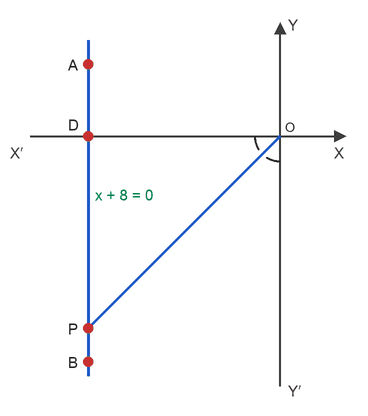
The equation of line AB is . The slope of the line OP which bisects angle O, is :
- 941 mark
Question 94
The line , meets -axis at point A and -axis at point B, then :
- 951 mark
Question 95
Two straight lines and .
Assertion (A) : The given two lines are perpendicular to each other and .
Reason (R) : If the inclinations of two lines are α and β; then .
- 961 mark
Question 96
A line .
Assertion (A) : The equation of line passing through origin and parallel to given line is .
Reason (R) : Equation of the line passing through origin and parallel to is .
- 971 mark
Question 97
Points P(, 2), A(−2, 3) and B(−5, 4) are collinear.
Statement (1) : Slope of PA = slope of PB = slope of AB.
Statement (2) : .
- 981 mark
Question 98
Lines and are perpendicular to each other.
Statement (1) : .
Statement (2) : Slope of line is and slope of line is .
- 993 marks
Question 99
Point P divides the line segment joining the points A (8, 0) and B (16, −8) in the ratio 3 : 5. Find the co-ordinates of point P.
Also, find the equation of the line through P and parallel to .
- 1003 marks
Question 100
The line segment joining the points A (3, −4) and B (−2, 1) is divided in the ratio 1 : 3 at point P in it. Find the co-ordinates of P.
Also, find the equation of the line through P and perpendicular to the line .
- 1013 marks
Question 101
A line meets -axis at point P. Find the co-ordinates of point P. Find the equation of a line through P and perpendicular to .
- 1023 marks
Question 102
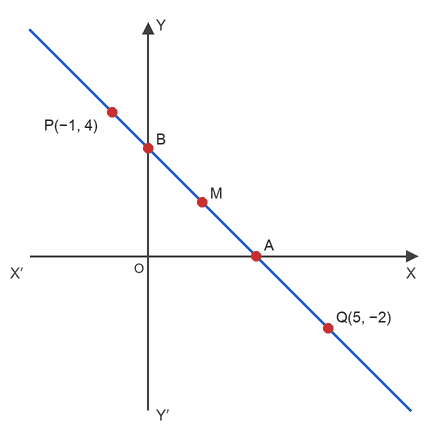
A straight line passes through the points P(−1, 4) and Q(5, −2). It intersects the co-ordinate axes at points A and B. M is the mid-point of the segment AB. Find :
(i) The equation of the line.
(ii) The co-ordinates of A and B.
(iii) The co-ordinates of M.
- 1033 marks
Question 103
Show that A (3, 2), B (6, −2) and C (2, −5) can be the vertices of a square.
(i) Find the co-ordinates of its fourth vertex D, if ABCD is a square.
(ii) Without using the co-ordinates of vertex D, find the equation of side AD of the square and also the equation of diagonal BD.
- 1043 marks
Question 104
A line through origin meets the line at right angles at point X. Find the co-ordinates of X.
- 1053 marks
Question 105
A straight line passes through the point (3, 2) and the portion of this line, intercepted between the positive axes, is bisected at this point.

Find the equation of the line.
- 1063 marks
Question 106
Find the equation of the line passing through the point of intersection of and ; and perpendicular to the line .
- 1073 marks
Question 107
Determine whether the line through points (−2, 3) and (4, 1) is perpendicular to the line .
Does line bisect the line segment joining the two given points ?
- 1083 marks
Question 108
Given a straight line . Determine the equation of the other line which is parallel to it and passes through (4, 3).
- 1093 marks
Question 109
Find the value of such that the line is :
(i) perpendicular to the line
(ii) parallel to it.
- 1103 marks
Question 110
The vertices of a triangle ABC are A (0, 5), B (−1, −2) and C (11, 7). Write down the equation of BC. Find :
(i) the equation of line through A and perpendicular to BC.
(ii) the co-ordinates of the point P, where the perpendicular through A, as obtained in (i), meets BC.
- 1113 marks
Question 111
From the given figure, find :
(i) the co-ordinates of A, B and C.
(ii) the equation of the line through A and parallel to BC.
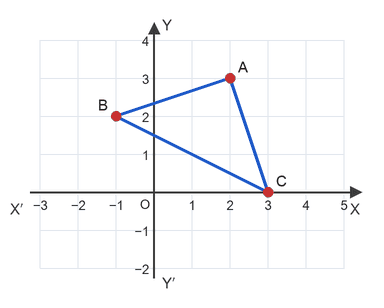
- 1123 marks
Question 112
A(8, −6), B(−4, 2) and C(0, −10) are vertices of a triangle ABC. If P is the mid-point of AB and Q is the mid-point of AC, use co-ordinate geometry to show that PQ is parallel to BC. Give a special name to quadrilateral PBCQ.
- 1133 marks
Question 113
A line AB meets the -axis at point A and -axis at point B. The point P(−4, −2) divides the line segment AB internally such that AP : PB = 1 : 2.
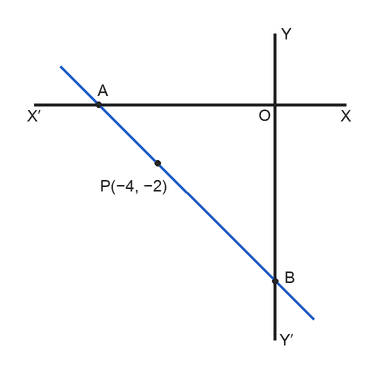
Find :
(i) the co-ordinates of A and B.
(ii) equation of line through P and perpendicular to AB.
- 1143 marks
Question 114
A line intersects -axis at point (−2, 0) and cuts off an intercept of 3 units from the positive side of -axis. Find the equation of the line.
- 1153 marks
Question 115
Find the equation of a line passing through the point (2, 3) and having the -intercept of 4 units.
- 1163 marks
Question 116
The given figure (not drawn to scale) shows two straight lines AB and CD. If equation of the line AB is : and equation of line CD is : . Write down the inclination of lines AB and CD; also, find the angle θ between AB and CD.
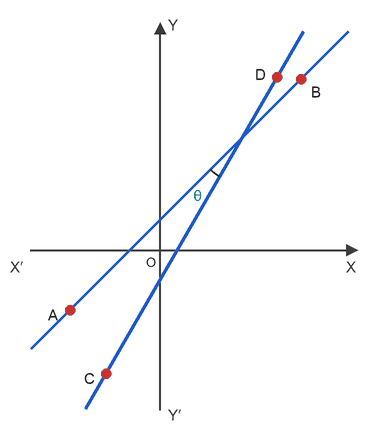
- 1173 marks
Question 117
Write down the equation of the line whose gradient is and which passes through P, where P divides the line segment joining A(−2, 6) and B(3, −4) in the ratio 2 : 3.
- 1183 marks
Question 118
The ordinate of a point lying on the line joining the points (6, 4) and (7, −5) is −23. Find the co-ordinates of that point.
- 1193 marks
Question 119
Point A and B have co-ordinates (7, −3) and (1, 9) respectively. Find :
(i) the slope of AB.
(ii) the equation of perpendicular bisector of the line segment AB.
(iii) the value of '' if (−2, ) lies on it.
- 1203 marks
Question 120
A and B are two points on the -axis and -axis respectively. P(2, −3) is the mid point of AB. Find the
(i) co-ordinates of A and B
(ii) slope of line AB
(iii) equation of line AB.

- 1213 marks
Question 121
ABCD is a parallelogram where A(, ), B(5, 8), C(4, 7) and D(2, −4). Find :
(i) co-ordinates of A
(ii) equation of diagonal BD.
- 1223 marks
Question 122
Given equation of line is .
(i) Write the slope of line if is the bisector of angle O.
(ii) Write the co-ordinates of point P.
(iii) Find the equation of .

- 1233 marks
Question 123
Find the equation of the line that has -intercept = −3 and is perpendicular to .
- 1243 marks
Question 124
A straight line passes through the points P(−1, 4) and Q(5, −2). It intersects -axis at point A and -axis at point B. M is the mid-point of the line segment AB.
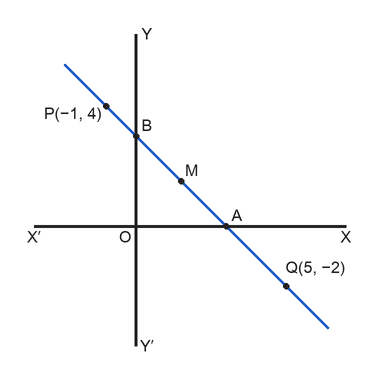
Find :
(i) the equation of the line.
(ii) the co-ordinates of points A and B.
(iii) the co-ordinates of point M.
- 1253 marks
Question 125
In the given figure, line AB meets -axis at point A. Line through C(2, 10) and D intersects line AB at right angle at point P. Find :
(i) equation of line AB.
(ii) equation of line CD.
(iii) co-ordinates of points E and D.
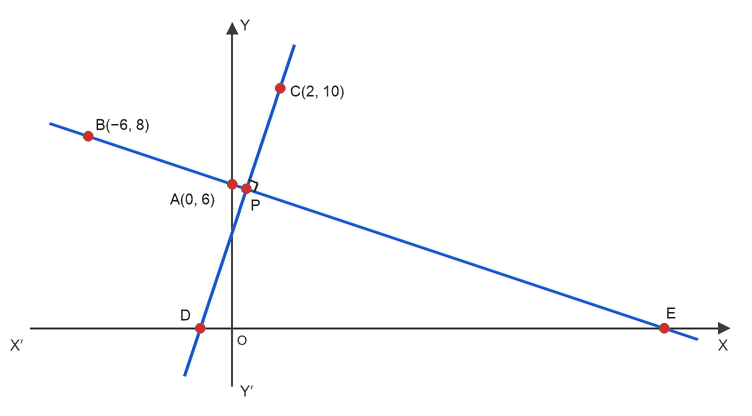
- 1263 marks
Question 126
Find the equation of the line through the points A(−1, 3) and B(0, 2). Hence, show that the points A, B and C(1, 1) are collinear.
- 1273 marks
Question 127
In the figure, given below, ABC is a triangle and BC is parallel to the -axis. AB and AC intersect the -axis at P and Q respectively.
(i) Write the co-ordinates of A.
(ii) Find the length of AB and AC.
(iii) Find the ratio in which Q divides AC.
(iv) Find the equation of the line AC.
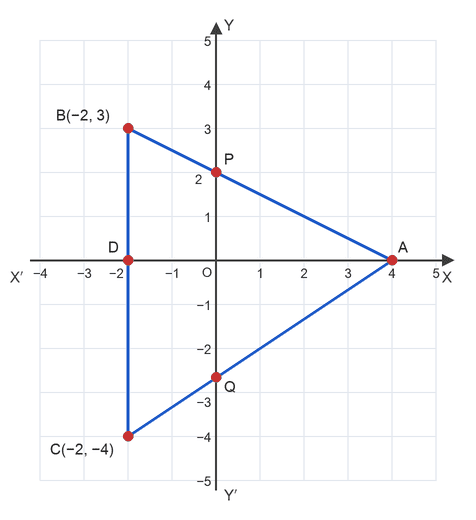
- 1283 marks
Question 128
A line AB meets X-axis at A and Y-axis at B. P(4, −1) divides AB in the ratio 1 : 2.
(i) Find the co-ordinates of A and B.
(ii) Find the equation of the line through P and perpendicular to AB.
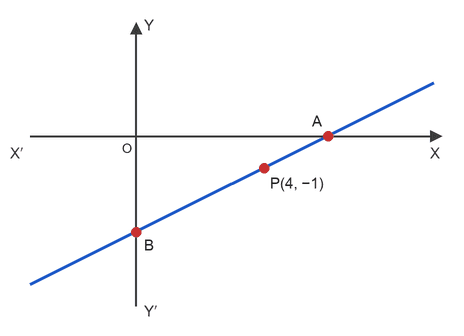
What Class 10 Maths Ch 14 covers
The sections of the chapter, in the order the book takes them. Every question above comes from one of these.
- 01A Basic Concept
- 02Inclination of a Line
- 03Slope (or Gradient) of a Straight Line
- 04Slope of a Line Passing Through Two Fixed Points
- 05Parallel and Perpendicular Lines
- 06Condition for Collinearity of Three Points
More ways to study this chapter
The same chapter asked three other ways. Practise it, revise it, and see what the board has set on Ch 14 before.
- Competency-Based Questions (CBQ)Case study questions: a situation, and the part of the chapter that answers it.40questionsOpen
- Previous Year QuestionsQuestions that have actually appeared in board papers, each tagged with its year.22questionsOpen
- Practice QuestionsExtra questions per chapter, for when one attempt at a method is not enough.42questionsOpen
Ch 14 in past ICSE papers
The same chapter as the board has actually asked it. These are worded differently from the textbook exercise, which is the point of reading them.
- 13 marks
Board paper question 1
The slope of a line joining P(6, k) and Q(1-3k, 3) is . Find
(i) k
(ii) Midpoint of PQ, using the value of 'k' found in (i).
Solve with AIWritten solution
Solution:
Concept: The slope of the line through and is . The mid-point of and is .
Given: P(6, k), Q(1 − 3k, 3) and slope of PQ .
Step 1 — Write the slope of PQ and set it equal to 1/2.
The slope of PQ is the change in y over the change in x, from P(6, k) to Q(1 − 3k, 3). It is given as :
Step 2 — Solve for k.
Cross-multiplying removes the fractions:
Step 3 — Find the points and the mid-point.
With k = −11, P is (6, −11) and Q is (1 + 33, 3), that is (34, 3). The mid-point averages the coordinates:
Check: With these points the slope of PQ works out to , as given:
Watch out: Keep the order the same on top and bottom: (y of Q − y of P) over (x of Q − x of P).
Therefore, (i) k = −11; (ii) the mid-point of PQ is .
- 23 marks
Board paper question 2
A line AB meets X-axis at A and Y- axis at B. P(4, -1) divides AB in the ratio 1:2.
(i) Find the coordinates of A and B.
(ii) Find the equation of the line through P and perpendicular to AB.
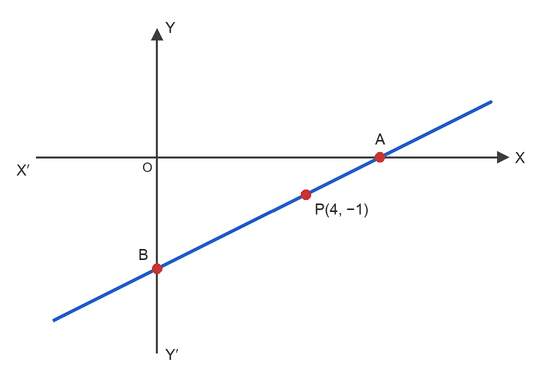 Solve with AI
Written solution
Solution:
Concept: Section formula: the point dividing the join of and in the ratio is . The slope of the line through and is . Parallel lines have equal slopes. Perpendicular lines have slopes whose product is , so each slope is the negative reciprocal of the other.
Given: AB meets the x-axis at A and the y-axis at B; P(4, −1) divides AB in the ratio 1 : 2.
Step 1 — Name A and B.
A is on the x-axis and B on the y-axis, so let A be (a, 0) and B be (0, b).
Step 2 — Use the section formula.
P(4, −1) divides AB in the ratio 1 : 2, so goes with B and goes with A:
So A is (6, 0) and B is (0, −3).
Step 3 — Find the slopes.
The slope of AB comes from A(6, 0) and B(0, −3); the required line is perpendicular to AB:
Step 4 — Write the equation through P.
The point-slope form through P(4, −1) with slope −2 gives:
Watch out: In the ratio 1 : 2 (AP : PB), the 1 multiplies the far end B and the 2 multiplies A.
Therefore, (i) A(6, 0), B(0, −3); (ii) the line is .
- 33 marks
Board paper question 3
A(-1, 3) , B(4, 2) and C(3, -2) are the vertices of a triangle.
(i) Find the coordinates of the centroid G of the triangle.
(ii) Find the equation of the line through G and parallel to AC.
Solve with AIWritten solution
Solution:
Concept: The centroid of a triangle is . The slope of the line through and is . Parallel lines have equal slopes. Perpendicular lines have slopes whose product is , so each slope is the negative reciprocal of the other.
Given: A(−1, 3), B(4, 2), C(3, −2).
Step 1 — Find the centroid.
The centroid's coordinates are the averages of the coordinates of A(−1, 3), B(4, 2) and C(3, −2):
Step 2 — Find the slope of AC.
A line parallel to AC has the same slope as AC:
Step 3 — Write the equation through G.
The point-slope form through G(2, 1) is cleared of fractions by multiplying by 4:
Watch out: Parallel means the SAME slope; do not take the negative reciprocal here.
Therefore, (i) G is (2, 1); (ii) the line is .
- 43 marks
Board paper question 4
If the straight lines and are perpendicular to one another, find the value of .
Solve with AIWritten solution
Solution:
Concept: A line has slope ; to see it, make y the subject, . Parallel lines have equal slopes. Perpendicular lines have slopes whose product is , so each slope is the negative reciprocal of the other.
Given: and are perpendicular.
Step 1 — Find the slope of the first line.
Making y the subject of shows its slope:
So .
Step 2 — Find the slope of the second line.
Making y the subject of :
So .
Step 3 — Use the perpendicular condition.
The product of the slopes must be −1:
Watch out: In the y-term is negative, so the slope is , not .
Therefore, (that is, 2.4).
- 54 marks
Board paper question 5
A(2, 5), B(– 1, 2) and C(5, 8) are the vertices of a triangle ABC, 'M' is a point on AB such that AM : MB = 1 : 2. Find the co-ordinates of 'M'. Hence find the equation of the line passing through the points C and M.
Solve with AIWritten solution
Solution:
Concept: Section formula: the point dividing the join of and in the ratio is . The slope of the line through and is . The line through with slope is (the point-slope form).
Given: A(2, 5), B(−1, 2), C(5, 8) and AM : MB = 1 : 2.
Step 1 — Find M by the section formula.
AM : MB = 1 : 2, so goes with B(−1, 2) and goes with A(2, 5):
Step 2 — Find the slope of CM.
The line passes through C(5, 8) and M(1, 4):
Step 3 — Write the equation of CM.
The point-slope form through M(1, 4) with slope 1 gives:
Check: C(5, 8) satisfies it, because . ✓
Watch out: M is one-third of the way from A to B, so it must be nearer A; (1, 4) is.
Therefore, M is (1, 4) and the line CM is .
- 63 marks
Board paper question 6
The vertices of a are A(3, 8), B(–1, 2) and C(6, –6). Find:
(i) Slope of BC.
(ii) Equation of a line perpendicular to BC and passing through A.
Solve with AIWritten solution
Solution:
Concept: The slope of the line through and is . Parallel lines have equal slopes. Perpendicular lines have slopes whose product is , so each slope is the negative reciprocal of the other. The line through with slope is (the point-slope form).
Given: A(3, 8), B(−1, 2), C(6, −6).
Step 1 — Find the slope of BC.
Using B(−1, 2) and C(6, −6):
Step 2 — Find the perpendicular slope.
The required line is perpendicular to BC, so its slope is the negative reciprocal:
Step 3 — Write the equation through A.
The point-slope form through A(3, 8) is cleared of fractions by multiplying by 8:
Watch out: The perpendicular slope is the NEGATIVE reciprocal. Turning the fraction over but keeping the sign gives a wrong line.
Therefore, (i) the slope of BC is ; (ii) the line is .
All 22 board paper questions for this chapter, solved the same way.
Class 10 Maths Ch 14 questions students ask
How many questions are there in Class 10 Maths Ch 14?
128 questions. Every one is solved step by step on this page.
Are these Class 10 Maths solutions free?
Yes. Every question and its full working is free to read, with no account needed.
Can I download the Class 10 Maths Ch 14 solutions as a PDF?
There is no PDF to download. Every solution is on this page instead, which means it is searchable, always the current syllabus, and readable on a phone. Use your browser's print option if you want it on paper.