
Opening your dashboard
Class 10 Maths Chapter 14 Equation of a Line: Previous Year Questions
22 questions on Chapter 14, each solved step by step. Class 10 Maths, ICSE 2026-27.
22 questions with solutions
1–5 marks · Mixed difficulty
The first 20 solutions are on this page. This chapter is a long one, so the rest open on their own page to keep this one quick to load.
- 13 marks
Question 1
The slope of a line joining P(6, k) and Q(1-3k, 3) is . Find
(i) k
(ii) Midpoint of PQ, using the value of 'k' found in (i).
Solve with AIWritten solution
Solution:
Concept: The slope of the line through and is . The mid-point of and is .
Given: P(6, k), Q(1 − 3k, 3) and slope of PQ .
Step 1 — Write the slope of PQ and set it equal to 1/2.
The slope of PQ is the change in y over the change in x, from P(6, k) to Q(1 − 3k, 3). It is given as :
Step 2 — Solve for k.
Cross-multiplying removes the fractions:
Step 3 — Find the points and the mid-point.
With k = −11, P is (6, −11) and Q is (1 + 33, 3), that is (34, 3). The mid-point averages the coordinates:
Check: With these points the slope of PQ works out to , as given:
Watch out: Keep the order the same on top and bottom: (y of Q − y of P) over (x of Q − x of P).
Therefore, (i) k = −11; (ii) the mid-point of PQ is .
- 23 marks
Question 2
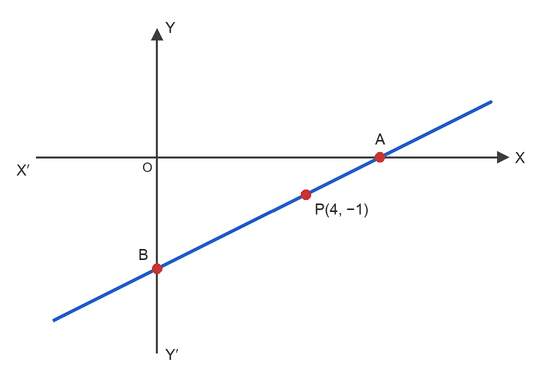
A line AB meets X-axis at A and Y- axis at B. P(4, -1) divides AB in the ratio 1:2.
(i) Find the coordinates of A and B.
(ii) Find the equation of the line through P and perpendicular to AB.
 Solve with AI
Written solution
Solution:
Concept: Section formula: the point dividing the join of and in the ratio is . The slope of the line through and is . Parallel lines have equal slopes. Perpendicular lines have slopes whose product is , so each slope is the negative reciprocal of the other.
Given: AB meets the x-axis at A and the y-axis at B; P(4, −1) divides AB in the ratio 1 : 2.
Step 1 — Name A and B.
A is on the x-axis and B on the y-axis, so let A be (a, 0) and B be (0, b).
Step 2 — Use the section formula.
P(4, −1) divides AB in the ratio 1 : 2, so goes with B and goes with A:
So A is (6, 0) and B is (0, −3).
Step 3 — Find the slopes.
The slope of AB comes from A(6, 0) and B(0, −3); the required line is perpendicular to AB:
Step 4 — Write the equation through P.
The point-slope form through P(4, −1) with slope −2 gives:
Watch out: In the ratio 1 : 2 (AP : PB), the 1 multiplies the far end B and the 2 multiplies A.
Therefore, (i) A(6, 0), B(0, −3); (ii) the line is .
- 33 marks
Question 3
A(-1, 3) , B(4, 2) and C(3, -2) are the vertices of a triangle.
(i) Find the coordinates of the centroid G of the triangle.
(ii) Find the equation of the line through G and parallel to AC.
Solve with AIWritten solution
Solution:
Concept: The centroid of a triangle is . The slope of the line through and is . Parallel lines have equal slopes. Perpendicular lines have slopes whose product is , so each slope is the negative reciprocal of the other.
Given: A(−1, 3), B(4, 2), C(3, −2).
Step 1 — Find the centroid.
The centroid's coordinates are the averages of the coordinates of A(−1, 3), B(4, 2) and C(3, −2):
Step 2 — Find the slope of AC.
A line parallel to AC has the same slope as AC:
Step 3 — Write the equation through G.
The point-slope form through G(2, 1) is cleared of fractions by multiplying by 4:
Watch out: Parallel means the SAME slope; do not take the negative reciprocal here.
Therefore, (i) G is (2, 1); (ii) the line is .
- 43 marks
Question 4
If the straight lines and are perpendicular to one another, find the value of .
Solve with AIWritten solution
Solution:
Concept: A line has slope ; to see it, make y the subject, . Parallel lines have equal slopes. Perpendicular lines have slopes whose product is , so each slope is the negative reciprocal of the other.
Given: and are perpendicular.
Step 1 — Find the slope of the first line.
Making y the subject of shows its slope:
So .
Step 2 — Find the slope of the second line.
Making y the subject of :
So .
Step 3 — Use the perpendicular condition.
The product of the slopes must be −1:
Watch out: In the y-term is negative, so the slope is , not .
Therefore, (that is, 2.4).
- 54 marks
Question 5
A(2, 5), B(– 1, 2) and C(5, 8) are the vertices of a triangle ABC, 'M' is a point on AB such that AM : MB = 1 : 2. Find the co-ordinates of 'M'. Hence find the equation of the line passing through the points C and M.
Solve with AIWritten solution
Solution:
Concept: Section formula: the point dividing the join of and in the ratio is . The slope of the line through and is . The line through with slope is (the point-slope form).
Given: A(2, 5), B(−1, 2), C(5, 8) and AM : MB = 1 : 2.
Step 1 — Find M by the section formula.
AM : MB = 1 : 2, so goes with B(−1, 2) and goes with A(2, 5):
Step 2 — Find the slope of CM.
The line passes through C(5, 8) and M(1, 4):
Step 3 — Write the equation of CM.
The point-slope form through M(1, 4) with slope 1 gives:
Check: C(5, 8) satisfies it, because . ✓
Watch out: M is one-third of the way from A to B, so it must be nearer A; (1, 4) is.
Therefore, M is (1, 4) and the line CM is .
- 63 marks
Question 6
The vertices of a are A(3, 8), B(–1, 2) and C(6, –6). Find:
(i) Slope of BC.
(ii) Equation of a line perpendicular to BC and passing through A.
Solve with AIWritten solution
Solution:
Concept: The slope of the line through and is . Parallel lines have equal slopes. Perpendicular lines have slopes whose product is , so each slope is the negative reciprocal of the other. The line through with slope is (the point-slope form).
Given: A(3, 8), B(−1, 2), C(6, −6).
Step 1 — Find the slope of BC.
Using B(−1, 2) and C(6, −6):
Step 2 — Find the perpendicular slope.
The required line is perpendicular to BC, so its slope is the negative reciprocal:
Step 3 — Write the equation through A.
The point-slope form through A(3, 8) is cleared of fractions by multiplying by 8:
Watch out: The perpendicular slope is the NEGATIVE reciprocal. Turning the fraction over but keeping the sign gives a wrong line.
Therefore, (i) the slope of BC is ; (ii) the line is .
- 73 marks
Question 7
Find the value of '' if the lines, and are perpendicular to each other. Hence, find the equation of a line passing through and parallel to .
Solve with AIWritten solution
Solution:
Concept: A line has slope ; to see it, make y the subject, . Parallel lines have equal slopes. Perpendicular lines have slopes whose product is , so each slope is the negative reciprocal of the other.
Given: The lines and are perpendicular; the new line passes through (−2, −1).
Step 1 — Write both slopes.
By the rule slope , the line has slope and the line has slope .
Step 2 — Use the perpendicular condition.
The product of the slopes is −1:
Step 3 — Find the slope of the parallel line.
Putting −10 for p, the second line becomes . A parallel line has the same slope:
Step 4 — Write the equation through (−2, −1).
The point-slope form, multiplied by 5, gives:
Watch out: With the slope is ; watch the two minus signs.
Therefore, p = −10, and the required line is .
- 81 mark
Question 8
If two lines are perpendicular to one another then the relation between their slopes and is:
Solve with AIAnswer
(A)
(B)
(C)
- Correct
(D)
Answer: (D)
Concept: Parallel lines have equal slopes. Perpendicular lines have slopes whose product is , so each slope is the negative reciprocal of the other.
Step 1 — Recall the condition.
When two lines are perpendicular, one slope is the negative reciprocal of the other, ; multiplying both sides by , we get .
Step 2 — Test it with an example.
Slopes 2 and belong to perpendicular lines, and their product is −1:
Watch out: The minus sign matters: a product of +1 does not give perpendicular lines.
Why the other options are wrong:
- (A) : this is the condition for parallel lines, not perpendicular ones.
- (B) : this makes the product equal to +1; slopes 2 and give lines that are not perpendicular.
- (C) : this works only for slopes 1 and −1; slopes 2 and −2 have product −4, so those lines are not perpendicular.
Therefore, the relation is , option (D).
- 92 marks
Question 9
Find '' if A , B and C are collinear.
Solve with AIWritten solution
Solution:
Concept: Three points are collinear (on one straight line) when the slope of AB equals the slope of BC. The slope of the line through and is .
Given: A(2a + 2, 3), B(7, 4), C(2a + 5, 2) are collinear.
Step 1 — Write the slope of AB.
Points are collinear when the slope of AB equals the slope of BC. From A(2a + 2, 3) to B(7, 4):
Step 2 — Write the slope of BC.
From B(7, 4) to C(2a + 5, 2):
Step 3 — Equate the slopes and solve.
Setting the two slopes equal and cross-multiplying:
Check: With a = 4 the points are A(10, 3), B(7, 4), C(13, 2). The slopes and are both . ✓
Watch out: Expand carefully: it is .
Therefore, a = 4.
- 102 marks
Question 10
Line AB is perpendicular to CD coordinates of B, C and D respectively (4, 0), (0, –1) and (4, 3).

Find
(a) Slope of CD
(b) Equation of AB
Solve with AIWritten solution
Solution:
Concept: The slope of the line through and is . Parallel lines have equal slopes. Perpendicular lines have slopes whose product is , so each slope is the negative reciprocal of the other.
Given: AB ⊥ CD with B(4, 0), C(0, −1), D(4, 3).
Step 1 — Find the slope of CD.
Using C(0, −1) and D(4, 3):
Step 2 — Find the slope of AB.
AB is perpendicular to CD, so its slope is the negative reciprocal of 1, which is −1.
Step 3 — Write the equation of AB.
AB passes through B(4, 0) with slope −1:
Watch out: The perpendicular slope is the NEGATIVE reciprocal. Turning the fraction over but keeping the sign gives a wrong line.
Therefore, (a) the slope of CD is 1; (b) AB is .
- 113 marks
Question 11
Find the equation of a line parallel to the line and passing through the intersection of the lines and .
Solve with AIWritten solution
Solution:
Concept: A line has slope ; to see it, make y the subject, . Parallel lines have equal slopes. Perpendicular lines have slopes whose product is , so each slope is the negative reciprocal of the other.
Given: Parallel to , through the meeting point of and .
Step 1 — Find the point of intersection.
Adding the equations and removes y:
Then, from the first equation, y is 4 − 4, which is 0; so the lines meet at (4, 0).
Step 2 — Find the slope.
The line has slope , that is −2. A parallel line has slope −2 too.
Step 3 — Write the equation.
The point-slope form through (4, 0) with slope −2:
Watch out: The new line keeps the x and y coefficients 2 and 1; only the constant changes.
Therefore, the required line is .
- 123 marks
Question 12
ABC is a triangle whose vertices are , and .
D is the midpoint of BC. Find the :
(a) coordinates of D.
(b) equation of the median AD.
Solve with AIWritten solution
Solution:
Concept: The mid-point of and is . A median joins a vertex to the mid-point of the opposite side. The slope of the line through and is .
Given: A(1, −1), B(0, 4), C(−6, 4).
Step 1 — Find D, the mid-point of BC.
Averaging the coordinates of B(0, 4) and C(−6, 4):
Step 2 — Find the slope of AD.
Using A(1, −1) and D(−3, 4):
Step 3 — Write the equation of the median AD.
The point-slope form through A(1, −1), multiplied by 4:
Check: D(−3, 4) satisfies it, because . ✓
Watch out: (4 − (−1)) is 5, not 3; subtracting a negative adds.
Therefore, (a) D is (−3, 4); (b) the median AD is .
- 131 mark
Question 13
Points , and are collinear. The value of in terms of is :
Solve with AIAnswer
(A)
(B)
(C)
- Correct
(D)
Answer: (D)
Concept: Three points are collinear when the slope between any two pairs is the same. The line through with slope is (the point-slope form).
Step 1 — Find the slope of BC.
Since A, B, C are on one line, the line is fixed by B(3, −2) and C(4, −5):
Step 2 — Write the line through B and put in A(x, y).
Any point (x, y) on the line satisfies the point-slope form through B:
Check: Putting in the x-coordinates of B and C gives back their y-coordinates: 3 gives −2 and 4 gives −5. ✓
Watch out: The line falls from B to C (y goes down as x goes up), so the coefficient of x must be negative.
Why the other options are wrong:
- (A) : has slope +3, but the line through B and C has slope −3.
- (B) : at x = 3 it gives 2 instead of −2, so it misses B(3, −2).
- (C) : has slope +3 as well, so it rises where the real line falls.
Therefore, , option (D).
- 143 marks
Question 14
(a) If the lines and are perpendicular to each other, find the value of .
(b) Find the equation of a line parallel to and passing through
Solve with AIWritten solution
Solution:
Concept: In , m is the slope and c is the y-intercept. Parallel lines have equal slopes. Perpendicular lines have slopes whose product is , so each slope is the negative reciprocal of the other.
Given: , ; point (−1, 1).
Step 1 — Write both slopes.
Written as , the first line has slope k; written as , the second line has slope 3.
Step 2 — Find k.
The lines are perpendicular, so the product of the slopes is −1:
Step 3 — Write the parallel line through (−1, 1).
A line parallel to has slope 3:
Watch out: Divide by 2 first: the slope is 3, not 6.
Therefore, (a) ; (b) the line is (or ).
- 151 mark
Question 15
The equation of the line passing through origin and parallel to the line is:
Solve with AIAnswer
(A)
(B)
(C)
- Correct
(D)
Answer: (D)
Concept: A line has slope ; to see it, make y the subject, . Parallel lines differ only in the constant term.
Step 1 — Keep the same slope.
A line parallel to has the same slope, , so it can be written with only the constant c changed.
Step 2 — Use the origin.
The line passes through (0, 0), so putting x = 0 and y = 0 must satisfy it:
So the line is .
Watch out: A line through the origin has no constant term.
Why the other options are wrong:
- (A) : it is parallel, but at (0, 0) its left side is 5, not 0; so it misses the origin.
- (B) : it has slope , so it is perpendicular to the given line, and it misses the origin too.
- (C) : it passes through the origin but has slope ; so it is perpendicular, not parallel.
Therefore, the line is , option (D).
- 165 marks
Question 16
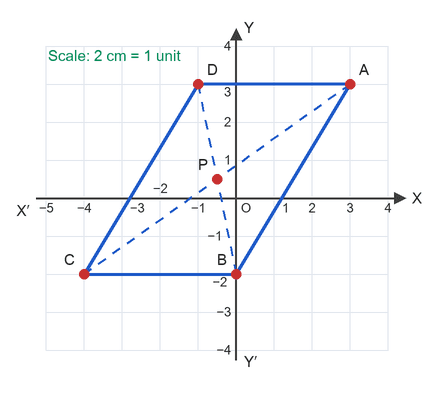
In the given graph ABCD is a parallelogram.
Using the graph, answer the following:
(a) write down the coordinates of A, B, C and D.
(b) calculate the coordinates of ‘P’, the point of intersection of the diagonals AC and BD.
(c) find the slope of sides CB and DA and verify that they represent parallel lines.
(d) find the equation of the diagonal AC.
Solve with AIWritten solution
Solution:
Concept: The mid-point of and is . The diagonals of a parallelogram bisect each other. The slope of the line through and is . Lines with equal slopes are parallel.
Given: ABCD is a parallelogram (graph).
Step 1 — Read the vertices.
From the graph: A(3, 3), B(0, −2), C(−4, −2) and D(−1, 3).
Step 2 — Find P, the meeting point of the diagonals.
The diagonals of a parallelogram bisect each other, so P is the mid-point of AC (and also of BD):
The mid-point of BD, , is the same point.
Step 3 — Find the slopes of CB and DA.
Both slopes come from the slope formula:
The slopes are equal (both 0, both lines horizontal), so CB ∥ DA.
Step 4 — Find the slope of AC.
Using A(3, 3) and C(−4, −2):
Step 5 — Write the equation of AC.
The point-slope form through A(3, 3), multiplied by 7:
Check: C(−4, −2) satisfies it, because . ✓
Watch out: A horizontal line has slope 0; a vertical line has no defined slope.
Therefore, (a) A(3, 3), B(0, −2), C(−4, −2), D(−1, 3); (b) ; (c) both slopes are 0, so CB ∥ DA; (d) AC is .
- 173 marks
Question 17
In the given graph, P and Q are points such that PQ cuts off intercepts of 5 units and 3 units along the x-axis and y-axis respectively. Line RS is perpendicular to PQ and passes through the origin. Find the:
(a) coordinates of P and Q
(b) equation of line RS
 Solve with AI
Written solution
Solution:
Concept: A line through the origin with slope m is . The slope of the line through and is . Parallel lines have equal slopes. Perpendicular lines have slopes whose product is , so each slope is the negative reciprocal of the other.
Given: Intercepts 5 (x-axis) and 3 (y-axis, below O); RS ⊥ PQ through O.
Step 1 — Read P and Q.
PQ cuts the x-axis 5 units to the right of O, so P is (5, 0). The graph shows Q 3 units BELOW O on the y-axis, so Q is (0, −3).
Step 2 — Find the slope of PQ and of RS.
RS is perpendicular to PQ:
Step 3 — Write the equation of RS.
RS passes through the origin (0, 0), so its equation is :
Watch out: The intercept on the y-axis is 3 units long, but the graph puts Q below O, so its coordinate is −3.
Therefore, (a) P(5, 0) and Q(0, −3); (b) RS is .
- 183 marks
Question 18
Equation of a line AB is . A perpendicular PQ is dropped on AB from the point meeting AB at Q. Find the:
(a) equation of PQ.
(b) coordinates of the point Q.
Solve with AIWritten solution
Solution:
Concept: A line has slope ; to see it, make y the subject, . Parallel lines have equal slopes. Perpendicular lines have slopes whose product is , so each slope is the negative reciprocal of the other. The foot of a perpendicular is where the two lines meet: solve them together.
Given: AB: ; PQ ⊥ AB from P(3, −2), meeting AB at Q.
Step 1 — Find the slope of AB and of PQ.
AB is , so its slope is . PQ is perpendicular to AB, so its slope is 2.
Step 2 — Write the equation of PQ.
The point-slope form through P(3, −2) with slope 2:
Step 3 — Find Q, where PQ meets AB.
Q lies on both lines. From PQ, y is ; we put this into the equation of AB:
Check: Q(2, −4) is on AB, because . ✓
Watch out: The perpendicular slope is the NEGATIVE reciprocal. Turning the fraction over but keeping the sign gives a wrong line.
Therefore, (a) PQ is ; (b) Q is .
- 191 mark
Question 19
Find the equation of a line whose y-intercept is 6 and is parallel to x-axis.
Solve with AIAnswer
- Correct
(A)
(B)
(C)
(D)
Answer: (A)
Concept: A horizontal line (parallel to the x-axis) has slope 0 and equation , where c is its y-intercept.
Step 1 — Picture the line.
A line parallel to the x-axis is horizontal. Every point on it has the same y-value.
Step 2 — Use the y-intercept.
The line cuts the y-axis at y = 6, so that common y-value is 6. Its equation is therefore .
Watch out: A line parallel to the x-axis has an equation in y only, not in x.
Why the other options are wrong:
- (B) : it is a vertical line, parallel to the y-axis.
- (C) : it has slope −1, so it is not parallel to the x-axis.
- (D) : it has slope 1, so it is not parallel to the x-axis either.
Therefore, the line is , option (A).
- 203 marks
Question 20
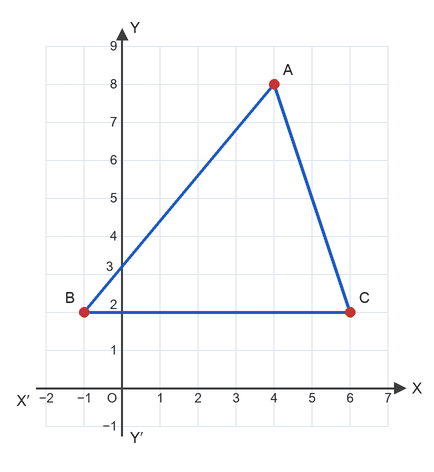
Use the following graph and answer the given questions :
(a) Write the co-ordinates of points A, B and C.
(b) Find the equation of a line passing through the mid-point of AC and parallel to AB.
 Solve with AI
Written solution
Solution:
Concept: The mid-point of and is . The slope of the line through and is . Parallel lines have equal slopes. Perpendicular lines have slopes whose product is , so each slope is the negative reciprocal of the other.
Given: The graph of triangle ABC.
Step 1 — Read the points.
From the graph: A(4, 8), B(−1, 2) and C(6, 2).
Step 2 — Find the mid-point of AC.
Averaging the coordinates of A(4, 8) and C(6, 2):
Step 3 — Find the slope of AB.
The new line is parallel to AB, so it has the slope of AB:
Step 4 — Write the equation.
The point-slope form through (5, 5), multiplied by 5:
Watch out: Parallel lines share the slope; do not take the negative reciprocal.
Therefore, (a) A(4, 8), B(−1, 2), C(6, 2); (b) the line is .
- 211 mark
Question 21
The points , and are collinear. The value of is:
- 223 marks
Question 22
The equation of a line is . Find the:
(a) slope of the line.
(b) equation of a line perpendicular to the given line and having a y-intercept equals to 2.