Solution:
Concept: The mid-point of (x1,y1) and (x2,y2) is (2x1+x2,2y1+y2). The diagonals of a parallelogram bisect each other. The slope of the line through (x1,y1) and (x2,y2) is m=x2−x1y2−y1. Lines with equal slopes are parallel.
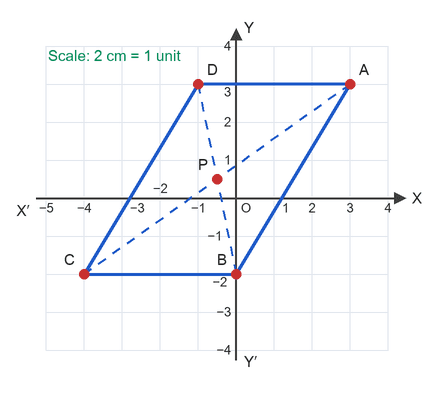
Given: ABCD is a parallelogram (graph).
Step 1 — Read the vertices.
From the graph: A(3, 3), B(0, −2), C(−4, −2) and D(−1, 3).
Step 2 — Find P, the meeting point of the diagonals.
The diagonals of a parallelogram bisect each other, so P is the mid-point of AC (and also of BD):
xP=23+(−4)=−21
yP=23+(−2)=21
The mid-point of BD, (20+(−1),2−2+3), is the same point.
Step 3 — Find the slopes of CB and DA.
Both slopes come from the slope formula:
mCB=0−(−4)−2−(−2)=40=0
mDA=3−(−1)3−3=40=0
The slopes are equal (both 0, both lines horizontal), so CB ∥ DA.
Step 4 — Find the slope of AC.
Using A(3, 3) and C(−4, −2):
mAC=−4−3−2−3=−7−5=75
Step 5 — Write the equation of AC.
The point-slope form through A(3, 3), multiplied by 7:
y−3=75(x−3)
7y−21=5x−15
5x−7y+6=0
Check: C(−4, −2) satisfies it, because −20+14+6=0. ✓
Watch out: A horizontal line has slope 0; a vertical line has no defined slope.
Therefore, (a) A(3, 3), B(0, −2), C(−4, −2), D(−1, 3); (b) P(−21,21); (c) both slopes are 0, so CB ∥ DA; (d) AC is 5x−7y+6=0.