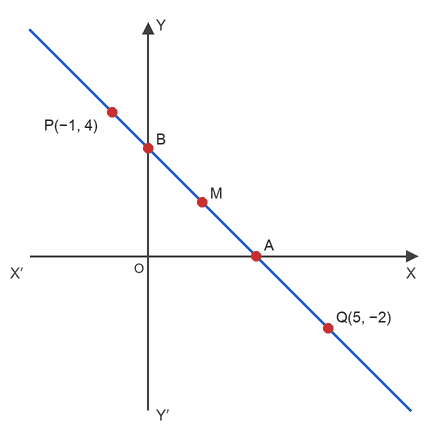
Solution:
Concept: The slope (gradient) of the line through (x1,y1) and (x2,y2) is m=x2−x1y2−y1, the rise divided by the run. The point–slope form: the line through the point (x1,y1) with slope m is y−y1=m(x−x1). We then clear fractions and collect the terms to give a neat equation. So for a line through two points we first find its slope. On the x-axis every point has y-co-ordinate 0, and on the y-axis every point has x-co-ordinate 0. The mid-point of the join of (x1,y1) and (x2,y2) is (2x1+x2,2y1+y2).
Step 1 — Part (i): slope of PQ.
We take P(−1, 4) and Q(5, −2).
m=x2−x1y2−y1=5−(−1)−2−4=6−6=−1
Step 2 — Part (i): equation.
We use the point–slope form with P(−1, 4), expand and collect the terms.
y−4y−4x+y=−1(x+1)=−x−1=3
Step 3 — Part (ii): A and B.
A is on the x-axis, so we put y=0; B is on the y-axis, so we put x=0.
x+0x=3=3
0+yy=3=3
So A is (3, 0) and B is (0, 3).
Step 4 — Part (iii): M, the mid-point of AB.
We use the mid-point formula with A(3, 0) and B(0, 3).
x=2x1+x2=23+0=23
y=2y1+y2=20+3=23
So M is (23,23).
Watch out: A is where the line meets the x-axis (put y=0) and B where it meets the y-axis (put x=0).
Therefore, (i) x+y=3; (ii) A(3, 0) and B(0, 3); (iii) M(23,23).