
Question 52 marksEasy
Mention the basic tendency of an atom which makes it to combine with other atoms.
Confirming your payment
Sign up now and get 250 free tokens.
Chemical Bonding · Question 5 of 71
Mention the basic tendency of an atom which makes it to combine with other atoms.
Solution:
Concept: Noble gases (helium, neon, argon …) do not combine, because their outermost shells are already complete. All other atoms have incomplete outermost shells.
Step 1 — See why noble gases are stable.
Neon (2, 8) and argon (2, 8, 8) have 8 electrons in their outermost shell (helium has 2). These complete shells make them unreactive.
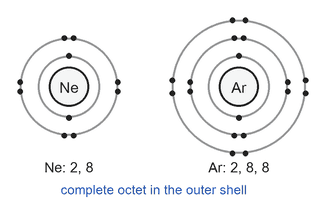
Step 2 — State the tendency of other atoms.
Every other atom tends to attain the stable electronic configuration of the nearest noble gas: an octet (8 electrons) in its outermost shell, or a duplet (2 electrons) for atoms close to helium, such as hydrogen and lithium.
Step 3 — Say how it reaches this configuration.
To reach it, the atom combines with other atoms by losing, gaining or sharing electrons. This tendency is the reason atoms form chemical bonds.
Therefore, the basic tendency of an atom is to attain the stable octet (or duplet) configuration of the nearest noble gas, by losing, gaining or sharing electrons, and this makes it combine with other atoms.