
Question 45 marksEasy
An atom X has three electrons more than the noble gas configuration. What type of ion will it form ? Write the formula of its (i) sulphate (ii) nitrate (iii) phosphate (iv) carbonate (v) hydroxide.
Confirming your payment
Sign up now and get 250 free tokens.
Chemical Bonding · Question 4 of 71
An atom X has three electrons more than the noble gas configuration. What type of ion will it form ? Write the formula of its (i) sulphate (ii) nitrate (iii) phosphate (iv) carbonate (v) hydroxide.
Solution:
Concept: In an ionic compound the total positive charge equals the total negative charge, so the compound is neutral. To write its formula, take enough of each ion to make the charges cancel (criss-cross the valencies and reduce to the simplest ratio).
Step 1 — Decide the type of ion.
X has 3 electrons more than a noble gas configuration. The easiest way to reach that stable configuration is to lose these 3 electrons, so X forms a cation with a charge of 3+ (its valency is 3).
Step 2 — List the acid radicals and their valencies.
Each formula needs the charge of the negative ion: sulphate (2), nitrate (1), phosphate (3), carbonate (2) and hydroxide (1).
Step 3 — Balance the charges for each compound.
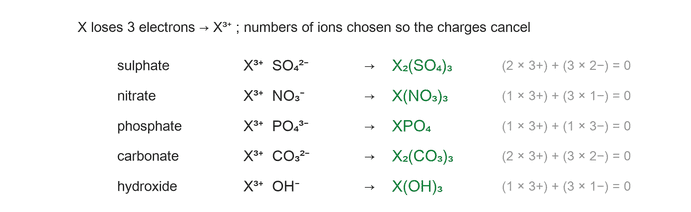
Take enough of each ion so that the total positive charge equals the total negative charge, as in the table below.
| Compound | Ions taken | Charge check | Formula |
|---|---|---|---|
| (i) Sulphate | 2 X³⁺ and 3 SO₄²⁻ | 6+ and 6− | |
| (ii) Nitrate | 1 X³⁺ and 3 NO₃⁻ | 3+ and 3− | |
| (iii) Phosphate | 1 X³⁺ and 1 PO₄³⁻ | 3+ and 3− | |
| (iv) Carbonate | 2 X³⁺ and 3 CO₃²⁻ | 6+ and 6− | |
| (v) Hydroxide | 1 X³⁺ and 3 OH⁻ | 3+ and 3− |
Step 4 — Check with a real element.
Aluminium (2, 8, 3) has three electrons more than neon and behaves exactly like X: its compounds are , , and .
Watch out: Put brackets round a polyatomic ion when more than one of it is needed: X(NO₃)₃, not XNO₃₃.
Therefore, X forms the cation X³⁺, and the formulae are (i) X₂(SO₄)₃, (ii) X(NO₃)₃, (iii) XPO₄, (iv) X₂(CO₃)₃ and (v) X(OH)₃.