
Question 32 marksEasy
What are the conditions for the formation of an electrovalent bond ?
Confirming your payment
Sign up now and get 250 free tokens.
Chemical Bonding · Question 3 of 71
What are the conditions for the formation of an electrovalent bond ?
Solution:
Concept: An ionic bond needs one atom that gives up electrons easily (to form a cation) and another atom that takes them up easily (to form an anion).
Step 1 — Condition on the atom that loses electrons.
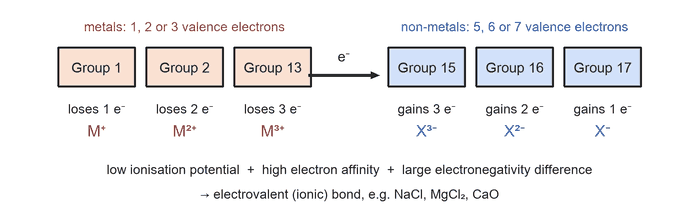
The metal atom should have a low ionisation potential (the energy needed to remove an electron), so that it loses its valence electron(s) easily and forms a cation. Metals of groups 1, 2 and 13, with 1, 2 or 3 valence electrons, have low ionisation potentials.
Step 2 — Condition on the atom that gains electrons.
The non-metal atom should have a high electron affinity (it gives out energy readily when it takes an electron), so that it accepts electron(s) easily and forms an anion. The non-metals of groups 16 and 17, with 6 or 7 valence electrons, are the best examples; nitrogen of group 15 also forms the N³⁻ ion with very reactive metals (as in magnesium nitride).
Step 3 — Condition on the pair of atoms.
There should be a large difference in electronegativity between the two atoms. The larger the difference, the more completely the electron is transferred and the more ionic the compound (caesium fluoride, CsF, is among the most ionic compounds known).
Watch out: A low ionisation potential is needed for the metal and a high electron affinity for the non-metal; do not swap them.
Therefore, an electrovalent bond forms when (1) the metal atom has a low ionisation potential, (2) the non-metal atom has a high electron affinity, and (3) the electronegativity difference between the two atoms is large.