
Question 64 marksEasy
The element X has the electronic configuration 2, 8, 18, 8, 1. Without identifying X,
(a) predict the sign and charge on a simple ion of X.
(b) write if X will be an oxidising agent or a reducing agent and why.
Confirming your payment
Sign up now and get 250 free tokens.
Chemical Bonding · Question 6 of 71
The element X has the electronic configuration 2, 8, 18, 8, 1. Without identifying X,
(a) predict the sign and charge on a simple ion of X.
(b) write if X will be an oxidising agent or a reducing agent and why.
Solution:
Concept: A metal atom with 1, 2 or 3 valence electrons loses them to reach a noble gas configuration and forms a positive ion. A reducing agent is an electron donor; an oxidising agent is an electron acceptor.
Step 1 — Count the valence electrons.
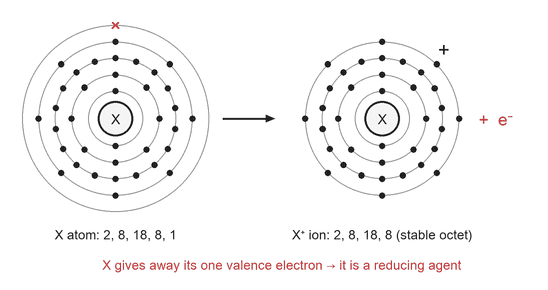
The configuration 2, 8, 18, 8, 1 shows only one electron in the outermost shell. Losing one electron is far easier than gaining seven.
Step 2 — Predict the ion.
(a) X loses its single valence electron. The shell beneath (2, 8, 18, 8) then becomes the outermost shell, with a stable octet.
The ion has one electron fewer than it has protons, so it carries one unit of positive charge: X⁺.
Step 3 — Decide oxidising or reducing agent.
(b) X readily gives away its valence electron to another substance. A substance that donates electrons is a reducing agent: the substance that takes the electron is reduced, while X itself is oxidised.
Watch out: Do not call X an oxidising agent because it 'gets oxidised'; the substance that is oxidised is the reducing agent.
Therefore, (a) the ion of X is positive with a single charge, X⁺; (b) X is a reducing agent, because it readily loses (donates) its one valence electron.