
Question 643 marksEasy
Acids dissolve in water and produce positively charged ions. Draw the structure of these positive ions.
Confirming your payment
Sign up now and get 250 free tokens.
Chemical Bonding · Question 64 of 71
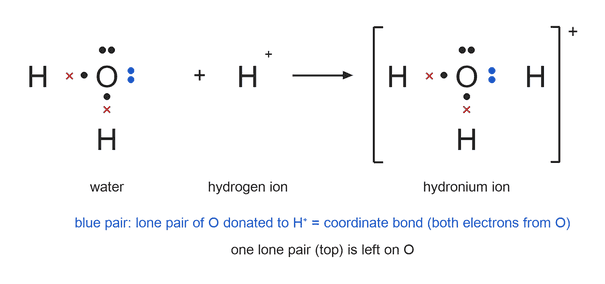
Acids dissolve in water and produce positively charged ions. Draw the structure of these positive ions.
Solution:
Concept: A coordinate (dative) bond is a covalent bond in which both electrons of the shared pair come from the same atom (the donor, which has a lone pair) and are accepted by an atom or ion that is short of a pair (the acceptor, such as ). It is shown by an arrow from the donor to the acceptor.
Step 1 — The acid ionises.
An acid gives H⁺ ions in water, for example hydrogen chloride:
Step 2 — H⁺ joins a water molecule.
A bare H⁺ ion has no electrons, so it attaches to a lone pair on the oxygen of a water molecule. The positive ion formed is the hydronium ion.
Step 3 — Describe its structure.
The hydronium ion contains two covalent O–H bonds and one coordinate bond (both electrons from oxygen), with one lone pair left on oxygen.
Therefore, the positive ion produced by acids in water is the hydronium ion, H₃O⁺, whose structure is shown above.