Solution:
Concept: Atoms of the noble gases (helium, neon, argon …) are stable and do not combine, because their outermost shell is complete: 8 electrons (an octet), or 2 electrons (a duplet) for helium. Every other atom tends to reach the electronic configuration of its nearest noble gas by losing, gaining or sharing electrons, and this is why atoms form chemical bonds. Atoms with few valence electrons release them; atoms with many require more (by gaining or by sharing).
Step 1 — Count the atoms.
(a) Read the number of atoms of each kind from the formula.
| Substance | Formula | Atoms present |
|---|
| Calcium oxide | CaO | 1 Ca, 1 O |
| Chlorine | Cl₂ | 2 Cl |
| Water | H₂O | 2 H, 1 O |
| Carbon tetrachloride | CCl₄ | 1 C, 4 Cl |
Step 2 — Electrons required or released.
(b) Compare each atom's valence electrons with the nearest noble gas configuration.
| Atom | Electronic configuration | Electrons to reach a noble gas configuration |
|---|
| Ca | 2, 8, 8, 2 | releases 2 (→ argon 2, 8, 8) |
| O | 2, 6 | requires 2 (→ neon 2, 8) |
| Cl | 2, 8, 7 | requires 1 (→ argon 2, 8, 8) |
| H | 1 | requires 1 (→ helium 2) |
| C | 2, 4 | requires 4, by sharing (→ neon 2, 8) |
Step 3 — How the electrons are obtained.
In Cl₂, H₂O and CCl₄ the electrons are obtained by sharing; in CaO they are transferred.
Ca+O→Ca2++O2−
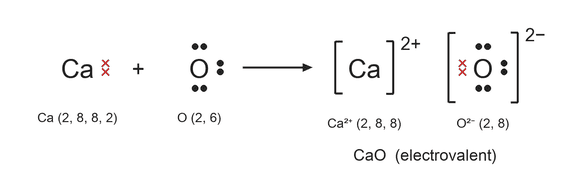
Watch out: CaO is ionic, so strictly it has no molecules; CaO is its formula unit (1 Ca²⁺ and 1 O²⁻).
Therefore, (a) CaO has 1 Ca and 1 O, Cl₂ has 2 Cl, H₂O has 2 H and 1 O, CCl₄ has 1 C and 4 Cl; (b) Ca releases 2, O requires 2, Cl requires 1, H requires 1 and C requires 4 electrons.
