
Question 625 marksMedium
Draw an electron dot diagram for the formation of each of the following :
(a) Hydronium ion (b) Ammonium ion
(c) Hydroxyl ion.
State the type of bonding present in them.
Confirming your payment
Sign up now and get 250 free tokens.
Chemical Bonding · Question 62 of 71
Draw an electron dot diagram for the formation of each of the following :
(a) Hydronium ion (b) Ammonium ion
(c) Hydroxyl ion.
State the type of bonding present in them.
Solution:
Concept: A coordinate (dative) bond is a covalent bond in which both electrons of the shared pair come from the same atom (the donor, which has a lone pair) and are accepted by an atom or ion that is short of a pair (the acceptor, such as ). It is shown by an arrow from the donor to the acceptor. The hydroxyl ion forms when water loses H⁺, leaving the shared pair behind on oxygen.
Step 1 — Hydronium ion.
(a) A lone pair on the oxygen of water is donated to H⁺.
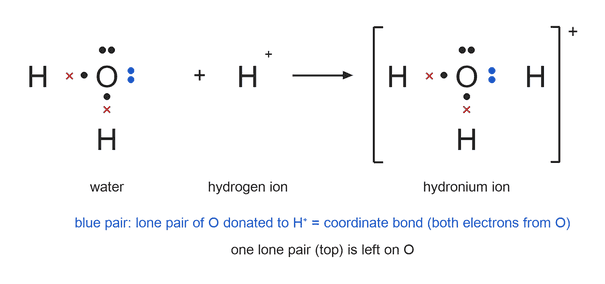
Bonding: two covalent O–H bonds and one coordinate bond; one lone pair remains on oxygen.
Step 2 — Ammonium ion.
(b) The lone pair on the nitrogen of ammonia is donated to H⁺.

Bonding: three covalent N–H bonds and one coordinate bond; no lone pair remains, and once formed all four N–H bonds are identical.
Step 3 — Hydroxyl ion.
(c) A water molecule loses a hydrogen ion. Oxygen is more electronegative, so it keeps the electron pair it shared with that hydrogen, and the ion carries one negative charge.
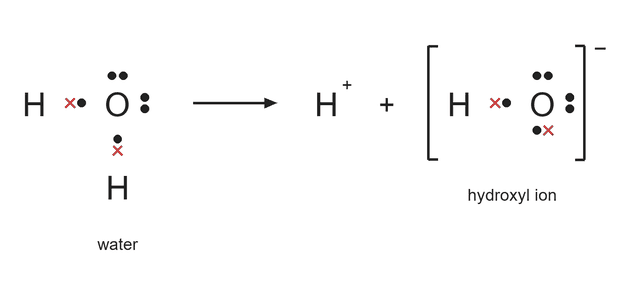
Bonding: one covalent O–H bond.
Watch out: H⁺ has no electrons at all, so it can only be joined by a coordinate bond.
Therefore, the hydronium ion has covalent and coordinate bonds, the ammonium ion has covalent and coordinate bonds, and the hydroxyl ion has a covalent bond, as shown in the diagrams.