
Question 613 marksEasy
Define a coordinate bond and give the conditions for its formation.
Confirming your payment
Sign up now and get 250 free tokens.
Chemical Bonding · Question 61 of 71
Define a coordinate bond and give the conditions for its formation.
Solution:
Concept: A coordinate (dative) bond is a covalent bond in which both electrons of the shared pair come from the same atom (the donor, which has a lone pair) and are accepted by an atom or ion that is short of a pair (the acceptor, such as ). It is shown by an arrow from the donor to the acceptor.
Step 1 — Define the bond.
A coordinate (dative) bond is the bond formed between two atoms by sharing a pair of electrons that is provided entirely by one of the combining atoms but shared by both. The atom that gives the pair is the donor; the atom or ion that accepts it is the acceptor. The bond is shown by an arrow (→) from the donor to the acceptor.
Step 2 — First condition.
One of the two atoms must have at least one lone pair of electrons to donate (e.g. nitrogen in NH₃, oxygen in H₂O).
Step 3 — Second condition.
The other atom or ion must be short of a pair of electrons (e.g. the hydrogen ion, H⁺, which has no electrons), so that it can accept the pair.
Step 4 — Example.
The lone pair of ammonia is donated to a hydrogen ion.
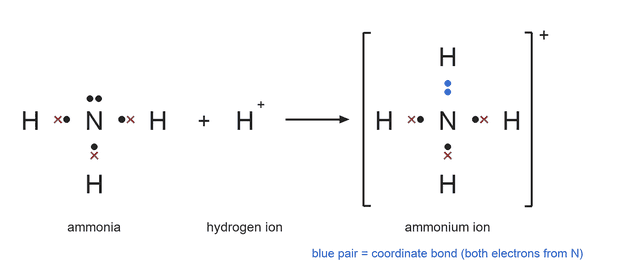
Therefore, a coordinate bond is a shared pair donated entirely by one atom; it needs a donor with a lone pair and an acceptor short of a pair of electrons.