Solution:
Concept: An electrovalent (ionic) bond forms when one or more electrons are transferred from a metal atom (which becomes a positive ion, a cation) to a non-metal atom (which becomes a negative ion, an anion). The oppositely charged ions are held together by strong electrostatic forces of attraction.
Step 1 — Identify A and B.
A (2, 8, 1) is sodium, which loses 1 electron; B (2, 6) is oxygen, which gains 2 electrons.
Step 2 — Formation of the ions.
(a) A loses its one valence electron and B gains two electrons.
A→A++e−
B+2e−→B2−
Step 3 — Why ions form.
(b) By losing or gaining electrons, both A and B attain the stable octet (noble gas) configuration of neon, 2, 8.
Step 4 — Which pair forms a compound.
(c) Only (ii) A and B form a compound. One B needs 2 electrons and each A gives only 1, so two A atoms combine with one B, giving A₂B. The bonding is electrovalent (ionic).
4A+B2→2A2B
A and A only give the metal itself, and B and B give the element B₂ (oxygen gas, covalent), so neither of these is a compound.
Step 5 — Which atom is oxidised.
(d) A loses electrons, so A is oxidised.
Step 6 — Electron dot diagram.
(e) Each of the two A atoms gives one electron (×) to B.
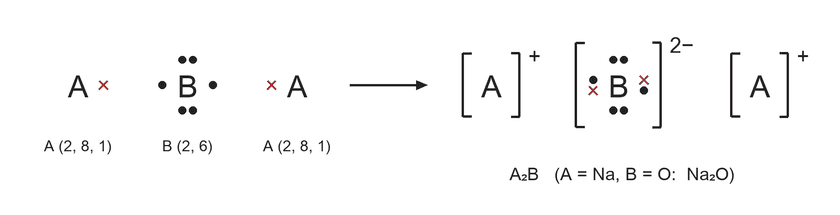
Step 7 — Formulae with the given properties.
(f) (i) A₂B has a high melting and boiling point, since it is an ionic solid. (ii) No compound of A and B is a gas: A₂B is a solid; the only gaseous substance these atoms form is B₂ (O₂), which is an element. (iii) A₂B is a good conductor in the molten state, because its ions become free to move.
Watch out: Count the charges: 2 × (+1) balances one 2−, so the formula is A₂B, not AB.
Note: part (f)(ii) asks for a gaseous compound, but A₂B is a solid; the gas the question most likely means is B₂ from 'B and B' in part (c), which is an element.
Therefore, (a) A → A⁺ + e⁻ and B + 2e⁻ → B²⁻; (b) to attain the octet of neon; (c) A and B, forming the ionic compound A₂B; (d) A is oxidised; (e) as in the diagram; (f) (i) A₂B, (ii) B₂ is the only gas (an element, not a compound), (iii) A₂B.
