
Question 655 marksEasy
(a) Elements Q and S react together to form an ionic compound. Under normal condition, which physical state will the compound QS exist in ?
(b) Can Q and S, both be metals? Justify your answer.
Confirming your payment
Sign up now and get 250 free tokens.
Chemical Bonding · Question 65 of 71
(a) Elements Q and S react together to form an ionic compound. Under normal condition, which physical state will the compound QS exist in ?
(b) Can Q and S, both be metals? Justify your answer.
Solution:
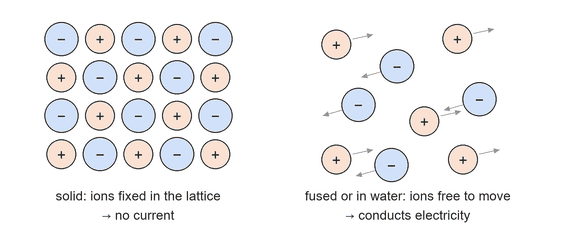
Concept: An electrovalent (ionic) bond forms when one or more electrons are transferred from a metal atom (which becomes a positive ion, a cation) to a non-metal atom (which becomes a negative ion, an anion). The oppositely charged ions are held together by strong electrostatic forces of attraction.
Step 1 — State of QS.
(a) QS is ionic, so its ions are held in a crystal lattice by strong electrostatic forces. Under normal conditions it exists as a solid (hard and crystalline).
Step 2 — Can both be metals?.
(b) No. In an ionic compound one element must lose electrons (a metal, forming a cation) and the other must gain them (a non-metal, forming an anion). Metals only lose electrons; neither metal would accept them. So one of Q and S must be a non-metal.
Therefore, (a) QS is a solid, and (b) Q and S cannot both be metals, because one of them must gain electrons to form an anion.