
Question 411 markMCQEasy
Which of the following is not a typical property of an ionic compound ?
Confirming your payment
Sign up now and get 250 free tokens.
Chemical Bonding · Question 41 of 71
Which of the following is not a typical property of an ionic compound ?
(A) High melting point
(B) Conduction of electricity in molten and aqueous states
(C) Insolubility in water
(D) Existence as oppositely charged ions even in the solid state.
Answer: (C) Insolubility in water
Concept: Electrovalent compounds are made of ions held by strong electrostatic forces in a crystal lattice; covalent compounds are made of molecules, and the forces between molecules are weak. Almost every difference in their properties (state, melting and boiling points, solubility, conductivity) follows from this. Ionic compounds are generally soluble in water.
Step 1 — Recall how ionic compounds dissolve.
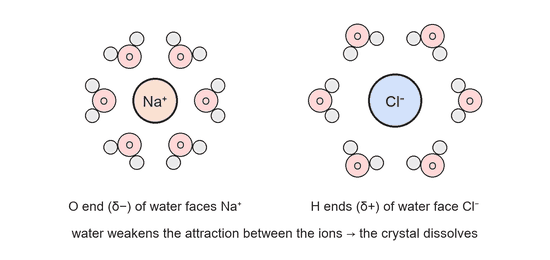
Water is a polar compound. Its δ− oxygen ends attract the cations and its δ+ hydrogen ends attract the anions.
Step 2 — See the result.
This weakens the attraction between the ions, so they separate and the compound dissolves. Insolubility in water is therefore not a typical property of ionic compounds.
Watch out: The question asks for the property that is NOT typical, so pick the false statement.
Why the other options are wrong:
Therefore, insolubility in water is not a typical property of an ionic compound, option (C).