
Question 421 markMCQEasy
Metals lose electrons during ionization. This change is called :
Confirming your payment
Sign up now and get 250 free tokens.
Chemical Bonding · Question 42 of 71
Metals lose electrons during ionization. This change is called :
(A) Oxidation
(B) Reduction
(C) Redox reaction
(D) Displacement
Answer: (A) Oxidation
Concept: Oxidation is the loss of electrons and reduction is the gain of electrons. Electrons lost by one substance are gained by another, so the two always happen together, in a redox reaction. The electron donor is the reducing agent; the electron acceptor is the oxidising agent.
Step 1 — See what the metal does.
A metal atom loses its valence electron(s) when it ionises, for example:
Step 2 — Name the change.
Loss of electrons is oxidation, so the change is oxidation. (When sodium burns in chlorine, the electrons lost by sodium are gained by chlorine, which is reduced; only the whole reaction is a redox reaction.)
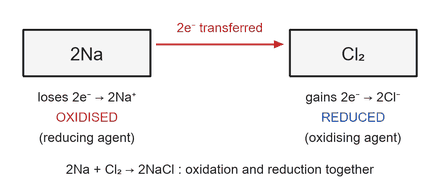
Why the other options are wrong:
Therefore, the loss of electrons by metals is called oxidation, option (A).