
Question 401 markMCQEasy
Which of the following compounds has all three bonds — ionic, covalent and coordinate bonds ?
Confirming your payment
Sign up now and get 250 free tokens.
Chemical Bonding · Question 40 of 71
Which of the following compounds has all three bonds — ionic, covalent and coordinate bonds ?
(A) Ammonia
(B) Ammonium chloride
(C) Sodium hydroxide
(D) Calcium chloride
Answer: (B) Ammonium chloride
Concept: A coordinate (dative) bond is a covalent bond in which both electrons of the shared pair come from the same atom (the donor, which has a lone pair) and are accepted by an atom or ion that is short of a pair (the acceptor, such as ). It is shown by an arrow from the donor to the acceptor. Look for a compound that has shared pairs, a donated pair and ions all at once.
Step 1 — Covalent bonds.
In ammonia, NH₃, nitrogen forms three covalent N–H bonds and keeps one lone pair.
Step 2 — Coordinate bond.
That lone pair is donated to a hydrogen ion, H⁺, forming the coordinate bond of the ammonium ion.
Step 3 — Ionic bond.
The ammonium ion, NH₄⁺, and the chloride ion, Cl⁻, are held together by an ionic bond in ammonium chloride, NH₄Cl.
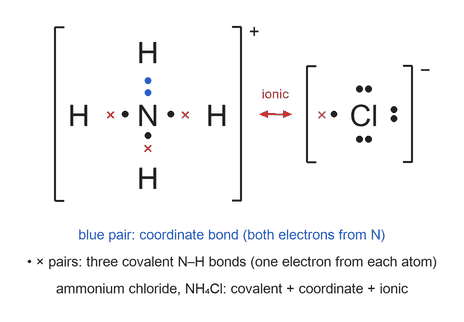
Watch out: The coordinate bond is not a fourth kind of particle: once formed, all four N–H bonds in NH₄⁺ are identical.
Why the other options are wrong:
Therefore, ammonium chloride has ionic, covalent and coordinate bonds, option (B).