
Question 184 marksEasy
Elements A, B and C have atomic numbers 17,19 and 10 respectively.
(a) State which one is : (i) a non-metal (ii) a metal, (iii) chemically inert ?
(b) Write down the formula of the compound formed by two of the above elements.
Confirming your payment
Sign up now and get 250 free tokens.
Chemical Bonding · Question 18 of 71
Elements A, B and C have atomic numbers 17,19 and 10 respectively.
(a) State which one is : (i) a non-metal (ii) a metal, (iii) chemically inert ?
(b) Write down the formula of the compound formed by two of the above elements.
Solution:
Concept: Write the electronic configuration first: atoms with 1–3 valence electrons are metals (they lose electrons), atoms with 5–7 are non-metals (they gain electrons), and atoms with a complete octet are chemically inert.
Step 1 — Write the configurations.
Fill the shells 2, 8, 8 … for each atomic number.
| Element | Atomic number | Configuration | Behaviour |
|---|---|---|---|
| A | 17 | 2, 8, 7 | needs 1 electron (chlorine) |
| B | 19 | 2, 8, 8, 1 | has 1 electron to give (potassium) |
| C | 10 | 2, 8 | outermost shell complete (neon) |
Step 2 — Classify the elements.
(a) (i) A is a non-metal, because it gains an electron to complete its octet. (ii) B is a metal, because it loses its single valence electron. (iii) C is chemically inert, because its octet is complete and it neither loses nor gains electrons.
Step 3 — Write the formula.
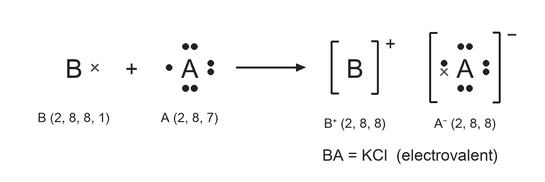
(b) The inert element C forms no compound, so the compound is formed by A and B. B gives one electron to A, forming B⁺ and A⁻. Both ions carry one unit of charge, so one of each is needed, and the cation is written first.
Watch out: Write the metal (cation) first in the formula: BA, not AB.
Therefore, (a) (i) A is a non-metal, (ii) B is a metal, (iii) C is chemically inert; (b) the compound of A and B is BA (potassium chloride, KCl), an electrovalent compound.