
Question 172 marksEasy
What are the conditions necessary for the formation of covalent molecules ?
Confirming your payment
Sign up now and get 250 free tokens.
Chemical Bonding · Question 17 of 71
What are the conditions necessary for the formation of covalent molecules ?
Solution:
Concept: A covalent bond forms when two atoms (usually of non-metals) share one or more pairs of electrons, each atom putting the same number of electrons into the shared pair(s). Each atom counts the shared electrons in its own outer shell, and so reaches a noble gas configuration. A covalent bond forms when both atoms want to gain electrons, so neither can pull electrons away from the other completely.
Step 1 — Condition on the number of valence electrons.
Both atoms should have four or more electrons in their outermost shells, i.e. they are usually non-metals (hydrogen, and a few elements such as beryllium, boron and aluminium, are exceptions).
Step 2 — Conditions on attracting electrons.
Both atoms should have a high electronegativity and a high electron affinity, so that each wants to gain electrons.
Step 3 — Condition on losing electrons.
Both atoms should have a high ionisation energy, so that neither loses its electrons easily.
Step 4 — Condition on the pair of atoms.
The electronegativity difference between the two atoms should be zero or small, so that the electrons are shared rather than transferred.
Step 5 — Example.
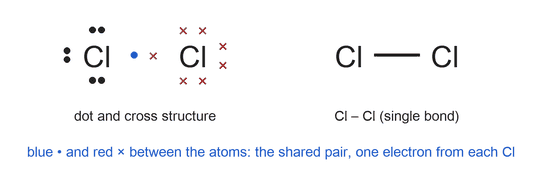
Two chlorine atoms (2, 8, 7) each need one electron. Neither gives one up, so each puts one electron into a shared pair, and both reach an octet.
Watch out: A large electronegativity difference gives an ionic bond, not a covalent one.
Therefore, covalent molecules form between atoms that have four or more valence electrons, high electronegativity, high electron affinity and high ionisation energy, and a zero or small difference in electronegativity.