
Question 165 marksEasy
Potassium (at No. 19) and chlorine (at No. 17) react to form a compound. Explain on the basis of electronic concept :
(i) oxidation (ii) reduction
(iii) oxidising agent (iv) reducing agent.
Confirming your payment
Sign up now and get 250 free tokens.
Chemical Bonding · Question 16 of 71
Potassium (at No. 19) and chlorine (at No. 17) react to form a compound. Explain on the basis of electronic concept :
(i) oxidation (ii) reduction
(iii) oxidising agent (iv) reducing agent.
Solution:
Concept: Oxidation is the loss of electrons and reduction is the gain of electrons. Electrons lost by one substance are gained by another, so the two always happen together, in a redox reaction. The electron donor is the reducing agent; the electron acceptor is the oxidising agent.
Step 1 — Write the configurations.
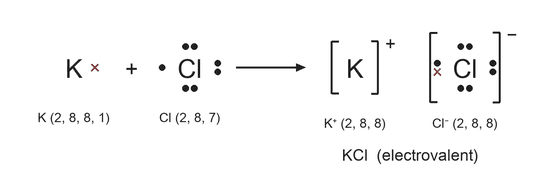
Potassium (atomic number 19) is 2, 8, 8, 1: it has one electron to give. Chlorine (atomic number 17) is 2, 8, 7: it needs one electron. So potassium transfers one electron to chlorine, forming potassium chloride.
Step 2 — Explain oxidation.
(i) Oxidation is loss of electrons. Potassium loses its valence electron and is oxidised, reaching the argon configuration (2, 8, 8).
Step 3 — Explain reduction.
(ii) Reduction is gain of electrons. Chlorine gains that electron and is reduced, also reaching 2, 8, 8.
Step 4 — Name the oxidising agent.
(iii) The oxidising agent is the electron acceptor, here chlorine. It takes the electron from potassium and so oxidises it.
Step 5 — Name the reducing agent.
(iv) The reducing agent is the electron donor, here potassium. It gives its electron to chlorine and so reduces it.
Watch out: The oxidising agent is itself reduced, and the reducing agent is itself oxidised.
Therefore, potassium loses an electron (oxidation) and is the reducing agent, while chlorine gains it (reduction) and is the oxidising agent.