
Question 195 marksMedium
Draw electron dot diagram and structure of :
(a) nitrogen molecule (b) magnesium chloride
(c) methane (2017)
Confirming your payment
Sign up now and get 250 free tokens.
Chemical Bonding · Question 19 of 71
Draw electron dot diagram and structure of :
(a) nitrogen molecule (b) magnesium chloride
(c) methane (2017)
Solution:
Concept: Show every valence electron. Covalent molecules (N₂, CH₄) share pairs of electrons; an electrovalent compound (MgCl₂) is formed by transfer of electrons and is made of ions.
Step 1 — Nitrogen molecule, N₂.
(a) Each nitrogen atom (2, 5) needs 3 more electrons. The two atoms share three pairs, forming a triple covalent bond; each atom keeps one lone pair and now has an octet.

Structure: N ≡ N.
Step 2 — Magnesium chloride, MgCl₂.
(b) Magnesium (2, 8, 2) transfers one electron to each of two chlorine atoms (2, 8, 7).

Structure: Cl⁻ Mg²⁺ Cl⁻, an electrovalent compound made of ions, with no shared pairs.
Step 3 — Methane, CH₄.
(c) Carbon (2, 4) needs 4 more electrons and each hydrogen needs 1. Carbon shares one electron pair with each of four hydrogen atoms.
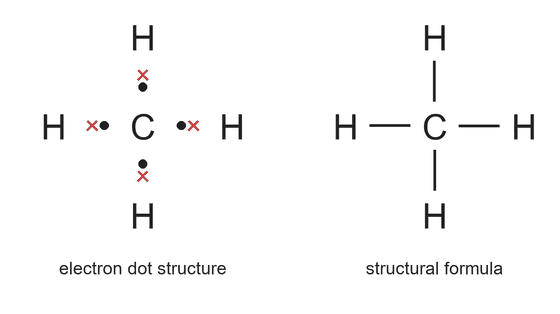
Structure: four C–H single covalent bonds, as in the structural formula above. Carbon gets an octet and each hydrogen a duplet.
Watch out: Do not draw lines (shared pairs) between Mg and Cl; MgCl₂ is ionic, so its structure shows separate ions.
Therefore, N₂ has a triple covalent bond (N ≡ N), MgCl₂ is electrovalent (Cl⁻ Mg²⁺ Cl⁻), and CH₄ has four C–H single covalent bonds, as shown in the diagrams.