Answer: (D) (4)
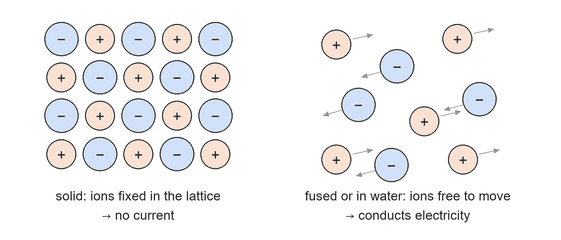
Concept: In an assertion–reason item, judge the assertion (A) and the reason (R) separately as true or false, and then decide whether R correctly explains A. An electric current passes through a liquid or a solution only if it contains ions that are free to move. Positive ions (cations) move to the cathode (negative electrode) and negative ions (anions) move to the anode (positive electrode).
Step 1 — Judge the assertion.
A is false: in the solid state the ions are held fixed in the crystal lattice and cannot move, so solid electrovalent compounds do not conduct; they conduct only when fused or dissolved.
Step 2 — Judge the reason.
R is true: electrovalent compounds are composed of ions.
Watch out: Having ions is not enough for conduction; the ions must also be free to move.
Why the other options are wrong:
- (A) (1): Code (1) needs A to be true, but A is false.
- (B) (2): Code (2) needs A to be true, but A is false.
- (C) (3): Code (3) says A is true and R is false, but it is the other way round.
Therefore, A is false but R is true, option (D).
