Solution:
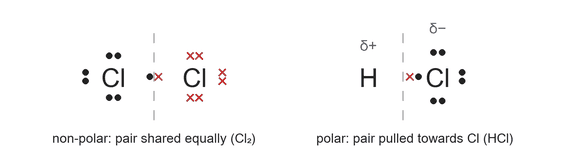
Concept: Electronegativity is the tendency of an atom to attract a shared pair of electrons towards itself. If the two bonded atoms have equal electronegativity, the pair is shared equally and the bond is non-polar; if one is more electronegative, it pulls the pair closer, gets a partial negative charge (δ−) and the other a partial positive charge (δ+), and the bond is polar. Ions in electrovalent compounds are held by electrostatic forces.
Step 1 — Polar bond between different atoms.
(a) Two different atoms pull the shared pair unequally, so the bond is polar. The sentence reads: When the nuclei of two different reacting atoms are of unequal mass, then a bond so formed is called polar covalent bond.
Step 2 — Non-polar bond.
(b) In a non-polar bond the pair is shared equally, so it sits midway. The sentence reads: In case of non-polar covalent bond, the covalent bond is formed in the middle of atoms and shared electrons are equally distributed.
Step 3 — Conduction by ionic compounds.
(c) In the solid the ions are fixed in the lattice and cannot move. The sentence reads: Ionic or electrovalent compounds do not conduct electricity in their solid state.
Step 4 — Forces between ions.
(d) Oppositely charged ions attract each other strongly. The sentence reads: The ions in electrovalent compounds are held very strongly due to strong electrostatic forces.
Step 5 — Covalent bond formation.
(e) The sentence reads: In covalent compounds, the bond is formed due to sharing of electrons.
Step 6 — Boiling point of ionic compounds.
(f) Much energy is needed to separate the ions. The sentence reads: Electrovalent compounds have a high boiling point.
Note: the book's sentence (a) links polarity to unequal mass; strictly, a bond between two different atoms is polar because their electronegativities differ, not because their masses differ.
Therefore, the blanks are (a) unequal, polar; (b) middle, equally; (c) solid; (d) electrovalent, electrostatic; (e) sharing; (f) high.
