Answer: (C) (3)
Concept: In an assertion–reason item, judge the assertion (A) and the reason (R) separately as true or false, and then decide whether R correctly explains A. A coordinate (dative) bond is a covalent bond in which both electrons of the shared pair come from the same atom (the donor, which has a lone pair) and are accepted by an atom or ion that is short of a pair (the acceptor, such as H+). It is shown by an arrow from the donor to the acceptor.
Step 1 — Judge the assertion.
A is true: a pair of valence electrons not shared with any other atom is called a lone pair.
Step 2 — Judge the reason.
R is false: ammonia has a lone pair on nitrogen, but in the ammonium ion this pair has been donated to H⁺, so all four pairs around nitrogen are bond pairs.
NH3+H+→NH4+
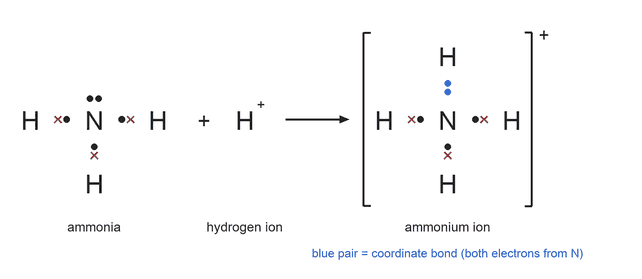
Watch out: Do not confuse ammonia (NH₃, one lone pair) with the ammonium ion (NH₄⁺, no lone pair).
Why the other options are wrong:
- (A) (1): Code (1) needs R to be true, but R is false.
- (B) (2): Code (2) also needs R to be true, but R is false.
- (D) (4): Code (4) needs A to be false, but A is true.
Therefore, A is true but R is false, option (C).
