Answer: (C) (3)
Concept: In an assertion–reason item, judge the assertion (A) and the reason (R) separately as true or false, and then decide whether R correctly explains A. An electric current passes through a liquid or a solution only if it contains ions that are free to move. Positive ions (cations) move to the cathode (negative electrode) and negative ions (anions) move to the anode (positive electrode).
Step 1 — Judge the assertion.
A is true: molten or dissolved ionic compounds conduct electricity, because their ions are free to move.
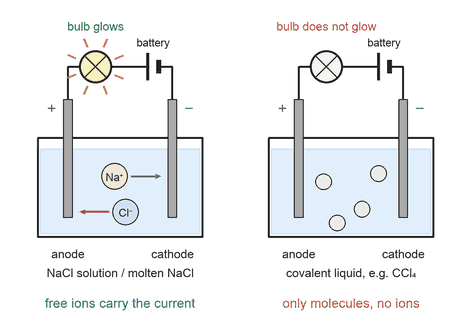
Step 2 — Judge the reason.
R is false: ionic compounds consist of ions, not molecules; molecules are found in covalent compounds.
Why the other options are wrong:
- (A) (1): Code (1) needs R to be true, but R is false.
- (B) (2): Code (2) also needs R to be true, but R is false.
- (D) (4): Code (4) says A is false and R is true, but it is the other way round.
Therefore, A is true but R is false, option (C).
