
Question 104 marksEasy
Compare :
(a) sodium atom and sodium ion
(b) chlorine atom and chloride ion, with respect to
(i) atomic structure, (ii) electrical state,
(iii) chemical action, (iv) toxicity.
Confirming your payment
Sign up now and get 250 free tokens.
Chemical Bonding · Question 10 of 71
Compare :
(a) sodium atom and sodium ion
(b) chlorine atom and chloride ion, with respect to
(i) atomic structure, (ii) electrical state,
(iii) chemical action, (iv) toxicity.
Solution:
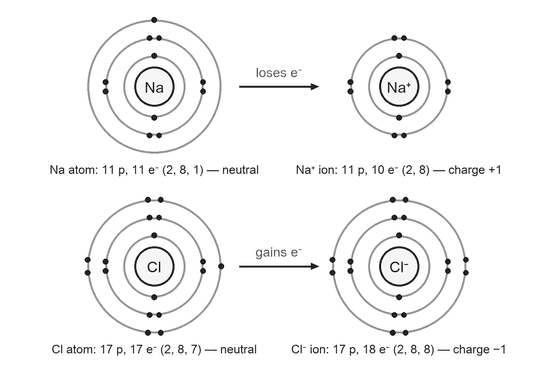
Concept: An ion has the same nucleus (the same number of protons) as its atom but a different number of electrons. This one change makes its properties very different from those of the atom.
Step 1 — Sodium atom and sodium ion.
(a) A sodium atom loses one electron to become a sodium ion.
| Property | Sodium atom (Na) | Sodium ion (Na⁺) |
|---|---|---|
| (i) Atomic structure | 11 protons, 11 electrons; 2, 8, 1 (incomplete outermost shell) | 11 protons, 10 electrons; 2, 8 (complete outermost shell) |
| (ii) Electrical state | Neutral | Positively charged (+1) |
| (iii) Chemical action | Very active (reacts vigorously with water) | Inactive (stable octet) |
| (iv) Toxicity | Poisonous | Non-poisonous |
Step 2 — Chlorine atom and chloride ion.
(b) A chlorine atom gains one electron to become a chloride ion.
| Property | Chlorine atom (Cl) | Chloride ion (Cl⁻) |
|---|---|---|
| (i) Atomic structure | 17 protons, 17 electrons; 2, 8, 7 (incomplete outermost shell) | 17 protons, 18 electrons; 2, 8, 8 (complete outermost shell) |
| (ii) Electrical state | Neutral | Negatively charged (−1) |
| (iii) Chemical action | Very active | Inactive (stable octet) |
| (iv) Toxicity | Poisonous | Non-poisonous |
Step 3 — Link to everyday life.
This explains why common salt (NaCl, made of Na⁺ and Cl⁻ ions) is safe to eat although sodium metal and chlorine gas are both dangerous.
Watch out: The number of protons does not change when an atom becomes an ion; only the number of electrons changes.
Therefore, the sodium atom (neutral, active, poisonous, 2, 8, 1) and the chlorine atom (neutral, active, poisonous, 2, 8, 7) differ from their ions Na⁺ and Cl⁻ (charged, inactive, non-poisonous, with complete octets) in structure, electrical state, chemical action and toxicity.