
Question 112 marksEasy
The electronic configuration of Fluoride ion is the same as that of a neon atom. What is the difference between the two ?
Confirming your payment
Sign up now and get 250 free tokens.
Chemical Bonding · Question 11 of 71
The electronic configuration of Fluoride ion is the same as that of a neon atom. What is the difference between the two ?
Solution:
Concept: The same electron arrangement (2, 8) does not make two particles the same. The number of protons in the nucleus decides which element a particle belongs to and what charge it carries.
Step 1 — Count the particles.
A fluorine atom has 9 protons and 9 electrons; the fluoride ion has gained one electron, so it has 9 protons and 10 electrons. A neon atom has 10 protons and 10 electrons.
Step 2 — Compare them.
The table sets out the differences.
| Fluoride ion (F⁻) | Neon atom (Ne) | |
|---|---|---|
| Protons in nucleus | 9 | 10 |
| Electrons | 10 (2, 8) | 10 (2, 8) |
| Charge | One unit negative (one electron more than protons) | Neutral (electrons equal protons) |
| How it exists | Formed when an F atom gains one electron; found in compounds such as NaF | Exists free as single atoms |
| Nature | Attracted to cations in ionic compounds | Chemically inert noble gas |
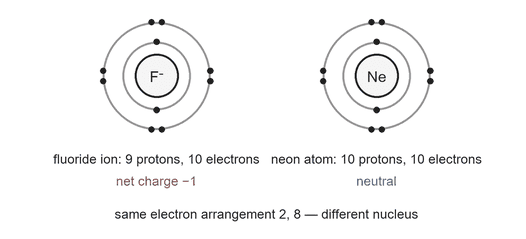
Therefore, although both have the configuration 2, 8, the fluoride ion has 9 protons and a charge of −1, while the neon atom has 10 protons and is neutral.