
Question 95 marksMedium
Explain with the help of ionic equation and electron dot structural diagram the formation of the following electrovalent compounds.
(i) NaCl
(ii) MgCl
(iii) CaO
Confirming your payment
Sign up now and get 250 free tokens.
Chemical Bonding · Question 9 of 71
Explain with the help of ionic equation and electron dot structural diagram the formation of the following electrovalent compounds.
(i) NaCl
(ii) MgCl
(iii) CaO
Solution:
Concept: In each case the metal atom loses electron(s) (oxidation), the non-metal atom gains them (reduction), and the oppositely charged ions attract each other. The number of electrons lost must equal the number gained, and this fixes the formula.
Step 1 — Sodium chloride, NaCl.
(i) Sodium (2, 8, 1) gives its one valence electron to chlorine (2, 8, 7), which needs exactly one.
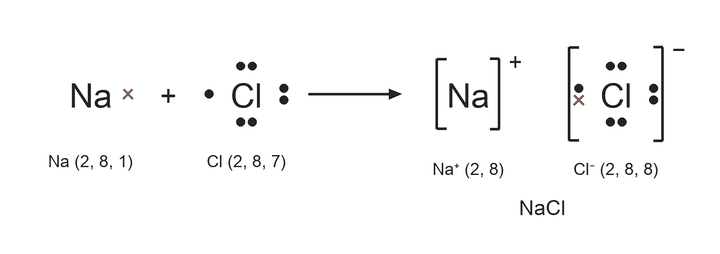
Now Na⁺ (2, 8) has the neon configuration and Cl⁻ (2, 8, 8) the argon configuration.
Step 2 — Magnesium chloride, MgCl₂.
(ii) Magnesium (2, 8, 2) must lose 2 electrons, but each chlorine atom (2, 8, 7) can take only 1. So two chlorine atoms are needed.

Step 3 — Calcium oxide, CaO.
(iii) Calcium (2, 8, 8, 2) gives both its valence electrons to one oxygen atom (2, 6), which needs exactly 2.
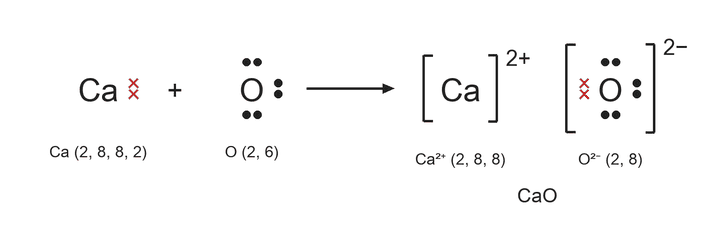
That is why the formula is CaO and not Ca₂O₂.
Watch out: Count the electrons: the electrons lost by the metal must equal the electrons gained by the non-metal atoms, which is why MgCl₂ needs two chlorine atoms but CaO needs only one oxygen atom.
Therefore, NaCl, MgCl₂ and CaO are formed by transfer of electrons from the metal to the non-metal, and in each compound all the ions have a noble gas configuration and are held by strong electrostatic forces.