
Question 54 marksEasy
Mention the following :
(i) Average life span of RBCs.
(ii) Range of RBCs per in a normal adult human female.
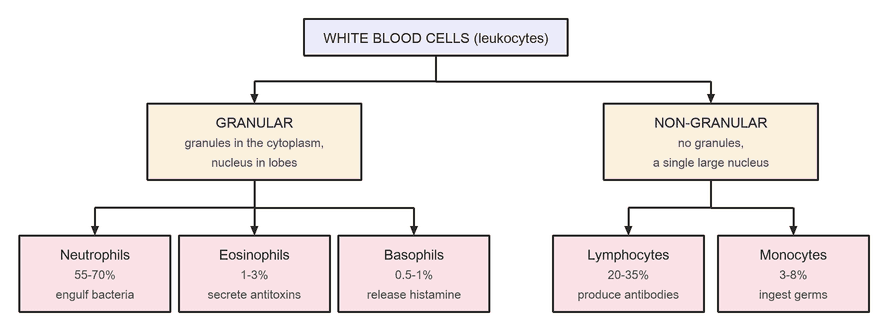
(iii) The two major categories of WBCs.
(iv) Blood cells involved in leukaemia.
Confirming your payment
Sign up now and get 250 free tokens.
The Circulatory System · Question 5 of 65
Mention the following :
(i) Average life span of RBCs.
(ii) Range of RBCs per in a normal adult human female.
(iii) The two major categories of WBCs.
(iv) Blood cells involved in leukaemia.
Solution:
Concept: these are standard facts about the blood cells: how long RBCs live, how many there are, and how WBCs are grouped.
Step 1 — (i) Life span of RBCs.
An RBC lives about 120 days. Old and weak RBCs are then destroyed in the spleen, liver and bone marrow.
Step 2 — (ii) RBC count in an adult female.
An adult female has about 4.5 million RBCs per , slightly fewer than an adult male (about 5 million). So the adult range is 4.5 to 5 million per .
Step 3 — (iii) The two categories of WBCs.
WBCs are grouped by whether their cytoplasm has granules. Granular WBCs have granules and a nucleus constricted into lobes (neutrophils, eosinophils, basophils). Non-granular WBCs have no granules and a single large nucleus (lymphocytes, monocytes).
Step 4 — (iv) Cells involved in leukaemia.
Leukaemia is a cancer of the tissue that forms the white blood cells. Their number increases manifold at the cost of the RBCs.
Therefore, (i) about 120 days; (ii) about 4.5 million per mm³; (iii) granular and non-granular WBCs; (iv) white blood cells (leukocytes).