Solution:
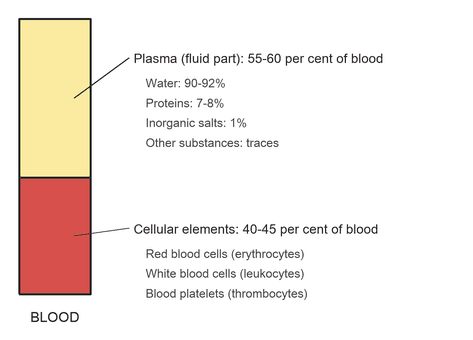
Concept: blood is made of a fluid part, the plasma, and the cellular elements (RBCs, WBCs and platelets) floating in it.
Step 1 — (i) The yellow fluid part.
The light-yellow, slightly alkaline liquid part of blood is the plasma. It forms 55–60 per cent of the blood and is mostly water (90–92%).
Step 2 — (ii) The pigment in RBCs.
The red pigment is haemoglobin. It is made of an iron-containing part (haemin) and a protein (globin). It combines with oxygen in the lungs to form unstable oxyhaemoglobin, which gives up the oxygen in the tissues.
Step 3 — (iii) Organelles a mature RBC lacks.
As an RBC matures it loses its nucleus, its mitochondria and its endoplasmic reticulum. This leaves more room for haemoglobin, so the cell carries more oxygen.
Step 4 — (iv) WBCs squeezing out of capillaries.
Most WBCs are amoeboid. They push out a pseudopodium and squeeze through the thin capillary wall into the tissues to fight germs. This is diapedesis.
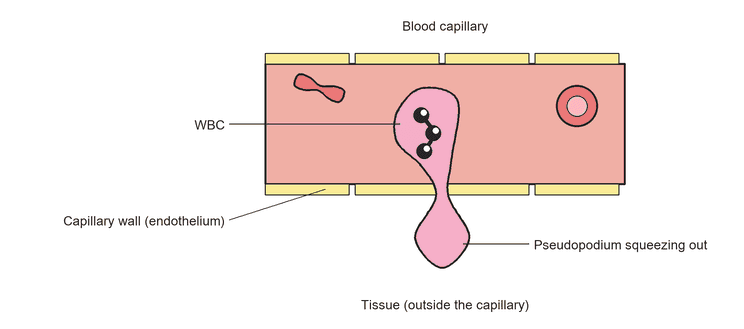
Watch out: Diapedesis (squeezing out) is different from phagocytosis (engulfing germs).
Therefore, (i) plasma; (ii) haemoglobin; (iii) any two of nucleus, mitochondria, endoplasmic reticulum; (iv) diapedesis.
