Solution:
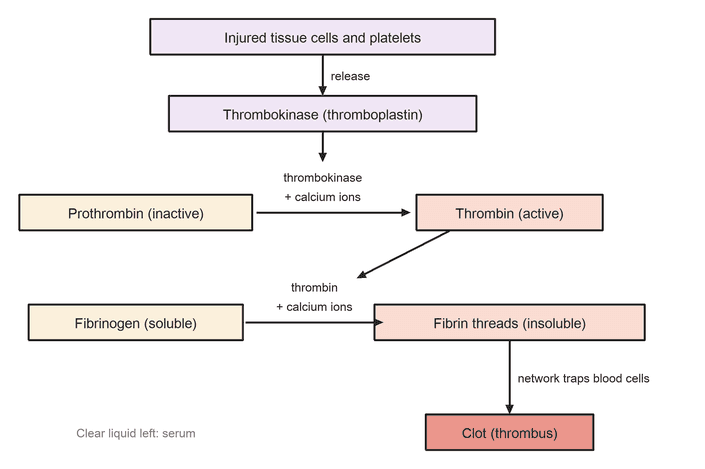
Concept: clotting is a chain of steps. Thrombokinase from injured tissue cells and platelets, with calcium ions, changes prothrombin into thrombin; thrombin changes soluble fibrinogen into insoluble fibrin threads.
Step 1 — Statement (i).
The substance that starts coagulation, thrombokinase, comes from the injured tissue cells and the platelets, not from the RBCs. So (i) is False.
Step 2 — Statement (ii).
Calcium ions are needed twice: to change prothrombin into thrombin and to change fibrinogen into fibrin. With too little calcium both steps slow down, so blood fails to clot readily. So (ii) is True.
Step 3 — Statement (iii).
Thrombin is the active enzyme formed from prothrombin; fibrin is the solid protein thread formed from fibrinogen. They are two different substances. So (iii) is False.
Step 4 — Statement (iv).
The fibrin network traps the blood cells, shrinks and squeezes out the rest of the plasma as a clear liquid, the serum. So (iv) is True.
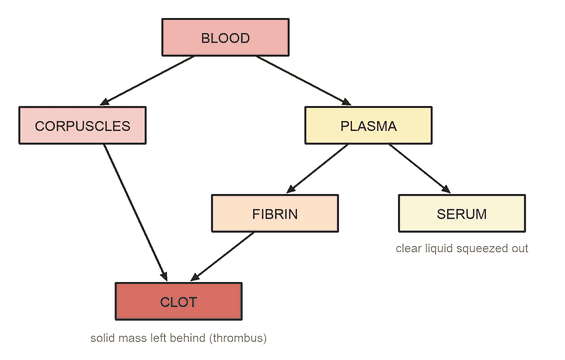
Watch out: Thrombin and fibrin sound alike but one is an enzyme and the other is the clot's threads.
Therefore, the true statements are (ii) and (iv).
