
Opening your dashboard
Class 11 Biology Chapter 15 Cell Cycle and Cell Division: Competency-Based Questions (CBQ)
40 questions on Chapter 15, each worked through on its own page with the AI tutor. Class 11 Biology, ICSE 2026-27.
40 questions
1–10 marks · Mixed difficulty
- 11 mark
Question 1
Assertion (A): Amitosis is also called direct cell division.
Reason (R): In amitosis the chromosomes first condense and line up at the centre of the nucleus before the nucleus splits.
- 21 mark
Question 2
A Paramecium has a small micronucleus and a large macronucleus. The macronucleus controls the everyday work of the cell and holds many copies of each of its genes. When Paramecium divides by fission, the macronucleus simply elongates and pinches into two by amitosis, so the two halves need not be exactly equal. Why do the daughter cells still work normally?
- 34 marks
Question 3
(Hypothetical data.) In a cell-biology laboratory in Hyderabad, the DNA content of 10,000 single cells from a growing culture of human skin cells is measured by a machine that reads the amount of DNA stain in each cell. The histogram shows the result, and the table groups the cells into three classes.
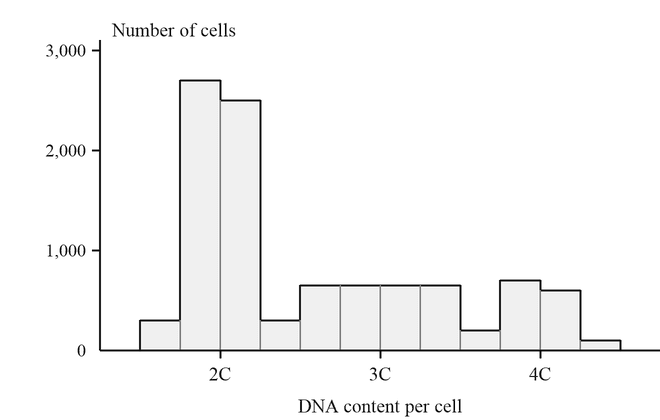
Class of cells DNA content per cell Number of cells Left peak 2C 5,800 Between the peaks more than 2C but less than 4C 2,600 Right peak 4C 1,600 (a) Name the phase or phases of the cell cycle to which the cells of each class belong. (1 mark)
(b) A second sample of the same culture is kept for five days in a medium without the growth factors that signal cells to divide. Now 9,300 of the 10,000 cells are in the left peak, 200 lie between the peaks and 500 are in the right peak. What has happened to most of these cells? (1 mark)
(c) The right peak cannot tell cells in G₂ from cells in M phase. Explain why, and state two features that a stained slide of the same cells would show to tell them apart. (2 marks)
- 41 mark
Question 4
Assertion (A): In a frog embryo, the first divisions after fertilisation follow one another very quickly, and the cells become smaller with every division.
Reason (R): In these early divisions the cell cycle has almost no G₁ and G₂, so the cells do not grow between one division and the next.
- 54 marks
Question 5
In a well-known experiment, scientists fused two cultured human cells that were at different stages of the cell cycle, so that the two nuclei shared one cytoplasm. They then watched what each nucleus did.
Cells fused What was seen S-phase cell + G₁ cell The G₁ nucleus began to copy its DNA sooner than it would have done on its own. S-phase cell + G₂ cell The G₂ nucleus did not copy its DNA again; the S-phase nucleus finished copying its DNA. M-phase cell + G₁ cell or G₂ cell The chromatin of the interphase nucleus at once condensed into visible chromosomes. (a) What does the first result suggest about the cytoplasm of a cell in S phase? (1 mark)
(b) Why did the G₂ nucleus not copy its DNA again, although it was exposed to the same cytoplasm? (1 mark)
(c) In the third fusion, predict how many chromatids each condensed chromosome shows when the interphase nucleus came from a G₁ cell, and when it came from a G₂ cell. Explain your answer. (2 marks)
- 61 mark
Question 6
Most cells in the embryo of a dry wheat grain rest with the DNA content of G₁, taken as 2C. When the grain is soaked in water, these cells start to cycle again. Which change would show that a cell has passed from G₁ into the next phase of the cell cycle?
- 74 marks
Question 7
(Hypothetical data.) At a research institute in Bengaluru, a culture of dividing animal cells is given radioactive thymidine for 15 minutes only. Thymidine is a building block that contains the base thymine, which is found in DNA but not in RNA. The cells are then washed and kept in ordinary medium. Samples are fixed at intervals, and the cells that are in mitosis are checked for radioactivity.
Time after the label was given (h) 1 2 2.5 3 3.5 4 5 Mitotic cells that are labelled (%) 0 0 6 24 50 77 96 The time at which half of the mitotic cells are labelled is taken as an estimate of the average length of G₂.
(a) Which cells took up the radioactive label during the 15 minutes, and why only these cells? (1 mark)
(b) Estimate the length of G₂ from the data, and explain why no labelled cells were seen in mitosis during the first two hours. (2 marks)
(c) Why would radioactive uridine, which a cell uses to make the base uracil, be a poor choice for marking the cells that were replicating their DNA? (1 mark)
- 84 marks
Question 8
(Hypothetical data.) In a laboratory in Kolkata, a culture of human skin cells is given a low dose of ultraviolet (UV) light, which damages DNA. The percentage of cells in each phase of the cell cycle is then measured at intervals.
Time G₁ (%) S (%) G₂ + M (%) Before UV 50 30 20 6 h after UV 74 9 17 12 h after UV 66 16 18 24 h after UV 51 29 20 (a) In which phase did the cells pile up after the UV dose, and which event of the cell cycle was being held back? (1 mark)
(b) Explain why it is useful for a cell whose DNA is damaged to pause before S phase rather than carry on. (2 marks)
(c) A line of cancer cells given the same dose shows almost the same percentages at every time. Suggest why such cells collect more and more changes in their DNA over many divisions. (1 mark)
- 93 marks
Question 9
A botany teacher in Kozhikode shows the class a stained drop of the liquid from a tender coconut under the microscope. No cell walls or cell membranes divide the liquid into cells, yet it holds hundreds of free nuclei. In some nuclei, threads of chromosomes are lined up across the middle of a spindle; in others, two groups of chromosomes are moving apart. The nuclei of this liquid endosperm are triploid (3n), and the diploid number of coconut is 2n = 32.
(a) What is this multinucleate condition called, and which step of cell division has not taken place? (1 mark)
(b) Give one observation from the slide which shows that the nuclei are dividing by mitosis and not by amitosis. (1 mark)
(c) How many chromosomes does each free nucleus have, and why will every nucleus formed from it have the same number? (1 mark)
- 101 mark
Question 10
Assertion (A): Mature red blood cells of humans divide by mitosis in the blood to replace those that wear out.
Reason (R): Worn-out or lost cells in the body are replaced by the mitosis of cells that are still able to divide.
- 111 mark
Question 11
A student preparing an onion root-tip squash sees many cells under the high power of the microscope, but none in any stage of mitosis. Which of the student's steps best explains this result?
- 124 marks
Question 12
(Hypothetical data.) The radiology department of a hospital in Chennai checks the health of its staff every year. White blood cells from a blood sample are made to divide in culture, and cells that have just divided are examined. X-rays can break chromosomes. A broken piece of a chromosome that has no centromere is left behind near the middle of the cell at anaphase, and a nuclear membrane later forms around it as a tiny extra nucleus called a micronucleus.
Group Micronuclei per 1,000 divided cells Office staff who do not work with X-rays 6 X-ray technicians who always wear protective aprons 7 A technician after an accidental exposure to X-rays 38 (a) Why is a piece of chromosome without a centromere not pulled to either pole at anaphase? (1 mark)
(b) What do the results show about the protection used by the technicians and about the accidental exposure? (1 mark)
(c) The daughter cell that loses such a piece into a micronucleus lacks the genes on that piece in its main nucleus. Explain why this loss can matter both for that cell and for the cells formed from it later. (2 marks)
- 131 mark
Question 13
A nursery in Ooty raises 200 rose plants from stem cuttings of one plant with deep red flowers. All the new plants bear exactly the same kind of flowers as the parent plant. Which statement best explains this?
- 144 marks
Question 14
(Hypothetical data.) A plant breeder at an agricultural university in Ludhiana studies the pollen mother cells of a crop plant with 2n = 12, which form 6 bivalents in meiosis. In 50 cells at diakinesis, the breeder counts the chiasmata on each bivalent.
Bivalents Relative length Mean number of chiasmata per bivalent Pairs 1 and 2 long 2.6 Pairs 3 and 4 medium 1.8 Pairs 5 and 6 short 1.0 No bivalent was ever seen without at least one chiasma.
(a) In which substage of prophase I did the crossing over that produced these chiasmata take place, and in which substage did the chiasmata first become visible? (1 mark)
(b) Calculate the mean number of chiasmata in one cell. (1 mark)
(c) What does the table suggest about the link between the length of a bivalent and crossing over? Why is it important that every bivalent keeps at least one chiasma until metaphase I? (2 marks)
- 151 mark
Question 15
Assertion (A): Cultivated bananas with three sets of chromosomes (3n = 33) produce almost no viable seeds.
Reason (R): In a triploid, each chromosome has two partners instead of one, so the chromosomes cannot pair and separate evenly in meiosis I, and the gametes get unbalanced sets of chromosomes.
- 164 marks
Question 16
A stud farm in Rajasthan breeds mules by crossing a female horse (2n = 64) with a male donkey (2n = 62). Mules are strong and healthy, but they are almost always sterile. When the testes of a male mule are examined, the germ cells begin meiosis, but most of them fail and break down during meiosis I.
(a) How many chromosomes are present in the horse's egg, in the donkey's sperm, and in a body cell of the mule? (1 mark)
(b) Explain why the germ cells of a mule cannot form normal bivalents in prophase I. (2 marks)
(c) The body cells of the mule divide by mitosis without any trouble. Why does the mixed set of chromosomes not upset mitosis? (1 mark)
- 171 mark
Question 17
Each egg made by a woman carries one chromosome of every homologous pair, and for each pair it may get either the chromosome she inherited from her father or the one she inherited from her mother. So her eggs carry different mixtures of whole chromosomes from her two parents. Which event in her meiosis gives rise to these different mixtures?
- 181 mark
Question 18
Assertion (A): The four pollen grains formed from one pollen mother cell of a mustard plant usually differ from one another in the genes they carry.
Reason (R): Pollen grains are formed inside the anthers of the flower.
- 194 marks
Question 19
(Hypothetical data.) In a cell-culture laboratory in Pune, normal human skin cells and cells of a cancer cell line are grown side by side, and the total number of times each population has doubled is recorded.
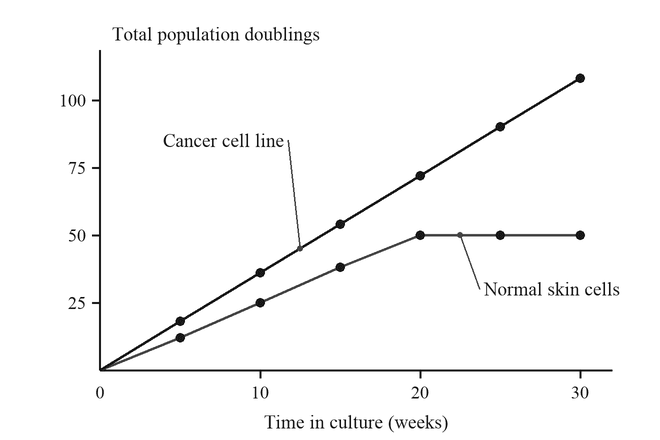
Weeks in culture 0 5 10 15 20 25 30 Normal skin cells (total doublings) 0 12 25 38 50 50 50 Cancer cell line (total doublings) 0 18 36 54 72 90 108 The workers also notice that the normal cells stop dividing when they come to touch one another, so they form a single flat layer on the dish, while the cancer cells keep on dividing and pile up into heaps.
(a) After how many weeks did the normal cells stop doubling, and how does the cancer cell line behave differently? (1 mark)
(b) A karyotype of the cancer cells shows 68 chromosomes in each cell. How many more is this than in a normal human body cell, and why can karyotyping detect such a change? (1 mark)
(c) Use both observations, the doubling data and the piling up, to explain how a single cancer cell in the body can give rise to a lump (tumour). (2 marks)
- 201 mark
Question 20
Assertion (A): Some anticancer drugs work by stopping spindle fibres from forming in dividing cells.
Reason (R): Cancer cells divide by meiosis instead of by mitosis.
- 211 mark
Question 21
A skin specialist in Jaipur notes that skin cancers are found far more often on the face, neck and arms of farm workers than on parts of their skin that are usually covered. Which is the best explanation?
- 224 marks
Question 22
A haematology laboratory in Lucknow examines bone-marrow cells from a patient with chronic myeloid leukaemia, a cancer in which white blood cells are produced in uncontrolled numbers. The cells are cultured, arrested at metaphase, stained and photographed. Every cell has 46 chromosomes, but chromosome pairs 9 and 22 look as shown below: one chromosome 9 is longer than its partner, and one chromosome 22 is much shorter than its partner.
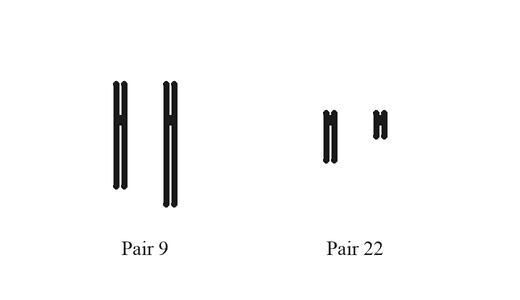
(a) Why would a count of the chromosomes alone have missed this change? (1 mark)
(b) Further study shows that the large piece missing from one chromosome 22 is now joined to one chromosome 9, and a small piece from the end of that chromosome 9 is now joined to the chromosome 22. How does staining the chromosomes with dyes that give bands help scientists to show this? (1 mark)
(c) The change began in a single bone-marrow cell. Explain why, years later, most of the patient's dividing marrow cells carry the same two changed chromosomes, and how this is linked to uncontrolled division. (2 marks)
- 231 mark
Question 23
Assertion (A): A karyotype prepared from a person's white blood cells can show whether the person carries the changed gene that causes sickle-cell anaemia.
Reason (R): A karyotype shows the number, size and shape of the chromosomes and their banding pattern.
- 241 mark
Question 24
A trainee in a chromosome laboratory photographs dividing white blood cells at early prophase instead of at metaphase. The karyotype made from these photographs is very hard to read. Why?
- 251 mark
Question 25
Assertion (A): People who smoke tobacco have a much higher risk of lung cancer than people who do not smoke.
Reason (R): Cancer cells undergo unusually rapid mitosis.
- 2610 marks
Question 26
Match the following:
Column I Column II 1. Centromeres of each chromosome separate and split into two. (a) Telophase 2. Chromosomes gradually change into chromatin network and nuclear membrane reappears. (b) Zygotene 3. Cells exit G₁ phase and enter the inactive phase. (c) Anaphase 4. Phase in which DNA replication occurs. (d) Metaphase I 5. Phase in which cell plate in the middle of the plant cell gets formed. (e) Prophase 6. Synaptonemal complex gets formed. (f) Amitosis 7. Bivalent chromosomes get aligned at the equatorial plate of the spindle. (g) Synthesis phase 8. Nuclear membrane disintegrates and DNA condenses into chromosomes. (h) G₁ phase 9. Phase when cell organelles, proteins, and ribosomes are formed along with cell growth. (i) G₀ phase 10. Kind of cell division which occurs in Paramecium. (j) Cytokinesis - 275 marks
Question 27
Read the sources given and answer any four from the questions given below.
The study of stem cells is closely linked to cell cycle regulation because these pluripotent cells can divide and differentiate to other type of cells. At the metaphase stage, each chromosome is made up of two sister chromatids held together at the centromere. The chromosomes are attached to the spindle fibres at the kinetochore regions. Kinetochores are small disc-shaped structures at the surface of chromosomes. The spindle fibres are made up of protein tubulin. During the anaphase stage, the spindle fibres attached to kinetochores shrink, pulling sister chromatids to the opposite poles. By late anaphase, each pole has one set of chromatids.
(1) The spindle fibres are made up of
(a) glycogen
(b) membranes
(c) tubulin
(d) vacuoles
(2) The kinetochores are present on the
(a) membrane
(b) chromosomes
(c) spindle fibres
(d) poles
(3) The place where chromosomes are attached to spindle fibres are
(a) chromatids
(b) kinetochores
(c) metaphase plate
(d) poles
(4) Which statement is true for anaphase stage?
(a) spindle fibres shrink
(b) spindle fibres elongate
(c) chromosomes uncoil
(d) chromatids break
(5) An important property of pluripotent cells is
(a) cannot differentiate
(b) remain in metaphase stage
(c) can differentiate to other cells
(d) remain in anaphase stage
- 285 marks
Question 28
Read the sources given and answer any four from the questions given below.
Most tissues of the body grow by increasing their cell number, but this growth is highly regulated to maintain a balance between different tissues. In adults, mitotic cell division is mainly involved in replacement of damaged tissue rather than growth. Skin cells, for example, are constantly being sloughed off and replaced by immature skin cells of lower layer. The mature differentiated skin cells do not divide. In liver cells, the mature cells remain capable of division to allow growth or regeneration after injury. Many types of cells in the body cannot divide or are prevented from dividing by certain molecules. As a result, in the adult organism, some tissues have a greatly reduced capacity to renew damaged or diseased cells. Examples of such tissues include heart muscle, nerve cells of the central nervous system, and lens cells in mammals. Maintenance and repair of these cells is limited to replacing intracellular components only.
(1) The following cells are constantly replaced by immature cells of lower layer by mitosis.
(a) liver
(b) heart
(c) nerve
(d) skin
(2) Which of the following statement is true for nerve cells?
(a) constantly replaced by new cells
(b) capable of unlimited growth
(c) can replace intracellular components
(d) grow in number till adult stage
(3) The cells which are capable of division for growth or regeneration after injury are
(a) mature skin cells
(b) nerve cells
(c) liver cells
(d) heart cells
(4) Mitotic division of cells helps in
(a) replacement of cells
(b) growth of tissue
(c) renew damaged cells
(d) all of these
(5) The mature differentiated cells of skin
(a) cannot divide
(b) can divide
(c) can give rise to other cells
(d) none of these
- 295 marks
Question 29
Read the sources given and answer any four from the questions given below.
All cells do not divide at the same rate. Cells have regulated rhythms. The regulation can come from inside or outside the cell. In the cell, it is determined by DNA. Any outside influence, such as radiation, toxic substances, various chemicals, certain viruses can bring uncontrolled cell divisions in certain tissues and organs. This is known as cancer. They undergo unusually rapid mitosis. The radiation can destroy DNA of the cell. As cancer cells divide rapidly, the radiation treatment is given, so that the cancerous cells are killed. In cases of extreme radiation, people get radiation sickness. It includes hair loss, vomiting and reduced white blood cells. These symptoms occur in parts of the body where normally the mitosis is taking place at a rapid rate.
(1) The following can bring uncontrolled cell divisions
(a) cell DNA
(b) cell RNA
(c) certain viruses
(d) air and water
(2) Cancerous cells can be killed by
(a) certain viruses
(b) radiation therapy
(c) DNA
(d) RNA
(3) Radiations can cause the following
(a) increased white blood cells
(b) increase cell mitosis
(c) increased hair loss
(d) increased red blood cells
(4) Normal cell regulation in human body is determined by
(a) cell DNA
(b) chemicals in cytoplasm
(c) various chemicals in food
(d) cell RNA
(5) Which of the following statements is true for cell division?
(a) Cells divide together at the same time
(b) Cancer cells have rapid controlled division
(c) Cancer cells cause radiation sickness
(d) Cells undergo cell divisions at different times
- 304 marks
Question 30
Look at the figure given below and answer the questions given.

(a) Identify the stage.
(b) Label the parts (i) and (ii).
(c) Name the next stage.
(d) How many chromosomes are shown in this stage?
- 314 marks
Question 31
Look at the figure given below and answer the questions given.

(a) Identify the stage shown.
(b) Name the parts labelled i, ii, iii and iv.
(c) What is the function of part iv?
(d) How many daughter cells are formed from this division?
- 324 marks
Question 32
(a) Name and draw a well-labelled diagram of a stage that comes after anaphase in an animal cell.
(b) Give one important feature of anaphase stage.
(c) In which type of body cells does this division occur?
- 335 marks
Question 33
(a) Draw a well-labelled diagram of interphase stage in animal cell.
(b) Name the stage when DNA synthesis occurs.
(c) Which stage comes after interphase?
(d) In which stage do the chromatids separate?
- 344 marks
Question 34
The diagram below represents a stage in a cell division. Study the same and answer the question given.
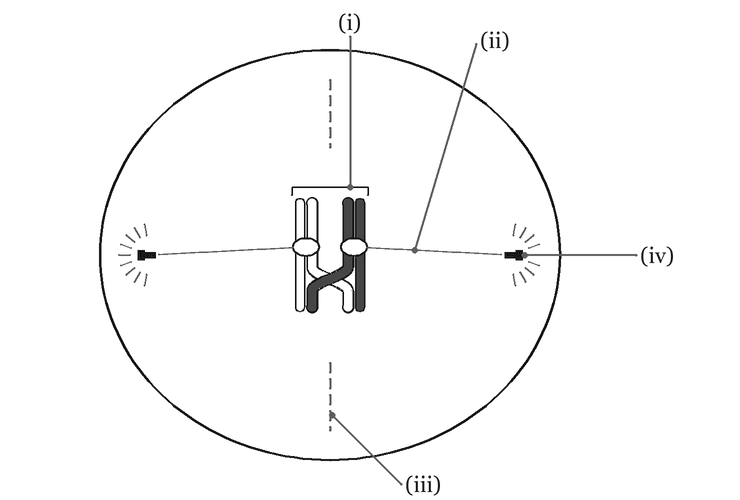
(a) Label the parts i, ii, iii and iv.
(b) Name the process being shown in the diagram.
(c) Name the type of cell division and the stage.
(d) When does the duplication of chromosome occurs?
- 354 marks
Question 35
(a) Draw a diagram showing cytokinesis in a plant cell and label: i. cell plate, ii. nucleus and iii. nuclear membrane.
(b) Which stage comes before cytokinesis?
(c) In which stages does nuclear membrane disappear?
- 363 marks
Question 36
What is significance of meiosis?
- 373 marks
Question 37
Analyse the events during every stage of cell cycle and notice how the following two parameters change:
(i) Number of chromosomes (N) per cell.
(ii) Amount of DNA content (C) per cell.
- 381 mark
Question 38
(Hypothetical data.) At a seed company's research farm near Bengaluru, germinating seeds of a diploid watermelon variety (2n = 22) are soaked for a day in a dilute solution of colchicine, a chemical that stops spindle fibres from forming. The seedlings are then grown in plain water. Root-tip squashes made a few days later show some cells at metaphase with 44 chromosomes. These 44 chromosomes look like ordinary watermelon chromosomes in size and shape, and they can be sorted into 11 groups of four look-alike chromosomes.
Which statement best explains how these cells came to have 44 chromosomes?
- 393 marks
Question 39
A farmer in Punjab keeps honeybee colonies to pollinate his mustard crop. In a colony, the queen and the worker bees are females that develop from fertilised eggs, and each of their body cells has 2n = 32 chromosomes. The male bees, called drones, develop from eggs that are not fertilised. A student writes in her notebook: "Every sperm is made by meiosis, and meiosis halves the chromosome number. So each sperm of a drone must carry 8 chromosomes."
(a) How many chromosomes are present in an egg laid by the queen, and in a body cell of a drone? (1 mark)
(b) Evaluate the student's claim, using what you know about the kind of cell in which meiosis can take place. (1 mark)
(c) A sperm from a drone fertilises an egg of the queen. How many chromosomes will the young bee have, and will it be male or female? Explain how the chromosome numbers of the three kinds of bee stay the same from one generation to the next. (1 mark)
- 405 marks
Question 40
(Hypothetical data.) In a research laboratory in Hyderabad, about two-thirds of the liver of anaesthetised adult rats is removed in a standard experiment on regeneration. Small samples of the remaining liver are stained to find the percentage of liver cells that are copying their DNA, and the mass of the liver is measured at intervals.
Time after surgery (h) 0 12 24 36 48 72 168 Liver cells in S phase (%) 0.5 1 32 14 9 4 1 Liver mass (% of the mass before surgery) 33 35 38 46 55 68 97 (a) Before surgery only about 0.5 % of the liver cells are in S phase. In which phase of the cell cycle are almost all the other liver cells, and what is their state? (1 mark)
(b) Explain why the percentage of cells in S phase hardly rises in the first 12 hours and reaches its peak only at 24 hours. Why does the liver mass go on rising after the S-phase peak has passed? (2 marks)
(c) Assume that the lost mass is replaced only by cell division, that every remaining liver cell takes part, and that new cells grow to the size of the old ones. Using doubling, show that the remaining cells must divide on average more than once but fewer than two times. What does the levelling off of the liver mass near 100 % tell you about the control of cell division in the liver? (2 marks)