
A haematology laboratory in Lucknow examines bone-marrow cells from a patient with chronic myeloid leukaemia, a cancer in which white blood cells are produced in uncontrolled numbers. The cells are cultured, arrested at metaphase, stained and photographed. Every cell has 46 chromosomes, but chromosome pairs 9 and 22 look as shown below: one chromosome 9 is longer than its partner, and one chromosome 22 is much shorter than its partner.
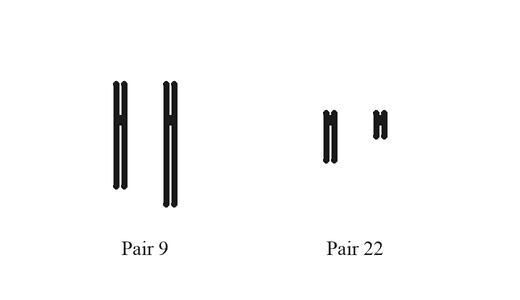
(a) Why would a count of the chromosomes alone have missed this change? (1 mark)
(b) Further study shows that the large piece missing from one chromosome 22 is now joined to one chromosome 9, and a small piece from the end of that chromosome 9 is now joined to the chromosome 22. How does staining the chromosomes with dyes that give bands help scientists to show this? (1 mark)
(c) The change began in a single bone-marrow cell. Explain why, years later, most of the patient's dividing marrow cells carry the same two changed chromosomes, and how this is linked to uncontrolled division. (2 marks)