
(Hypothetical data.) In a cell-culture laboratory in Pune, normal human skin cells and cells of a cancer cell line are grown side by side, and the total number of times each population has doubled is recorded.
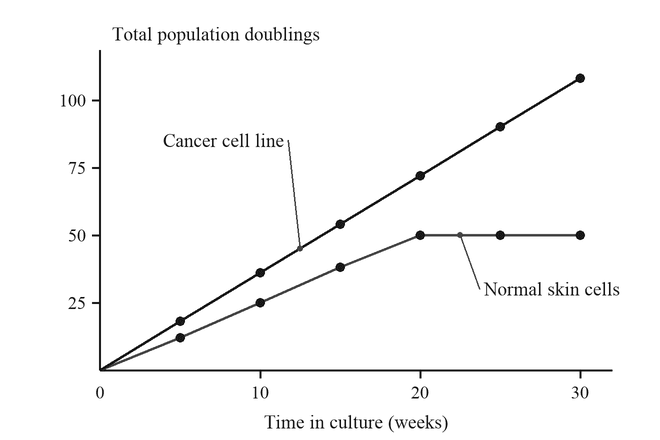
| Weeks in culture | 0 | 5 | 10 | 15 | 20 | 25 | 30 |
|---|---|---|---|---|---|---|---|
| Normal skin cells (total doublings) | 0 | 12 | 25 | 38 | 50 | 50 | 50 |
| Cancer cell line (total doublings) | 0 | 18 | 36 | 54 | 72 | 90 | 108 |
The workers also notice that the normal cells stop dividing when they come to touch one another, so they form a single flat layer on the dish, while the cancer cells keep on dividing and pile up into heaps.
(a) After how many weeks did the normal cells stop doubling, and how does the cancer cell line behave differently? (1 mark)
(b) A karyotype of the cancer cells shows 68 chromosomes in each cell. How many more is this than in a normal human body cell, and why can karyotyping detect such a change? (1 mark)
(c) Use both observations, the doubling data and the piling up, to explain how a single cancer cell in the body can give rise to a lump (tumour). (2 marks)