
Question 302 marksAsked 2025Medium
Figure 6 below shows an electric circuit.
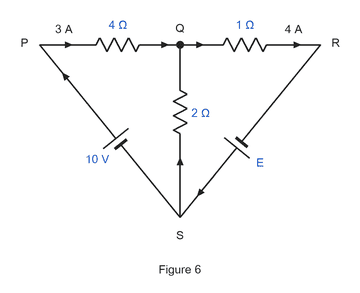
Apply Kirchhoff's laws to calculate:
(a) current '' flowing through the resistor.
(b) emf of the cell ''.
Confirming your payment
Sign up now and get 250 free tokens.
Previous Year Questions · Question 30 of 36
Figure 6 below shows an electric circuit.
Apply Kirchhoff's laws to calculate:
(a) current '' flowing through the resistor.
(b) emf of the cell ''.
Solution:
Key idea: Kirchhoff's junction law: the currents into a junction add up to the currents out of it. Kirchhoff's loop law: going round a closed loop, the sum of the potential rises (emfs, from − to +) equals the sum of the drops (in the direction of the current).
Step 1 — Apply the junction law at Q (part (a)).
At Q, arrives from P and the current arrives from S through the resistor (the arrow points up, towards Q). The current leaves towards R.
Step 2 — Check with loop PQSP.
We start at S and go up through the cell to P (from − to +, a rise of ), then through the resistor to Q (with the current, a drop of ), then down the resistor to S (against the current , a rise of ).
This agrees with Step 1.
Step 3 — Apply the loop law to loop QRSQ (part (b)).
From Q we go through the resistor to R (with , a drop of ). From R we go through the cell E to S; its long plate (+) faces S, so this is a rise of . From S we go up the resistor to Q (with the current , a drop of ).
Therefore, (a) the current through the resistor is (from S to Q), and (b) the emf of the cell E is .