Solution:
Key idea: Cells in series (aiding) add their emfs. Identical cells in parallel give the emf of one cell. With negligible internal resistance, the current through R is the emf of the combination divided by R.
Step 1 — Find the emf of each combination (part (a)).
In Figure 4 the two cells are in series, with the + plate of one joined to the − plate of the next, so
E4=E+E
E4=2E
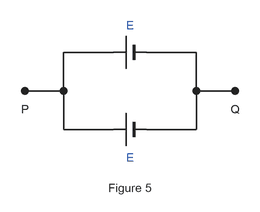
In Figure 5 the two identical cells are in parallel, so
E5=E
So the emf is greater in Figure 4.
Step 2 — Find the two currents (part (b)).
The internal resistance is negligible, so only R limits the current.
I1=R2E
I2=RE
Step 3 — Take the ratio.
Dividing the two currents cancels E and R.
I2I1=E/R2E/R
I2I1=2
Therefore, (a) the emf is greater for the series combination in Figure 4, and (b) I2I1=2.