Solution:
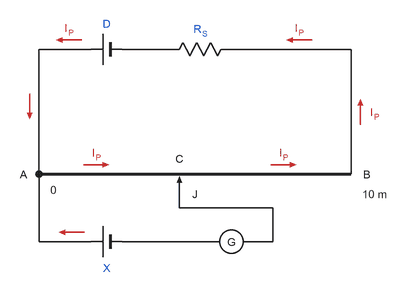
Key idea: With the jockey off the wire, the driver current is the emf divided by the total resistance of the driver circuit. The potential gradient k is the p.d. across the wire per metre. At balance, the emf of the cell X equals k times the balancing length.
Step 1 — Find the current in the wire (part a).
The driver circuit has the cell D (6 V, 2 Ω), RS=2 Ω and the wire (28 Ω) in series.
IP=2+2+286
IP=326
IP=0.1875 A
Step 2 — Find the potential gradient.
The p.d. across the 28 Ω wire is shared over its 10 m length.
VAB=0.1875×28
VAB=5.25 V
k=105.25
k=0.525 V m−1
Step 3 — Find the emf of X (part b).
At balance no current flows through X, so its emf equals the p.d. across AC (4.5 m).
EX=k×AC
EX=0.525×4.5
EX≈2.36 V
(More precisely 2.3625 V.)
Therefore, (a) IP≈0.19 A (exactly 0.1875 A) and (b) the emf of X is about 2.36 V.