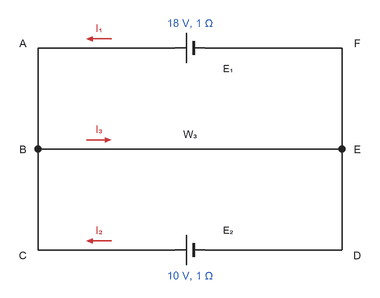
Solution:
Key idea: Kirchhoff's junction law: the currents into a junction equal the currents out. Kirchhoff's loop law: round a closed loop, the sum of the emfs equals the sum of the IR drops. The resistance of a uniform wire is shared equally between its two halves.
Step 1 — Find the resistance of each half wire.
B is the midpoint of W1 (8 Ω) and E the midpoint of W2 (6 Ω).
RAB=28 Ω
RAB=4 Ω
RFE=26 Ω
RFE=3 Ω
In the same way, RBC=4 Ω and RED=3 Ω.
Step 2 — Mark the currents.
The current I1 flows through E1 from F to A and down AB. I2 flows through E2 from D to C and up CB. By the junction law at B, the current in W3 from B to E is
I3=I1+I2
Step 3 — Apply the loop law to loop ABEFA.
The emf is 18 V. The current I1 passes the internal resistance 1 Ω, AB (4 Ω) and EF (3 Ω), and I1+I2 passes W3 (10 Ω).
18=(1+4+3)I1+10(I1+I2)
18I1+10I2=18...(1)
Step 4 — Apply the loop law to loop CBEDC.
The emf is 10 V. The current I2 passes the internal resistance 2 Ω, CB (4 Ω) and ED (3 Ω), and I1+I2 passes W3.
10=(2+4+3)I2+10(I1+I2)
10I1+19I2=10...(2)
Step 5 — Solve the two equations.
We multiply equation (1) by 19 and equation (2) by 10, so that the I2 terms match.
342I1+190I2=342...(3)
100I1+190I2=100...(4)
Subtracting equation (4) from equation (3) removes I2.
242I1=242
I1=1 A
Putting I1=1 into equation (2) gives I2.
10+19I2=10
I2=0
Step 6 — Find the current in W₃.
The current in W3 is the sum of the two currents.
I3=1+0
I3=1 A
Note: The figure labels E2 as "10 V, 1 Ω", while the text gives 2 Ω. We used the text value. With 1 Ω the equations still give I1=1 A and I2=0, so the answer is the same.
Therefore, the current in the wire W3 is 1 A, flowing from B to E.