
Question 22 marksAsked 2015Easy
(i) Explain the term hysteresis.
(ii) Name three elements of the earth's magnetic field which help in defining earth's magnetic field completely.
Confirming your payment
Sign up now and get 250 free tokens.
Previous Year Questions · Question 2 of 9
(i) Explain the term hysteresis.
(ii) Name three elements of the earth's magnetic field which help in defining earth's magnetic field completely.
Solution:
Key idea: (i) In a ferromagnetic material the magnetic field (or the magnetisation) depends not only on the present magnetising field but also on how the material was magnetised before. (ii) The earth's field at a place is a vector, so three independent quantities are needed to fix it.
Step 1 — Explain hysteresis (part i).
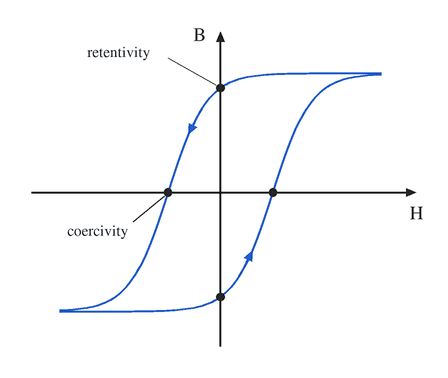
Hysteresis is the lagging of the magnetic induction (or the magnetisation ) behind the magnetising field when a ferromagnetic material is taken through a cycle of magnetisation. When is reduced to zero, does not become zero; the value left is the retentivity. A reverse field, called the coercivity, is needed to bring to zero. Plotting against for a complete cycle gives a closed curve called the hysteresis loop, and the area of the loop is the energy lost as heat per unit volume per cycle.
Step 2 — Name the three elements (part ii).
The three magnetic elements of the earth are the angle of declination (the angle between the magnetic meridian and the geographic meridian), the angle of dip or inclination (the angle the earth's field makes with the horizontal), and the horizontal component of the earth's field.
Therefore, (i) hysteresis is the lagging of behind in a ferromagnetic material taken through a magnetisation cycle, and (ii) the three elements are declination, dip (inclination) and the horizontal component of the earth's field.